Black Hole “ringing” could put Einstein’s theory to its toughest test
Fading tones from merged black holes could reveal their mass, spin and whether gravity behaves exactly as Einstein predicted.

 Edited By: Joseph Shavit

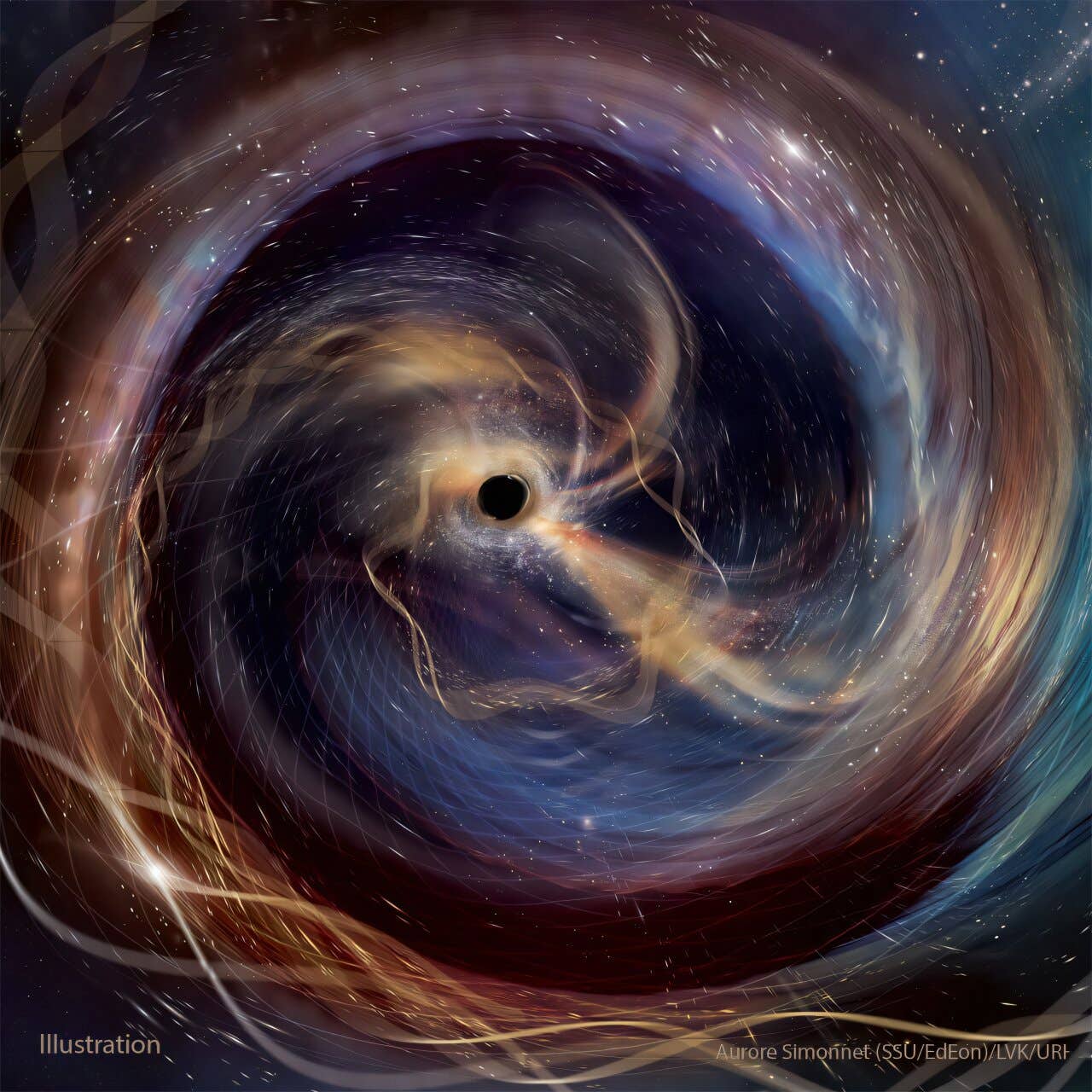
GW250114: Rotating Black Holes Collide. Black hole spectroscopy uses gravitational-wave ringing to test Einstein’s theory and search for new physics. (CREDIT: Aurore Simonnet (SSU/EdEon), LVK, URI; LIGO Collaboration)
A newly merged black hole does not become quiet at once. It vibrates, sheds energy through gravitational waves and produces a fading pattern of tones that scientists are learning to read with increasing precision.
Those tones could reveal whether Einstein’s theory of general relativity still holds under some of the most extreme conditions in the universe. They may also help researchers search for dark matter, unfamiliar particles and quantum effects near black hole horizons.
A major international review led by researchers at the University of Birmingham, Johns Hopkins University and Instituto Superior Técnico in Lisbon describes how black hole spectroscopy is moving from theory toward observational science. More than 70 experts contributed to the assessment, which was published with the Institute of Physics.
The field takes its name from ordinary spectroscopy, where scientists identify atoms by the frequencies of light they emit or absorb. Black hole researchers instead study gravitational-wave frequencies released after a collision.
“By listening to the ringing of newly formed black holes, we are turning gravitational waves into a tool for exploring some of the deepest questions in physics, from the nature of gravity itself to the possibility of discovering entirely new forms of matter and energy,” said review co-lead Dr. Gregorio Carullo of the University of Birmingham.
A cosmic bell settles into silence
When two black holes spiral together and merge, the collision violently distorts space-time. The new object then settles toward a stable state during a phase known as ringdown.
Its vibrations are called quasinormal modes. Each mode has a characteristic frequency and decay time, much like the tones and fading resonances of a struck bell.
The pattern depends mainly on the black hole’s mass and spin under general relativity. Measuring several modes gives scientists a way to check whether they all point to the same object.
Any consistent disagreement could signal that the standard description is incomplete. It might indicate an unexpected environment around the black hole, an unfamiliar compact object or physics beyond Einstein’s equations.
Black hole collisions offer conditions that cannot be reproduced on Earth. Their gravitational fields are both intense and rapidly changing, giving scientists an unusual opportunity to test gravity where its effects are strongest.
Since gravitational waves were first detected in 2015, the LIGO-Virgo-KAGRA collaboration has observed hundreds of black hole mergers. Researchers have also measured ringdown signals from tens of those events.
Every ringdown measured so far has agreed with general relativity. Current instruments, however, cannot usually resolve enough separate modes to carry out the most demanding tests.
More than one note may be present
The review describes several developments that have made the field more complex than the simplest ringing-bell picture.
Researchers have reported multiple overtones in gravitational-wave data. These are additional vibrations related to the dominant signal, similar to harmonics in musical instruments.
The analysis also covers interactions between modes, where one vibration influences another. Some modes may be excited dynamically as the newly formed black hole changes immediately after the merger.
Exceptional points create another possibility. At these points, two modes can approach, merge or exchange their behavior in unusual ways. Such effects are known in other physical systems but are now being studied in black hole spectra.
Scientists are also examining long-lasting “tails” that can follow the main ringdown. The surrounding environment may amplify these emissions, particularly when mergers occur in crowded regions containing matter or other compact objects.
These effects make the signals harder to interpret. They also carry information that a simpler model could miss.
The review brings together developments in black hole perturbation theory, numerical simulations and gravitational-wave data analysis. These areas must work together because observed signals depend on both the black hole’s natural modes and the details of the collision that excited them.
Testing what a black hole really is
General relativity predicts that an isolated rotating black hole can be described by only a small number of properties, especially mass and angular momentum.
That simplicity makes spectroscopy possible. If several measured frequencies match one mass and spin, they support the standard rotating black hole described by the Kerr solution.
If the tones cannot be reconciled, scientists would need to consider other explanations.
The review identifies several targets for these tests. One is modified gravity, a broad group of theories that depart from Einstein’s description under certain conditions.
Another is dark matter. New particles or fields surrounding a black hole could affect its vibration spectrum, although separating those effects from ordinary astrophysical matter would be difficult.
Researchers are also interested in quantum-scale changes near an event horizon. General relativity is a classical theory, while black holes raise unresolved questions about quantum mechanics, singularities and the loss of information.
Ringdown observations may not solve those problems directly. They could still place limits on proposed alternatives or reveal patterns that existing models do not predict.
The approach depends on measuring weak signals after the loudest part of a merger. That requires sensitive detectors, accurate waveform models and careful statistical analysis.
Future detectors could hear a richer spectrum
The next generation of gravitational-wave observatories is expected to increase the number and quality of ringdown measurements.
The European-led Einstein Telescope and the proposed Cosmic Explorer in the United States would operate on Earth with greater sensitivity than current facilities. The Laser Interferometer Space Antenna, or LISA, is designed to detect gravitational waves from space.
These observatories should detect more mergers across a wider range of black hole masses. They may also measure several modes from individual events instead of relying mainly on the strongest tone.
Routine multimode measurements would let astronomers compare mass and spin estimates within the same signal. They could also reveal how black holes formed and whether some mergers challenge existing formation models.
The 2024 “Ringdown Inside and Out” workshop in Copenhagen helped spur the review. The meeting brought together specialists from several continents as the subject expanded across theory, observation and instrumentation.
“As gravitational-wave detectors become more sensitive, black hole spectroscopy promises to transform black holes from mysterious objects into precision laboratories to study challenging astrophysical processes and uncover new fundamental physics phenomena,” Carullo said.
Practical implications of the research
Black hole spectroscopy gives scientists a direct way to test gravity without recreating extreme conditions in a laboratory.
Better ringdown measurements could improve estimates of black hole mass and spin, clarify how merged objects settle and reveal whether their vibrations match general relativity across multiple modes.
The work can also guide detector design and waveform modeling. Knowing which tones, overtones and interactions matter most will help researchers decide where greater sensitivity and better calculations are needed.
Most importantly, the method creates a clear experimental path for investigating ideas that have remained largely theoretical. Future detections may strengthen Einstein’s theory further, narrow the space available for competing models or expose a signal that current physics cannot explain.
Research findings are available online in the journal Classical and Quantum Gravity.
The original story "Black Hole “ringing” could put Einstein’s theory to its toughest test" is published in The Brighter Side of News.
Related Stories
- Strange gravitational waves may reveal dark matter near merging black holes
- Collapsing stars could form gravastars instead of black holes
- The Universe is creating black holes in many different ways
Like these kind of feel good stories? Get The Brighter Side of News' newsletter.
Joshua Shavit
Writer and Editor
Joshua Shavit is a NorCal-based science and technology writer with a passion for exploring the breakthroughs shaping the future. As a co-founder of The Brighter Side of News, he focuses on positive and transformative advancements in technology, physics, engineering, robotics, and astronomy. Having published articles on AOL.com, MSN, Yahoo News, and Ground News, Joshua's work highlights the innovators behind the ideas, bringing readers closer to the people driving progress.