Strange gravitational waves may reveal dark matter near merging black holes
A gravitational wave from 2019 may have passed through a dark matter cloud. Physicists built the tool to find out.

 Edited By: Joshua Shavit

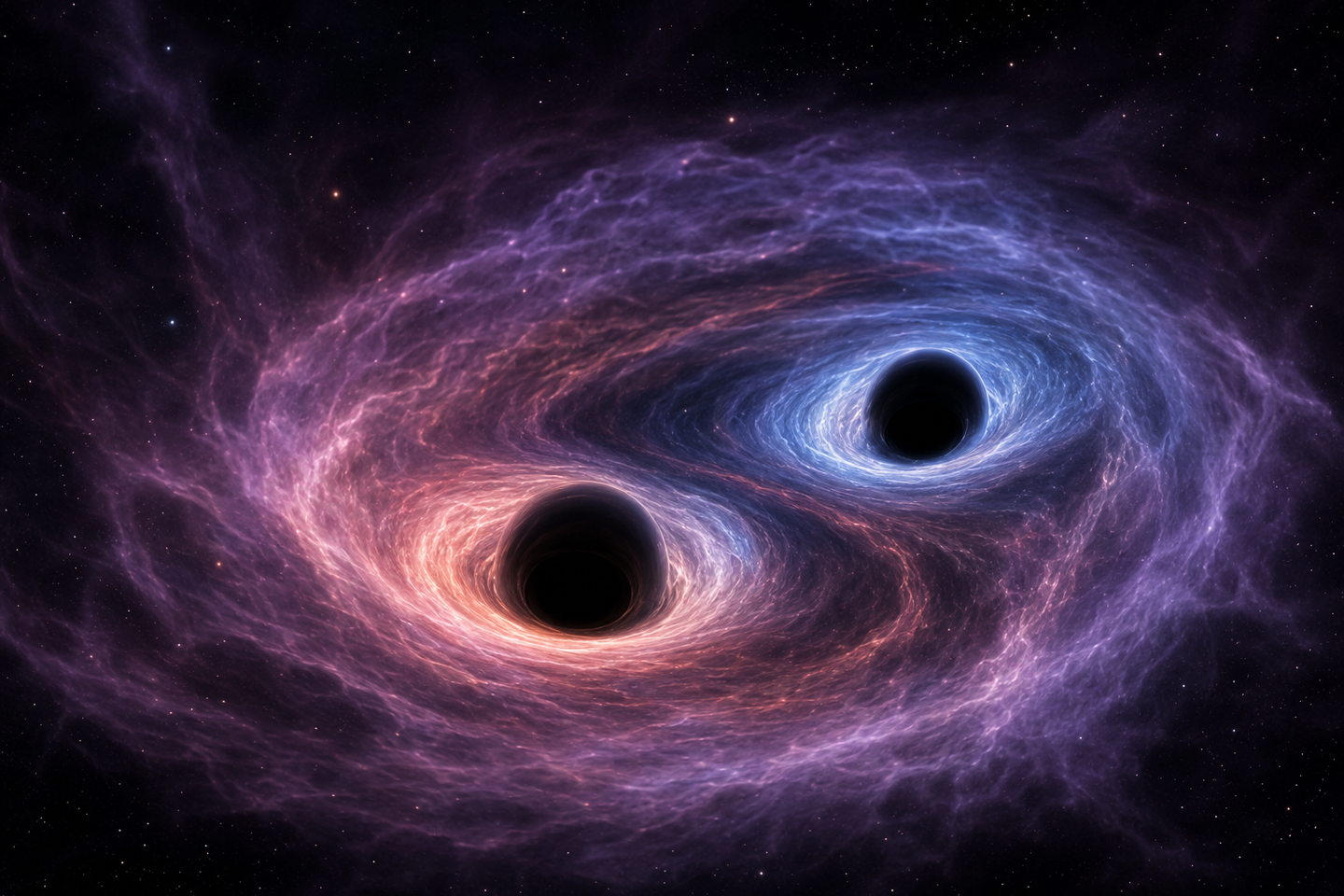
MIT-led physicists built a model to search for dark matter traces in gravitational waves. One black hole merger event, GW190728, fits the pattern of a collision inside a dense scalar cloud. (CREDIT: Wikimedia / AI-Generated / CC BY-SA 4.0)
The evidence for dark matter is everywhere and the evidence for dark matter is nothing. Galaxies rotate in ways that make no sense unless something invisible is adding mass. Light bends around galaxy clusters more sharply than visible matter alone could explain. Cosmological structure across the entire observable universe fits a pattern that requires most of its matter to be something that does not emit, absorb, or reflect light.
And yet, after decades of increasingly sensitive experiments, dark matter has never been directly detected. No particle, no signal and no fingerprint.
Now a team of physicists led by researchers at MIT and several European institutions has built a tool to look for it in an entirely unexpected place: the ripples in space-time produced when two black holes collide.
What a Merger Carries Through Space
When two black holes spiral together and merge, they release energy as gravitational waves, distortions in the fabric of space-time that travel outward at the speed of light. Detectors like LIGO, Virgo, and KAGRA are sensitive enough to register these distortions as they pass through Earth, measuring the characteristic chirp of frequency and amplitude that marks a collision billions of light-years away.
That signal carries information about the black holes themselves, their masses, their spins, how they moved. What it could also carry, the team now argues, is information about whatever those black holes were moving through when they merged.
The relevant physics involves a proposed class of dark matter candidates called extremely light scalar particles. Near spinning black holes, these particles can behave less like individual specks and more like coordinated waves. A process called superradiance, in which a fast-spinning black hole transfers rotational energy to surrounding particles, could amplify that material into an extraordinarily dense cloud. Densities in such a cloud could exceed a billion grams per cubic centimeter around stellar-mass black holes, more than thirty orders of magnitude above the diffuse dark matter background spread across a galaxy.
That kind of density is enough to change how a black hole binary behaves. As two black holes spiral together through a scalar cloud, they exchange angular momentum with the surrounding material. The timing and phase evolution of the gravitational wave they produce should drift slightly away from what would be expected in empty space. Not enough to look like something other than a black hole merger, but enough to leave a subtle distortion in the signal.
That distortion is what the researchers built a model to find.
Building the Tool
The team developed what they call a semianalytic waveform model, a set of equations that predict what a merger signal should look like if the black holes are moving through a scalar field environment rather than a vacuum. They then validated that model against numerical relativity simulations, computationally intensive calculations that solve the full equations of gravity and the scalar field directly.
Those simulations revealed something important about what happens when you use the wrong model. A standard vacuum analysis of a black hole merger that actually occurred inside a dark matter cloud will not simply fail to detect the cloud. It will misread the system. It will infer a slightly wrong chirp mass, because it is trying to explain an altered inspiral without accounting for the extra material. The standard tools produce a biased answer.
"Without waveform models like ours, we could be detecting black hole mergers in dark matter environments, but systematically classifying them as having occurred in vacuum," said Josu Aurrekoetxea, a postdoctoral researcher at MIT and one of the study's authors.
The new model corrected those biases in the simulations, recovering the injected parameters with better accuracy and matching the altered frequency evolution that the numerical calculations produced.
Twenty-Seven Events Said Nothing. One Did.
With the tool validated, the team searched 28 compact binary merger signals from the GWTC-3 catalog, the third gravitational-wave transient catalog compiled from LIGO, Virgo, and KAGRA data. For each event they compared two possibilities: the merger occurred in vacuum, or it occurred inside a scalar field environment.
Twenty-seven events were consistent with vacuum.
One was not.
The event designated GW190728, detected on July 28, 2019, showed a statistical preference for the scalar-environment model. When the researchers applied physically motivated constraints based on how superradiance actually works, restricting the allowed particle mass and cloud properties to plausible values, the result still leaned toward the dark matter scenario. The preferred particle mass in that analysis landed around 10 to the negative 12 electron volts, an extraordinarily light particle, far lighter than anything in the standard model of particle physics.
The statistical evidence is real but modest. The reported Bayes factor, a measure of how much the data favor one model over another, is about 3.5 in natural log units. That is interesting. It is not a discovery.
"The statistical significance of this is not high enough to claim a detection of dark matter, and further checks should be performed by independent groups," Aurrekoetxea said.
The team also checked whether the signal could be explained by other effects: eccentricity in the orbit, acceleration along the line of sight, or deviations from general relativity in the inspiral. None of those alternative explanations found support in GW190728. The signal remained consistent with vacuum when those tests were applied, but the scalar environment model fit the inspiral evolution better than the vacuum model did.
A Tool That Could Matter More Than the Result
The significance of the paper may rest less on GW190728 itself than on what the method makes possible going forward.
Gravitational-wave detectors are improving. The catalog of events is growing. Future observing runs with LIGO, Virgo, and KAGRA will produce louder signals with higher signal-to-noise ratios. Next-generation detectors currently in development, the Einstein Telescope in Europe and Cosmic Explorer in the United States, will be sensitive enough to detect mergers at far greater distances and resolve waveform features in much finer detail.
With a tool that can identify the signature of scalar clouds in merger signals, those future detectors become dark matter experiments as well as black hole detectors.
Soumen Roy, who led the data analysis, put it plainly: "We now have the potential to discover dark matter around black holes as the LVK detectors keep collecting data in the coming years."
Rodrigo Vicente, who developed the analytical signal model, added a longer view: "Using black holes to look for dark matter would be fantastic. We would be able to probe dark matter at scales much smaller than ever before."
Practical Implications of the Research
If the method holds up under independent scrutiny and future testing, it broadens the function of gravitational-wave astronomy in a fundamental way. Instead of only characterizing the objects involved in a collision, signals from merging black holes could reveal what those objects were moving through on their way to impact.
That would give physicists access to dark matter density on spatial scales, around individual black holes, that no other observational technique can reach. Current constraints on ultralight dark matter candidates come from observations of black hole spins and from searches for continuous, nearly monochromatic gravitational waves emitted by superradiant clouds. The new approach, probing the phasing of merger signals, is complementary to both and sensitive to different parts of the relevant parameter space.
Even if GW190728 eventually turns out to be a statistical fluctuation or the result of some astrophysical effect that mimics the dark matter signature, the framework itself provides a systematic way to search every future merger event for the same kind of imprint. That is a change in how the field works, not just an addition to it.
Research findings are available online in the journal Physical Review Letters.
The original story "Strange gravitational waves may reveal dark matter near merging black holes" is published in The Brighter Side of News.
Related Stories
- Gravitational waves may be responsible for dark matter in the universe
- Gravitational waves finally reveal what's inside neutron stars
- New prototype quantum sensor expedites search for dark matter and gravitational waves
Like these kind of feel good stories? Get The Brighter Side of News' newsletter.
Joseph Shavit
Writer, Editor-At-Large and Publisher
Joseph Shavit, based in Los Angeles, is a seasoned science journalist, editor and co-founder of The Brighter Side of News, where he transforms complex discoveries into clear, engaging stories for general readers. With vast experience at major media companies like The Los Angeles Times, Times Mirror and Tribune Publishing, he writes with both authority and curiosity. His writing focuses on space science, planetary science, quantum mechanics, geology. Known for linking breakthroughs to real-world markets, he highlights how research transitions into products and industries that shape daily life.