The asteroid that killed the dinosaurs was more odd than expected
The asteroid that ended the dinosaurs may have carried far less sulfur than scientists once assumed.

 Edited By: Joseph Shavit

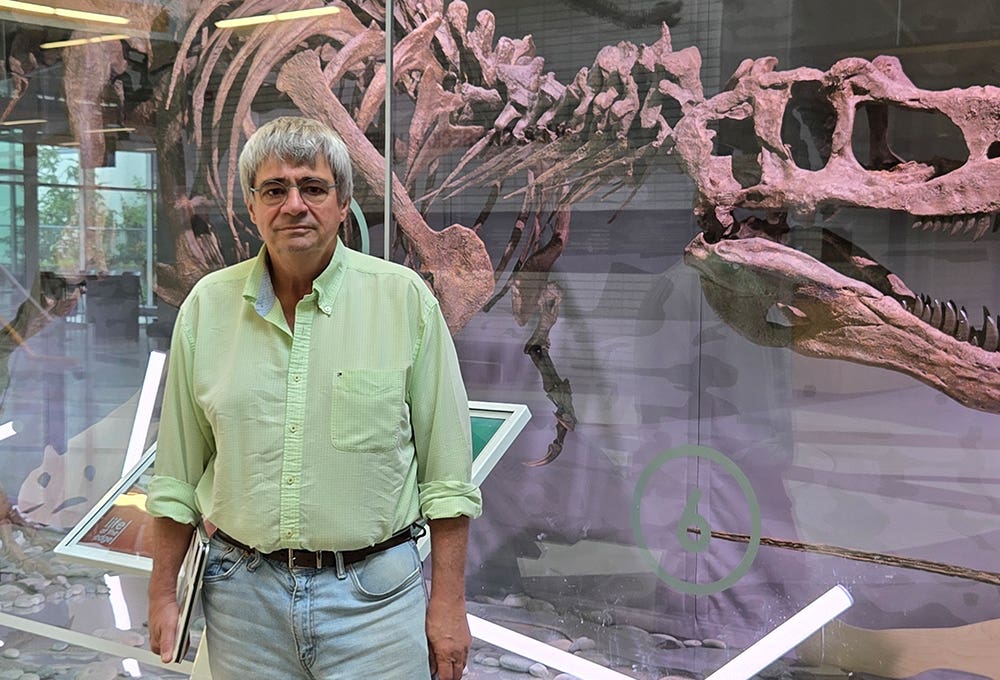
Dr. Philippe Claeys, a visiting professor at the University of British Columbia, in front of an exhibit at the Pacific Museum of Earth. (CREDIT: University of British Columbia)
The asteroid that ended the age of dinosaurs may have been far rarer, drier and less sulfur-rich than scientists once thought. Traces buried in clay now point toward an unusual meteorite with roots in a distant part of the solar system.
Nickel isotopes preserved at the boundary between the Cretaceous and Paleogene periods indicate that the Chicxulub impactor probably resembled a carbonaceous chondrite of the Ornans class, known as a CO chondrite.
The findings came from researchers working in Paris, Brussels, Vienna and at the University of British Columbia. The team analyzed samples collected from impact clay layers in Denmark, Spain and Italy.
CO chondrites represent a tiny fraction of meteorites recovered on Earth. They also contain fewer volatile substances, including carbon, zinc, water and sulfur, than several meteorite groups previously proposed as the Chicxulub projectile.
“Carbonaceous chondrites of the Ornans class are definitely not like the typical meteors you find in museum collections,” said Dr. Philippe Claeys, who worked on the research while visiting UBC.
A chemical fingerprint survived the collision
The impactor struck about 66 million years ago near what is now Mexico’s Yucatán Peninsula. Estimates place its diameter between 10 and 15 kilometers, or roughly six miles at the lower end of that range.
It hit Earth at an estimated 64,000 kilometers per hour and formed the Chicxulub crater. The collision coincided with one of the planet’s five major mass extinctions.
Non-avian dinosaurs disappeared, along with pterosaurs and ammonites. Estimates cited in the research suggest that 17 percent of biological families, 50 percent of genera and 85 percent of species vanished.
Scientists broadly agree that the impact played a major role. Dust, soot and vaporized material spread through the atmosphere, blocking sunlight and contributing to an “impact winter.” Changes in atmospheric and ocean chemistry added further stress.
The projectile itself did not survive intact. It vaporized during the collision, leaving only minute chemical traces in a thin global layer of clay.
“This is challenging work,” Claeys said. “Only a minute fraction of the projectile is preserved in the planet’s KT clay layer because the entire meteorite vaporized upon impact.”
Those traces nevertheless contain isotopic fingerprints. Isotopes are versions of an element that contain different numbers of neutrons. Their proportions can reveal where extraterrestrial material formed and distinguish it from terrestrial rock.
Nickel narrowed the list of suspects
Earlier chromium, ruthenium and platinum-group element studies had already identified the impactor as a carbonaceous chondrite. Those primitive meteorites formed early in solar system history and have undergone relatively little change.
But carbonaceous chondrites include several chemically distinct groups. Previous evidence often favored CM or CR chondrites, while allowing other possibilities.
The new analysis used nickel because it is abundant in primitive meteorites but less concentrated in Earth’s crust. Nickel also has five stable isotopes, giving researchers several related signatures to compare.
The team studied clay from Stevns Klint in Denmark, Caravaca in Spain, and Furlo, Frontale and Fornaci in Italy. Some layers contained more impact debris than others, allowing the scientists to follow a mixing trend between terrestrial material and the projectile.
Samples from Stevns Klint and Caravaca held the strongest extraterrestrial signal. Earlier estimates suggested that impact debris made up about 5 percent of those clays by mass.
Their nickel compositions closely matched ordinary carbonaceous chondrites but excluded CI chondrites and a proposed group called CY. A second comparison, combining nickel concentrations with isotope measurements, pointed most strongly toward CO chondrites or a proposed class called CT.
CT meteorites remain poorly characterized and extremely rare. Because CO chondrites fit the evidence and occur more often, the researchers concluded that a CO-like body remains the more probable explanation.
Earlier clues fall into place
Some previous findings appeared to conflict with a CO origin. Chromium measurements had been interpreted as favoring CM meteorites, while amino acids in boundary clay seemed more consistent with CM or CR material.
A broader chromium dataset changed that picture. CO meteorites showed isotope values that agreed with the nickel evidence when researchers included more samples.
The amino acid argument also weakened under closer examination. Carbon and nitrogen isotopes indicated that those molecules probably came from terrestrial biological material, possibly coal altered by the impact’s heat, rather than from the meteorite.
Other possible projectiles appear unlikely. Achondrites and iron meteorites do not match the chromium and platinum-group element record. An intact, differentiated body with a metallic core also seems improbable.
At 10 to 15 kilometers wide, the impactor was likely too small to retain enough heat to separate into a core and mantle. It may instead have been a primitive fragment created when a larger asteroid broke apart.
Its exact birthplace remains uncertain. Possible sources include debris-rich regions of the outer solar system or the outer asteroid belt near Jupiter.
“Being impacted by such a rare, distant projectile really underscores how unlucky the dinosaurs were,” Claeys said.
Less sulfur shifts the extinction debate
Identifying the meteorite class changes estimates of what the projectile delivered into Earth’s atmosphere.
Models based on a CM-like impactor suggested that the asteroid supplied about 40 percent of the sulfur released during the collision. That sulfur, emitted as sulfur dioxide and sulfur trioxide, could have helped cool the planet and damage ecosystems.
A CO chondrite would have carried roughly half as much sulfur.
“A CO contains much less volatile elements—like carbon, zinc, water and particularly sulphur—than other classes of meteorites we’ve discovered so far on Earth,” Claeys said. “It doesn’t alter our theory of what caused the extinction event—but it makes it less likely that sulphur contained in the impactor was the smoking gun. The fine debris thrown into the atmosphere would have the primary factor.”
The finding does not remove sulfur from the extinction scenario. The rocks struck at Chicxulub also released volatile compounds. It does, however, reduce the likely contribution from the projectile itself and places greater emphasis on dust and material blasted from the impact site.
Practical implications of the research
A clearer chemical identity for the Chicxulub impactor can improve models of the atmosphere after the collision. Researchers can now test extinction scenarios using volatile levels that better reflect a CO chondrite rather than a wetter, more sulfur-rich meteorite.
The nickel technique may also help identify extraterrestrial material in other impact layers where little of the original object remains. Combining nickel with chromium and ruthenium could narrow the origin of ancient projectiles more reliably.
Further measurements of proposed CT meteorites will be needed to separate them from CO chondrites with confidence. Their chromium signatures may provide the strongest next test.
Understanding the makeup and origins of large impactors also carries implications beyond the dinosaur extinction. Different asteroid compositions can produce different amounts of dust, gas and atmospheric disruption, making composition an important part of assessing the consequences of future impacts.
Research findings are available online in the journal Science Advances.
The original story "The asteroid that killed the dinosaurs was more odd than expected" is published in The Brighter Side of News.
Related Stories
- Marine life evolved rapidly after the dinosaur killing asteroid impact 66 million years ago
- Dinosaurs thrived until the end: New Mexico fossils rewrite extinction story
- Triassic fossil reveals a beaked, bipedal reptile that looked like an ostrich dinosaur
Like these kind of feel good stories? Get The Brighter Side of News' newsletter.
Rebecca Shavit
Writer
Based in Los Angeles, Rebecca Shavit is a dedicated science and technology journalist who writes for The Brighter Side of News, an online publication committed to highlighting positive and transformative stories from around the world. Having published articles on MSN, AOL News, and Yahoo News, Rebecca's reporting spans a wide range of topics, from cutting-edge medical breakthroughs to historical discoveries and innovations. With a keen ability to translate complex concepts into engaging and accessible stories, she makes science and innovation relatable to a broad audience.