Canada’s Barnes Ice Cap reveals that human-caused climate change stopped the next ice age
Ancient plants beneath Canada’s Barnes Ice Cap reveal renewed ice growth, which researchers interpret as a glaciation that human-caused warming interrupted.
 Columbia Writer: Adrienne Day

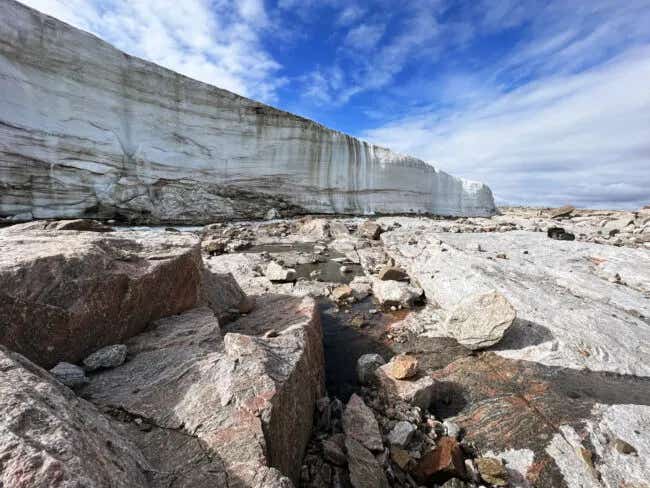
Margin of the Barnes Ice Cap. Bedrock has only become exposed sometime over the last decade. (CREDIT: Nicolás Young)
- Plants exposed by the retreating Barnes Ice Cap reveal renewed growth of the Laurentide Ice Sheet's last remnant before modern warming reversed it.
- Rock dating, buried vegetation and nearby ice-cap records suggest regrowth began roughly 2,000 years ago, with widespread retreat starting around 1960.
- The authors interpret that expansion as the next glaciation's beginning, challenging definitions that require much larger ice sheets before declaring its onset.
Dead moss emerging from an Arctic ice cap records a reversal in the history of North American ice. The plants grew on ground that was later buried as ice advanced, then reappeared as warmer summers drove retreat. Their ages help reconstruct an expansion that modern warming brought to an end.
The study, published in Science, focuses on the Barnes Ice Cap on Canada's Baffin Island. Nicolás Young and Joerg Schaefer of Columbia University's Lamont-Doherty Earth Observatory worked with colleagues including Gifford Miller at the University of Colorado Boulder. They investigated the surviving remnant of the Laurentide Ice Sheet, which once covered much of northern North America.
Their interpretation reaches beyond one shrinking ice cap. The researchers argue that renewed growth roughly 2,000 years ago marked the earliest stage of the next glacial period. That claim depends partly on how glacial onset is defined, rather than demonstrating that continent-wide ice cover had already returned.
A surviving piece of a vanished landscape
At its greatest extent, the Laurentide Ice Sheet stretched across Canada and into what is now the northern United States. Its retreat transformed the continent, but the ice did not disappear completely. The Barnes Ice Cap preserves a remnant on central Baffin Island in Nunavut.
That survival makes the site unusually valuable for studying how glaciation begins. Growing glaciers commonly remove or bury evidence of their earliest expansion. Researchers trying to identify the starting point can therefore find themselves searching for a record that subsequent ice movement has destroyed.
Conditions along the study margin helped preserve that record. There, the ice is frozen to its bed, greatly limiting sliding across the ground. Instead of scraping away every trace of vegetation, advancing ice covered moss and woody plants where they grew.
Retreat has exposed those remains again, giving scientists access to an otherwise hidden landscape. Sampling plants at different locations allows their burial ages to be compared with changes in the ice margin. Rock surfaces provide a complementary record of when earlier retreat exposed the ground.
Reading the dates in plants and rock
Radiocarbon dating measures the decay of carbon-14 in once-living material. After a plant dies, its radioactive carbon declines at a predictable rate. For vegetation buried in place beneath advancing ice, the estimated death date helps identify when the ice reached that location.
The team obtained 88 new radiocarbon ages from previously buried vegetation near the Barnes margin. A separate series of samples stretched along an approximately 800-meter transect. Comparing dates with their positions helped reconstruct the direction and timing of expansion.
Plants nearest the retreating ice could record earlier burial than plants farther toward its historical outer boundary. That pattern is consistent with an ice front advancing across vegetated ground. The dates also suggest smaller retreats and renewed advances within a longer period of net growth.
The researchers additionally measured beryllium-10 in bedrock and boulders. This isotope forms when cosmic rays strike exposed rock, helping scientists estimate how long a surface has been uncovered. Those measurements indicate that the retreating Laurentide margin had moved inside the ice cap's 2022 boundary about 3,600 years ago.
How the team reconstructed renewed growth
The ice did not immediately reverse course at that point. The combined evidence suggests it reached its smallest configuration between about 3,000 and 2,000 years ago. Its minimum extent was smaller than the ice cap's present dimensions, showing that today's retreat is uncovering ground exposed during an earlier warm interval.
At Barnes itself, the oldest plants exposed along the sampled transect document advance by around 1000 CE. Earlier stages remain difficult to observe because the relevant plants are still beneath the ice. The roughly 2,000-year estimate therefore draws on additional regional evidence rather than those plant dates alone.
That evidence includes 186 radiocarbon dates from vegetation uncovered beside nearby plateau ice caps and glaciers. None predates the Common Era. The researchers interpret the pattern as indicating that the regional snowline descended onto the plateau around that time, allowing ice to accumulate and expand.
Summer conditions are crucial to that process. When enough snow survives the melting season, an ice cap can retain more material than it loses. The reconstruction links regional cooling and a lower snowline with renewed growth of the Laurentide remnant.
The team connects that cooling to declining summer sunlight at high northern latitudes as Earth's orbital configuration changed. Expanding snow and ice could then reinforce cooling by reflecting more sunlight. These processes provide a physical explanation for the reconstructed expansion, alongside the geological chronology.
What counts as the next glaciation?
The phrase “next ice age” can obscure an important distinction. Earth already has permanent ice sheets and remains within a broader ice age. Within that long interval, colder glacial periods alternate with warmer interglacial periods, including the present Holocene.
Young and his colleagues argue that the first renewed expansion of an ice-sheet remnant should count as glacial inception. Earlier modeling studies have often used thresholds requiring substantial Northern Hemisphere ice growth. Under those definitions, onset may lie thousands or tens of thousands of years in the future.
The disagreement therefore involves the milestone being identified as well as the evidence used to locate it. A small Arctic ice cap beginning to regrow is different from ice sheets spreading across a continent. Recognizing that early growth does not establish that continental-scale glaciation was imminent on human timescales.
The study offers geological evidence of the former and interprets it as the opening stage of the latter. It does not provide an observed record of the continent-wide expansion that would have followed without modern warming. That distinction keeps the striking claim tied to what the landscape actually preserves.
Warming reversed the direction of change
Historical photographs help anchor the recent end of the chronology. Although retreat began earlier at one lake-influenced location, the researchers identify around 1960 as the onset of widespread Barnes retreat. Warmer summers had shifted the balance toward losing more ice than accumulated.
The authors attribute that reversal to human-caused warming, which overwhelmed the earlier regional cooling trend. “It’s a very powerful example of how we have jolted the system,” Young said. The result links the newly exposed plants with a modern interruption of long-term ice growth.
Previous modeling projects that Barnes could disappear within the coming centuries, with timing dependent on the scenarios examined. Losing it would also remove a surviving ice mass that could help future glaciation develop. The new study does not establish when another continental ice sheet might form under elevated greenhouse gas concentrations.
Continued retreat may expose older plants that clarify the earliest stages of regrowth. Those samples could sharpen the distinction between directly dated advances and the broader regional reconstruction. For now, the record shows an Arctic ice remnant reversing its long expansion while also revealing the evidence of that expansion beneath it.
Dig deeper into ice growth and glacial cycles
These resources explain the changing Barnes Ice Cap and the physical conditions that govern glacial onset.
Climate Change Stopped the Next Ice Age
Columbia's account explains the researchers' interpretation and why definitions of glacial onset matter to the findings. (Columbia Climate School, October 2026)
Early Snow Melt on Barnes Ice Cap
NASA's satellite imagery illustrates snow loss at Barnes and explains how darker exposed surfaces absorb more sunlight. (NASA Earthdata, August 2026)
New estimation of critical insolation–CO2 relationship for triggering glacial inception
This modeling study investigates how summer sunlight and atmospheric carbon dioxide combine to influence glacial inception. (Climate of the Past, June 2024)
The projected demise of Barnes Ice Cap: Evidence of an unusually warm 21st century Arctic
This earlier study models the ice cap's future under different climate scenarios and examines evidence of its long survival. (Geophysical Research Letters, March 2017)
Critical insolation–CO2 relation for diagnosing past and future glacial inception
This research links sunlight and carbon dioxide to large-scale ice-sheet growth, providing context for alternative estimates of glacial onset. (Nature, January 2016)
Research findings are available online in the journal Science.
The original story "Canada's Barnes Ice Cap reveals that human-caused climate change stopped the next ice age" is published in The Brighter Side of News.
Related Stories
- 'Snowball Earth' repeatedly thawed during a 56-million-year ice age
- Evidence of an Ice Age forest emerges from the North Sea floor
- Ancient land bridge discovery: How humans migrated to Europe during the last Ice Age
Like these kind of feel good stories? Get The Brighter Side of News' newsletter.
Joseph Shavit
Writer, Editor-At-Large and Publisher
Joseph Shavit, based in Los Angeles, is a seasoned science journalist, editor and co-founder of The Brighter Side of News, where he transforms complex discoveries into clear, engaging stories for general readers. With vast experience at major media companies like The Los Angeles Times, Times Mirror and Tribune Publishing, he writes with both authority and curiosity. His writing focuses on space science, planetary science, quantum mechanics, geology. Known for linking breakthroughs to real-world markets, he highlights how research transitions into products and industries that shape daily life.