‘Snowball Earth’ repeatedly thawed during a 56-million-year ice age
Ancient Earth may have flipped between global ice and hothouse warmth, solving a long-running puzzle about the Sturtian glaciation.

 Edited By: Joseph Shavit

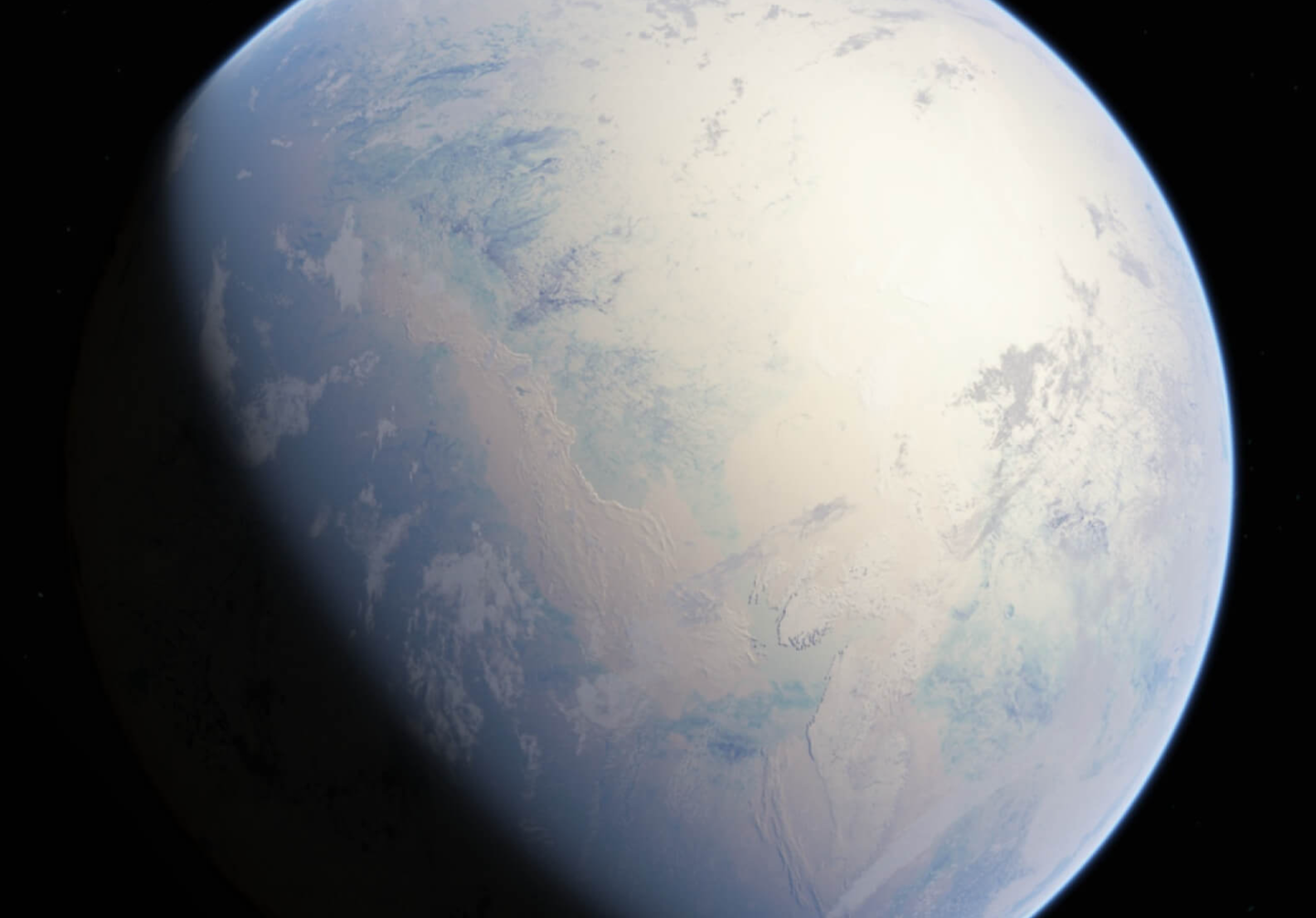
Artist’s rendition of a fully-frozen snowball Earth. (CREDIT: Wikimedia / CC BY-SA 4.0)
For 56 million years, Earth appears to have lurched between two extremes that are hard to picture together: a planet sealed in global ice, then a world hot enough to strip carbon dioxide from the sky and set the stage for the next freeze.
That is the case put forward by Earth scientists at Harvard’s John A. Paulson School of Engineering and Applied Sciences, who argue that the Sturtian glaciation was not one endless deep freeze. Instead, they say, the planet likely flipped back and forth between full Snowball Earth conditions and warm, ice-free intervals during the Cryogenian period, roughly 717 million to 660 million years ago.
The idea offers a way through one of ancient climate science’s most stubborn problems. Standard physical models have long struggled to explain how the Sturtian glaciation could have lasted about 56 million years when a fully frozen Earth should, in theory, thaw much sooner as volcanic carbon dioxide builds up in the atmosphere.
Graduate student Charlotte Minsky led the research with Robin Wordsworth, David T. Johnston and Andrew H. Knoll. Their analysis, published in Proceedings of the National Academy of Sciences, uses a coupled model of ancient climate and the global carbon cycle to test a different possibility: maybe the Sturtian was long not because one frozen state endured, but because freezing kept happening again.
A freeze that would not stay solved
In the classic Snowball Earth picture, ice shuts down silicate weathering, which normally removes carbon dioxide from the atmosphere. Volcanoes keep releasing carbon dioxide, so over time the gas accumulates, warms the planet and eventually melts the ice. That logic works reasonably well for the Marinoan glaciation, a later Cryogenian event that lasted about 4 million years.
The Sturtian is another matter. Geochronology places it at more than ten times longer, from about 717 million to 661 million years ago. In a hard Snowball scenario, the Harvard team notes, deglaciation should happen after roughly 3.8 million years. Slushier versions of the event, with open water or patchy ice near the equator, are even less stable over such long spans because they require less carbon dioxide to thaw.
The oxygen problem is just as serious.
If Earth stayed frozen for the full Sturtian interval, the researchers write, oxygen in the atmosphere and ocean should have been exhausted within a few million years as reduced volcanic gases kept reacting away the remaining supply and marine productivity collapsed. Yet the geologic record does not fit a world plunged into more than 50 million years of near-total anoxia. Some isotopic evidence points to oxygen availability after the Sturtian, and many microbial metabolisms and obligately aerobic eukaryotic groups made it through the interval.
That mismatch pushed the team toward a different framework, one in which short Snowball phases and short warm intervals alternate in a repeating rhythm.
Basalt, carbon dioxide and a repeating planetary loop
At the center of that rhythm is the Franklin Large Igneous Province, a huge volcanic region in what is now northern Canada. It erupted at about 717 million years ago, essentially right as the Sturtian began.
The team argues that weathering of basalt from that province could have drawn down atmospheric carbon dioxide strongly enough to trigger global glaciation. Once the planet froze, continental weathering would have slowed or stopped, allowing volcanic outgassing to rebuild carbon dioxide until deglaciation began.
Then the system would have turned on itself again.
As ice retreated, fresh basalt would have been exposed to the atmosphere. That renewed weathering would have pulled carbon dioxide back down, driving the planet into another Snowball phase. The process could repeat as long as the volcanic province still had enough weatherable rock left to keep upsetting the carbon cycle.
In the model, this produces a “limit cycle” climate regime, with self-terminating Snowball episodes alternating with hot interglacials. One example configuration highlighted by the researchers uses an initially 4.5 million square kilometer large igneous province drawing down carbon dioxide at a rate similar to modern volcanic fields such as Réunion. In that setup, a Sturtian-length interval of about 56 million years requires an 18 million year decay timescale for the weathering perturbation, which corresponds to an initial basalt thickness of about 2 kilometers, consistent with Neoproterozoic estimates of 1 to 4 kilometers.
The authors found that much of the plausible parameter space for the Franklin province could support this cycling. They also estimate that, under Neoproterozoic background conditions, as little as 0.4 teramoles of extra carbon weathering per year could sustain a limit cycle, while weathering of the Franklin basalt would exceed that threshold.
A different kind of survival story
This version of the Sturtian changes the biological picture too.
In a single unbroken Snowball, life would have had to endure extreme cold, little light in the surface ocean, weak nutrient supply and a steadily collapsing oxygen reservoir for tens of millions of years. In the Harvard scenario, those frozen intervals still last millions of years, but not long enough to fully drain atmospheric oxygen each time.
Warm intervals matter here for another reason. Weathering of the Franklin basalt would not only remove carbon dioxide, it would also release phosphate to the surface environment. That nutrient supply could boost marine productivity during interglacial periods, helping replenish oxygen in the atmosphere and ocean before the next freeze arrived.
“This could help explain how aerobic life persisted through such an extreme interval,” Minsky said.
The argument also lines up with some puzzling features of the sedimentary record. Intermittent ice-rafted debris and non-glacial deposits, including mudstone, sandstone and occasional carbonates, have been interpreted by some researchers as hints of cyclical ice retreat or periods of open water during the Sturtian. The new framework gives those observations a broader climate mechanism.
It may also help explain why atmospheric oxygen did not collapse in a way that would leave sulfur mass-independent fractionation in immediately post-glacial sediments.
What geologists would need to find next
The clearest test, the team writes, would be evidence that discrete glacial and interglacial cycles occurred globally and synchronously throughout the Sturtian’s 56 million years. That would require targeted sequence stratigraphic work, along with high-precision geochronology where rocks are well enough preserved.
Records from higher paleolatitudes would be especially useful. Open water at low latitudes might fit so-called Waterbelt scenarios, but ice-free conditions far from the equator would point to true global deglaciation between Snowball phases.
The study leaves open another big question: whether the younger Marinoan glaciation could somehow belong to the tail end of the same limit cycle regime, with the 22 million year gap between the two events representing one last interglacial. In the team’s current parameterization, that would require the silicate weathering feedback to be effectively shut off, a possibility they say is not yet well constrained.
Earth’s major ice ages: A long history of frozen worlds
The Sturtian glaciation described above was not Earth’s only deep freeze. Geologists have identified several major ice ages across the planet’s 4.5-billion-year history. An “ice age” does not always mean the whole planet was locked in ice the entire time. It usually means Earth spent a long interval in an icehouse climate, with large ice sheets growing, shrinking, or cycling across parts of the planet.
Huronian Ice Age
When it happened: About 2.4 billion to 2.1 billion years ago.
Human status: Humans did not exist. There were no animals, plants, or complex life forms. Life was microbial.
What happened and why it mattered: The Huronian is often described as one of Earth’s earliest great ice ages. It unfolded around the time oxygen began building up in the atmosphere during the Great Oxidation Event. Oxygen-producing microbes transformed the planet’s chemistry, likely reducing methane, a powerful greenhouse gas, and helping cool the world. This was a crisis for many anaerobic microbes, but it also helped set the stage for later oxygen-using life.
Cryogenian Ice Age
When it happened: About 720 million to 635 million years ago.
Human status: Humans did not exist. Dinosaurs, mammals, land plants, and animals as we know them had not yet evolved. Life was still mostly microbial, though more complex cells and early multicellular life were emerging.
What happened and why it mattered: This was the great “Snowball Earth” chapter. The Cryogenian included two extreme glaciations: the Sturtian glaciation, about 717 million to 660 million years ago, which is the ice age featured in this story, and the Marinoan glaciation, roughly 650 million to 635 million years ago. The Sturtian lasted about 56 million years, and the Harvard research above suggests Earth may have repeatedly flipped between frozen and warmer states during that time. After the Cryogenian, larger and more complex life forms began appearing in the fossil record, making this icy interval one of the key turning points before the rise of animals.
Andean-Saharan Ice Age
When it happened: Roughly 460 million to 430 million years ago, during the Late Ordovician and Silurian periods.
Human status: Humans did not exist. Vertebrates were still mostly aquatic, and life on land was in its earliest stages.
What happened and why it mattered: Ice sheets grew over parts of the ancient supercontinent Gondwana, especially regions that are now in Africa and South America. This ice age is closely tied to the Ordovician-Silurian mass extinction, one of the largest extinction events in Earth’s history. Falling sea levels during glaciation reduced shallow marine habitats, and later warming disrupted ecosystems again. Britannica estimates that the extinction eliminated about 85% of Ordovician species.
Late Paleozoic, or Karoo, Ice Age
When it happened: About 360 million to 260 million years ago, spanning parts of the Carboniferous and Permian periods.
Human status: Humans did not exist. Amphibians, early reptiles, giant insects, and vast coal-forming forests were present during parts of this interval.
What happened and why it mattered: This was one of the longest ice ages of the Phanerozoic Eon, the span of time that includes abundant animal life. Large ice sheets covered parts of Gondwana as land plants spread and vast forests pulled carbon dioxide from the atmosphere. The burial of plant material helped form many of the coal deposits later used by humans. Over time, the decline of this icehouse climate helped shift Earth toward the warmer, drier conditions of the Permian, reshaping ecosystems before the age of dinosaurs.
Quaternary Ice Age
When it happened: About 2.58 million years ago to the present.
Human status: Early members of the human genus appeared near the beginning of this ice age. Homo sapiens evolved much later, about 300,000 years ago, during a time of dramatic climate change. Modern humans eventually spread across much of the world, and agriculture began only after the most recent glacial period ended.
What happened and why it mattered: This is the ice age Earth is still technically in, because large ice sheets remain in Greenland and Antarctica. However, the planet is currently in a warmer interglacial interval called the Holocene. During the Quaternary, ice sheets repeatedly advanced and retreated across North America, Europe, and Asia. These cycles shaped landscapes, carved lakes and valleys, changed sea levels, influenced human migration, and contributed to the extinction of many large mammals and birds.
Research findings are available online in the journal PNAS.
The original story "'Snowball Earth' repeatedly thawed during a 56-million-year ice age" is published in The Brighter Side of News.
Related Stories
- Evidence of an Ice Age forest emerges from the North Sea floor
- Scientists discover the cause of Earth's longest ice age 700 million years ago
- Earth had rings 466 million years ago - profoundly shaping it's history
Like these kind of feel good stories? Get The Brighter Side of News' newsletter.
Rebecca Shavit
Writer
Based in Los Angeles, Rebecca Shavit is a dedicated science and technology journalist who writes for The Brighter Side of News, an online publication committed to highlighting positive and transformative stories from around the world. Having published articles on MSN, AOL News, and Yahoo News, Rebecca's reporting spans a wide range of topics, from cutting-edge medical breakthroughs to historical discoveries and innovations. With a keen ability to translate complex concepts into engaging and accessible stories, she makes science and innovation relatable to a broad audience.