Johns Hopkins engineers develop magnetic millirobots for targeted heart drug delivery
Johns Hopkins engineers tested paired magnetic millirobots in a heart model, demonstrating navigation and docking toward future targeted infection treatment.
 Johns Hopkins Writer: Jill Rosen

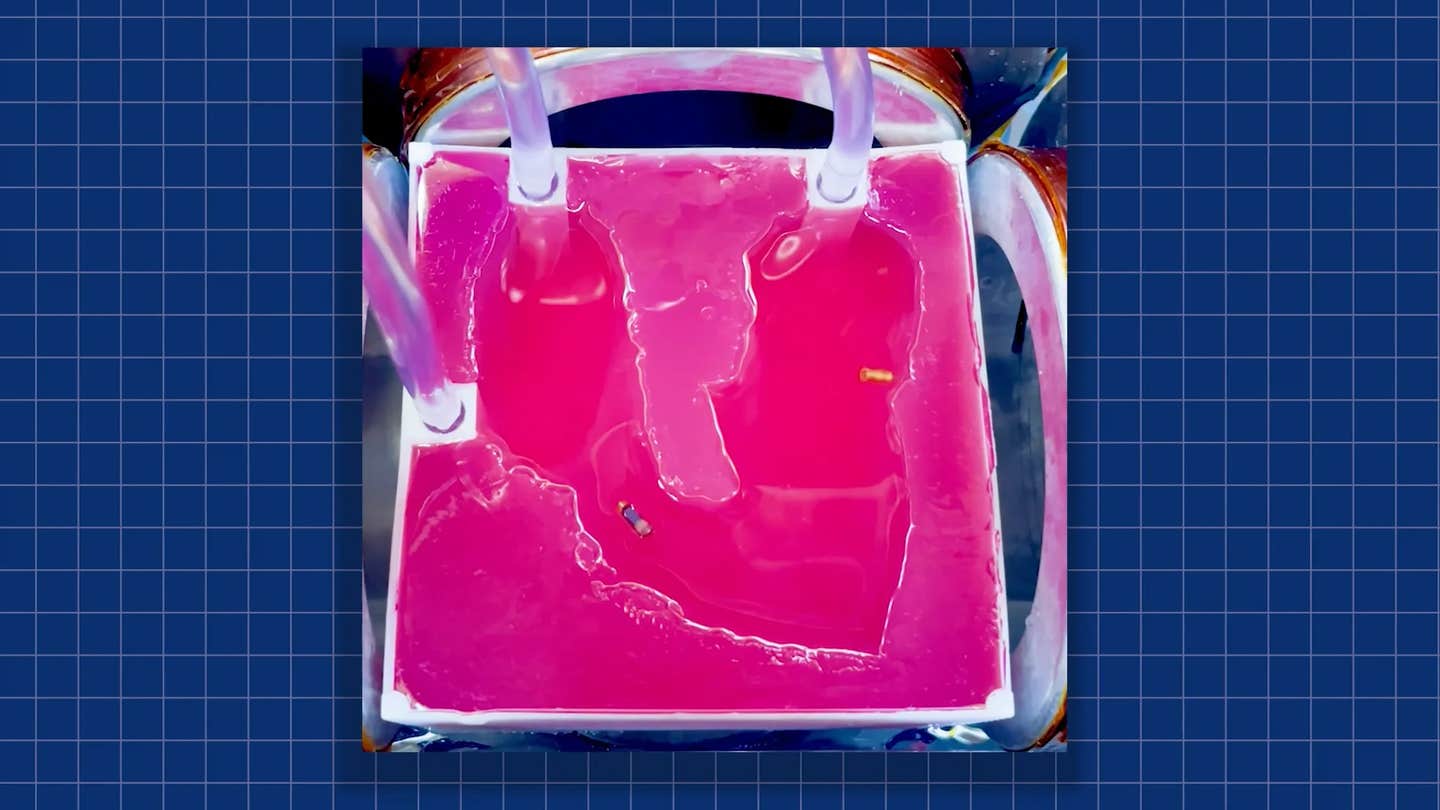
Paired magnetic millirobots navigate a heart model and dock for payload delivery, an early step toward targeted infection treatment. (CREDIT: Axel Krieger et al, Advanced Material Technologies 2026)
- Johns Hopkins engineers built paired magnetic millirobots that navigate a laboratory heart model, anchor and dock for targeted payload delivery.
- Tests used pulsating simulated blood flow and separate pig heart tissue experiments, with dye standing in for medicine.
- The work demonstrates engineering steps toward cardiac treatment, but has not shown infection cures, safety in living hearts or shorter antibiotic therapy.
Two tiny magnetic robots have navigated a laboratory heart model and joined together at a target site, demonstrating a possible approach to localized medicine delivery. One module anchors in tissue while another carries a payload to it. Separating those jobs could allow repeated deliveries without repeatedly inserting an anchor.
The Johns Hopkins University-led study appeared online in Advanced Materials Technologies. First author Anuruddha Bhattacharjee, a former Johns Hopkins postdoctoral researcher now at the University of Alabama at Birmingham, worked with senior author Axel Krieger and colleagues. Their experiments tested navigation, anchoring and magnetic connections in controlled environments.
The intended application is treatment of endocarditis, a potentially life-threatening infection involving the heart's inner lining or valves. However, the researchers used dye as a stand-in for medicine and did not treat an infection. The advance concerns the machinery needed for a future therapy, rather than a demonstrated replacement for antibiotics or heart surgery.
Dividing the work between two robots
The devices are millirobots, meaning their dimensions are measured in millimeters. Both modules are 2.8 millimeters wide, while the payload module measures 7.4 millimeters long. The needle module is longer, at 12.1 millimeters, making the prototypes small but considerably larger than microscopic particles.
Inside the needle module, permanent magnets allow external fields to move and orient the device. Its needle tip penetrates tissue, and backward-facing barbs help hold it in place. Once anchored, the module becomes a docking point for the second robot.
The payload module combines its own magnet with a hollow chamber and a perforated cap. Small openings allow its contents to diffuse into the surrounding fluid. Magnetic attraction brings the two modules together, while carefully controlled forces and turning motions separate them again.
That detachable connection is central to the design. An empty carrier could potentially be exchanged for another loaded module while the anchor remains in place. The proposed clinical workflow uses a catheter to introduce and recover the devices, rather than simply injecting them into a vein without supporting equipment.
Using two modules also makes coordination essential. A carrier must reach an anchor that stays secure during docking and release. That is why testing connection and separation matters as much as showing that a robot can move through fluid.
Steering through a heart-like flow environment
The robots carry no onboard batteries or motors. Instead, electromagnetic coils outside the test environment generate fields and gradients that exert forces on their embedded magnets. Adjusting those inputs guides movement and supplies the stronger forces needed for anchoring or separation.
For the main experiments, the team built a simplified heart phantom, a laboratory model reproducing selected anatomical features. It included spaces representing the right atrium, right ventricle and pulmonary trunk. A pump circulated a glycerin-and-water mixture to create pulsating flow through the model.
Paired with those physical components, a camera and artificial intelligence software tracked each robot's position and orientation. The control system used that feedback to guide the modules along planned paths. Tests included movement toward the target region and return journeys against the simulated flow.
This was supervised autonomy, rather than an entirely independent procedure. A human operator initiated critical steps including penetration, undocking and removal of the needle from tissue. Automated navigation reduced continuous manual steering, but it did not eliminate human decisions about when those actions should occur.
What the experiments actually demonstrated
Within the phantom, the needle module reached its target, penetrated the soft material and remained anchored. The carrier then navigated toward it and docked magnetically. The researchers also demonstrated separation and movement back toward the model's entry region.
Docking succeeded in all 15 reported trials, while undocking succeeded in 93% of 13 trials. Those results show repeatable operation under the tested conditions. They do not establish the reliability required for a medical device navigating an actual patient's heart.
The team separately tested anchoring and undocking in pig heart tissue outside the body. Magnetic forces drove the needle into the tissue, and the carrier subsequently detached while the anchor remained secure. These experiments added evidence about interaction with biological tissue, but took place without blood flow or a living heartbeat.
Payload release also needs careful interpretation. The material was a blue dye, and the researchers stopped the phantom's active flow to visualize its release. A separate release experiment followed dye diffusion over three hours, providing information about the carrier rather than antibiotic activity against bacteria.
Together, the tests address several pieces of a difficult engineering problem. They show that small modules can be guided, connected, anchored and separated using an external magnetic system. Combining those capabilities with effective treatment in a living heart remains a different stage of investigation.
Why the medical goal remains important
Endocarditis can develop when microorganisms enter the bloodstream and establish an infection inside the heart. Infected growths can damage valves, and fragments can break away into circulation. The disease can therefore require prolonged treatment and, in some cases, surgery.
Intravenous antibiotics remain an established treatment, with the drug choice and duration depending on the infection. Surgery may be necessary when complications develop or medication does not control the disease. The robotic study does not demonstrate that conventional antibiotics are generally ineffective or that local delivery would replace every surgical indication.
The proposed advantage is to maintain a drug source near the affected tissue. Concentrating delivery locally might improve exposure at the target while reducing unwanted exposure elsewhere. Whether the robots achieve those benefits depends on future measurements of actual drug concentrations, infection clearance and tissue safety.
For the same reason, a short robot procedure cannot yet be equated with a short infection treatment. The study did not compare its approach with weeks of antibiotic therapy in patients or infected animals. Suggestions that treatment could finish within a day remain aspirations rather than measured outcomes.
The challenges of operating inside a living heart
The phantom reproduced pulsating flow but did not have contracting heart walls or functioning valve leaflets. Real cardiac motion could alter navigation and place additional loads on an anchored needle. The researchers plan more representative testing that combines tissue interaction with flow and movement.
Imaging presents another substantial challenge. An overhead camera can track robots in a transparent laboratory model, but cannot provide the same view inside a patient. Ultrasound or X-ray imaging would require suitable tracking algorithms and validation under clinically realistic conditions.
The magnetic hardware also needs development. The authors state that their current laboratory coil system is unsuitable for controlling robots inside large animals or humans. Future work must adapt the approach to larger systems while establishing dependable recovery and retrieval procedures.
Other proposed applications, including cancer treatment, would require their own evidence. For cardiac infections, the immediate next question is whether the complete system can function safely with realistic tissue motion, blood flow and medical imaging. Successful docking in a model is a starting point for answering it.
Dig deeper into cardiac treatment and medical robotics
These resources explain the robotic work, established endocarditis care and the evidence needed to evaluate new treatments.
Tiny robots speed medicine through body to the heart
Johns Hopkins describes the modular robots and the researchers' proposed applications, which remain distinct from demonstrated clinical outcomes. (Johns Hopkins University, October 2026)
Robot performs first realistic surgery without human help
This account describes a separate surgical robotics project, providing context for Krieger's broader work on autonomous systems. (Johns Hopkins University, July 2025)
2023 ESC Guidelines for the management of endocarditis
These clinical guidelines outline established approaches to diagnosis, antibiotics, complications and decisions about surgery. (European Society of Cardiology, August 2023)
Partial Oral versus Intravenous Antibiotic Treatment of Endocarditis
This randomized trial evaluates antibiotic delivery strategies in selected stable patients, illustrating the clinical evidence used to assess treatment changes. (New England Journal of Medicine, August 2018)
Infective Endocarditis
The American Heart Association explains the infection, its complications and the roles of antibiotics and surgery. (American Heart Association)
Research findings are available online in the journal Advanced Materials Technologies.
The original story "Johns Hopkins engineers develop magnetic millirobots for targeted heart drug delivery" is published in The Brighter Side of News.
Related Stories
- New modular nanorobot can move, dock to cancer cells, deliver therapy, and be reused
- Battery breakthrough revolutionizes the use of cell-sized medical robots
- Scientists create a mini robot to simplify dental care
Like these kind of feel good stories? Get The Brighter Side of News' newsletter.
Mac Oliveau
Writer
Mac Oliveau is a Los Angeles–based science and technology journalist for The Brighter Side of News, an online publication focused on uplifting, transformative stories from around the globe. Having published articles on MSN, and Yahoo News, Mac covers a broad spectrum of topics including medical breakthroughs, health and green tech. With a talent for making complex science clear and compelling, they connect readers to the advancements shaping a brighter, more hopeful future.