Canadian radio telescope (CHIME) is turning hydrogen into a map of cosmic expansion
A faint hydrogen signal from a 5-billion-year-old universe emerged after astronomers stripped away overwhelming radio foregrounds.
 UBC Writer: Alex Walls

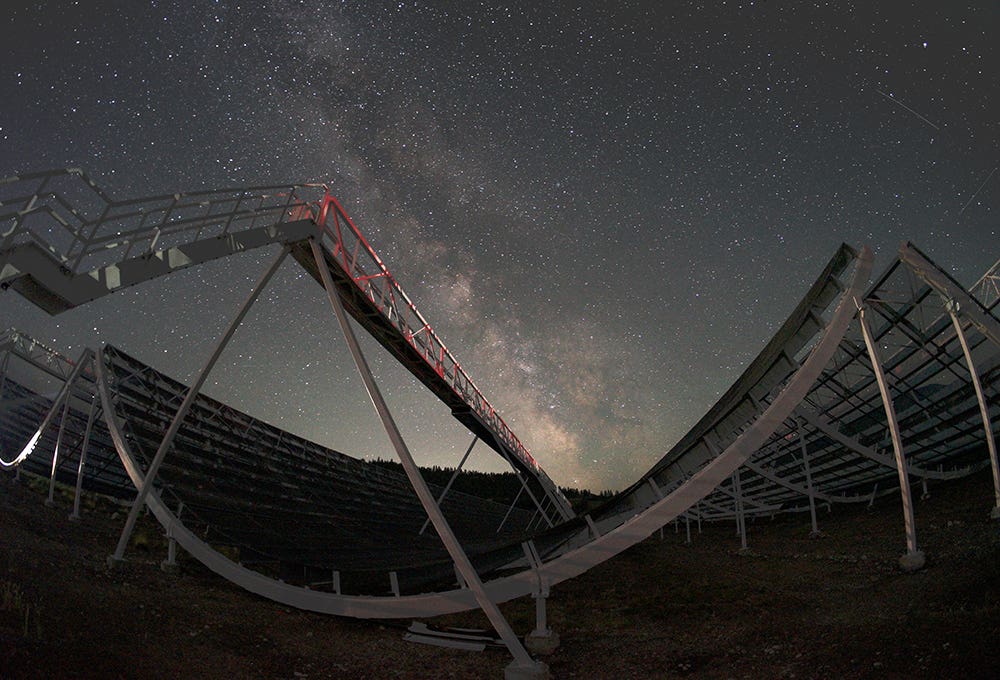
A view of CHIME at night, with the Milky Way in the background. (CREDIT: CHIME collaboration)
- CHIME has detected the cosmological 21-centimeter hydrogen signal using only its own observations, rather than relying on cross-correlation with an external galaxy survey.
- The telescope measured the hydrogen auto power spectrum at an average redshift of 1.16 with a signal-to-noise ratio of 12.4, using 94 nights of data from 2019.
- The result does not yet measure dark energy directly, but it demonstrates a technique designed to map enormous cosmic volumes and eventually track how the universe expanded across billions of years.
A faint radio signal emitted when the universe was roughly 5 billion years old has emerged from beneath layers of cosmic and human-made noise.
The Canadian Hydrogen Intensity Mapping Experiment, or CHIME, has detected the large-scale clustering of neutral hydrogen using only its own radio observations. Earlier CHIME results had depended on comparing its maps with galaxies or other structures already identified by separate surveys.
The measurement, published in The Astrophysical Journal, represents an important milestone for a telescope originally designed to map hydrogen across enormous portions of the universe. It could eventually give cosmologists another way to reconstruct cosmic expansion and investigate dark energy, the still-unexplained phenomenon associated with the universe’s accelerating expansion.
“This is a completely new technique for probing the cosmos, delivered by an instrument that was conceived, built and funded by Canadians,” said co-author Dr. Mark Halpern, professor in the UBC department of physics and astronomy and CHIME principal investigator. “It’s a bold new step in the global cosmology program and a Canadian success story.”
Hydrogen turns the universe into a radio map
Neutral atomic hydrogen produces a characteristic radio signal with a wavelength of about 21 centimeters. As the universe expands, that radiation stretches to longer wavelengths, allowing astronomers to determine approximately how far back in cosmic history the signal originated.
Rather than identifying individual galaxies, intensity mapping measures the combined 21-centimeter emission from large regions containing many unresolved galaxies. Variations in brightness reveal where hydrogen, and therefore matter, is more or less strongly clustered.
That approach sacrifices the fine detail of traditional galaxy surveys but gains speed and scale. Astronomers can map huge cosmic volumes without first detecting and cataloging every individual galaxy.
“Hydrogen is the most common element in the universe and the raw material from which stars form,” co-author Arnab Chakraborty of the University of Toronto said. “Its faint radio emission acts like a cosmic tracer, revealing how matter is distributed across space.”
CHIME watches the northern sky every day from the Dominion Radio Astrophysical Observatory near Penticton, British Columbia. Its four cylindrical reflectors have no moving parts, relying on Earth’s rotation to sweep the sky through the telescope’s field of view.
The signal was buried beneath much brighter noise
Detecting hydrogen this way is exceptionally difficult because the desired cosmological signal is not the brightest thing CHIME sees. It is not even close.
Radio emission from the Milky Way and distant astrophysical sources can exceed the hydrogen signal by several orders of magnitude. Human radio-frequency interference adds another layer, while small imperfections in the telescope can transform otherwise smooth foreground signals into patterns that resemble cosmological structure.
The CHIME team developed a substantially improved processing system to address those problems. It included new methods for identifying radio interference, controlling frequency-dependent instrumental effects, suppressing astronomical foregrounds and correcting residual calibration errors.
Researchers eventually selected 94 high-quality observing nights from 2019. They restricted the analysis to nighttime observations and a relatively clean frequency band between 608.2 and 707.8 megahertz.
Those frequencies correspond to hydrogen observed between redshifts 1.34 and 1.01. The average redshift was 1.16, meaning the radiation traces a universe substantially younger than the one surrounding Earth today.
CHIME no longer needed another survey
Previous CHIME detections used cross-correlation. Researchers compared patterns in CHIME’s radio measurements with the positions of known galaxies, quasars or hydrogen absorption measured by optical surveys.
Cross-correlation is powerful because unrelated noise tends not to appear in both datasets. A genuine cosmic structure, however, should leave related patterns in each.
The new analysis took away that safety net.
Researchers measured the hydrogen auto power spectrum, meaning they searched for statistical clustering directly within CHIME’s own hydrogen map. The resulting signal reached a signal-to-noise ratio of 12.4 across the full frequency range.
Independent analyses of two halves of the frequency band also detected the signal, providing another check against an instrumental artifact. The team tested numerous alternative processing choices and splits of the observations before accepting the result.
“We worked very hard to convince ourselves that this wasn't a false alarm,” Chakraborty said. “After all the tests, the signal remained.”
A power spectrum reveals cosmic structure
The researchers did not produce a photograph of individual hydrogen clouds. Instead, they measured a power spectrum, a statistical description of how strongly matter clusters across different spatial scales.
This first CHIME auto-correlation measurement covers scales smaller than those most directly useful for conventional dark-energy measurements. At these scales, gravity has already made matter clustering nonlinear, complicating cosmological interpretation.
A companion analysis examined what the signal says about neutral hydrogen itself. Researchers modeled the abundance and clustering of atomic hydrogen at a mean redshift of 1.16 and compared the observations with predictions from the IllustrisTNG cosmological simulations.
The CHIME measurement differed from the simulated hydrogen power spectra by 3.1 standard deviations for TNG100 and 4.0 for TNG300. The researchers argue that the discrepancy most likely reflects how strongly hydrogen clusters in velocity space at nonlinear scales rather than a simple disagreement over how much hydrogen exists.
That gives CHIME an additional role beyond dark-energy cosmology. Its measurements can test models of how gas occupies galaxies and dark-matter halos.
Dark energy remains the long-term target
CHIME was built largely to pursue a more ambitious goal: measuring baryon acoustic oscillations.
These enormous patterns are remnants of pressure waves that traveled through the hot early universe. Their characteristic size provides astronomers with a cosmic standard ruler.
Measuring how that ruler appears at different redshifts allows scientists to reconstruct the universe’s expansion history. Because dark energy affects how expansion changes with time, baryon acoustic oscillations can test competing models for its behavior.
The current result does not yet accomplish that. Foreground removal eliminates some of the largest-scale modes needed for precision cosmology, and the detected power spectrum occupies smaller nonlinear scales.
What the experiment establishes is that CHIME can recover the extraordinarily faint 21-centimeter signal without an external map telling researchers where cosmic structure should be.
That is a major requirement for turning hydrogen intensity mapping into an independent cosmological tool.
Seven years of observations are waiting
The published analysis uses only a small fraction of CHIME’s archive. Although the measurement relies on 94 nights from 2019, the telescope has now accumulated nearly seven years of observations.
More data could lower statistical noise, expand the usable sky and frequency range, and allow measurements farther into the past. Researchers are working toward periods when the universe was only about 3 billion years old.
The challenge will remain controlling foregrounds and instrumental systematics well enough to recover increasingly large cosmic scales.
For now, CHIME has cleared a fundamental hurdle. A telescope designed to map the universe through hydrogen has shown that it can isolate that hydrogen without another survey pointing out where to look.
Dig deeper into 21-centimeter intensity mapping
These recent and directly relevant resources explore CHIME’s hydrogen measurements, competing intensity-mapping approaches and the techniques needed to turn faint radio emission into precision cosmology.
Interpretation of 21 cm Auto Power Spectrum Measurement at z∼1 by the Canadian Hydrogen Intensity Mapping Experiment: This companion analysis interprets CHIME’s new auto power spectrum in terms of neutral-hydrogen abundance, clustering and comparisons with IllustrisTNG simulations. (CHIME Collaboration, 2026)
Unveiling the large-scale structure of the Universe with 21cm Intensity Mapping: This recent overview explains how neutral-hydrogen intensity mapping can probe large-scale structure, dark energy and the next generation of SKA observations. (Proceedings of the International Astronomical Union, 2026)
Revealing cosmological fluctuations in 21 cm intensity maps with MeerKLASS: from maps to power spectra: This review describes progress with MeerKAT intensity mapping, including foreground cleaning and cosmological clustering measurements that complement CHIME. (Astrophysics and Space Science, 2026)
Mitigating antenna gain errors with hybrid foreground residual subtraction in CHIME simulations: Researchers test a foreground-removal technique capable of reducing instrumental contamination in simulated CHIME power spectra by as much as three orders of magnitude. (Physical Review D, 2026)
A Detection of Cosmological 21 cm Emission from CHIME in Cross-correlation with eBOSS Measurements of the Lyman-α Forest: This earlier CHIME result detected hydrogen at a mean redshift of 2.3 by cross-correlating radio observations with the Lyman-alpha forest, illustrating the step that preceded the new standalone measurement. (The Astrophysical Journal, 2024)
Research findings are available online in The Astrophysical Journal.
The original story "Canadian radio telescope (CHIME) is turning hydrogen into a map of cosmic expansion" is published in The Brighter Side of News.
Related Stories
- The universe still has plenty of hydrogen, so why is it making fewer stars?
- Giant hydrogen halos are changing how astronomers view the early universe
- A cosmic giant 5,000 times the Milky Way’s mass emerges from the early Universe
Like these kind of feel good stories? Get The Brighter Side of News' newsletter.
Joshua Shavit
Writer and Editor
Joshua Shavit is a NorCal-based science and technology writer with a passion for exploring the breakthroughs shaping the future. As a co-founder of The Brighter Side of News, he focuses on positive and transformative advancements in technology, physics, engineering, robotics, and astronomy. Having published articles on AOL.com, MSN, Yahoo News, and Ground News, Joshua's work highlights the innovators behind the ideas, bringing readers closer to the people driving progress.