Supermassive black holes leave a glowing trail far beyond their host galaxies
DESI and LOFAR reveal a directional H-alpha glow showing where black hole jets disturb cool gas far beyond their host galaxies.
 ASU Writer: Kim Baptista

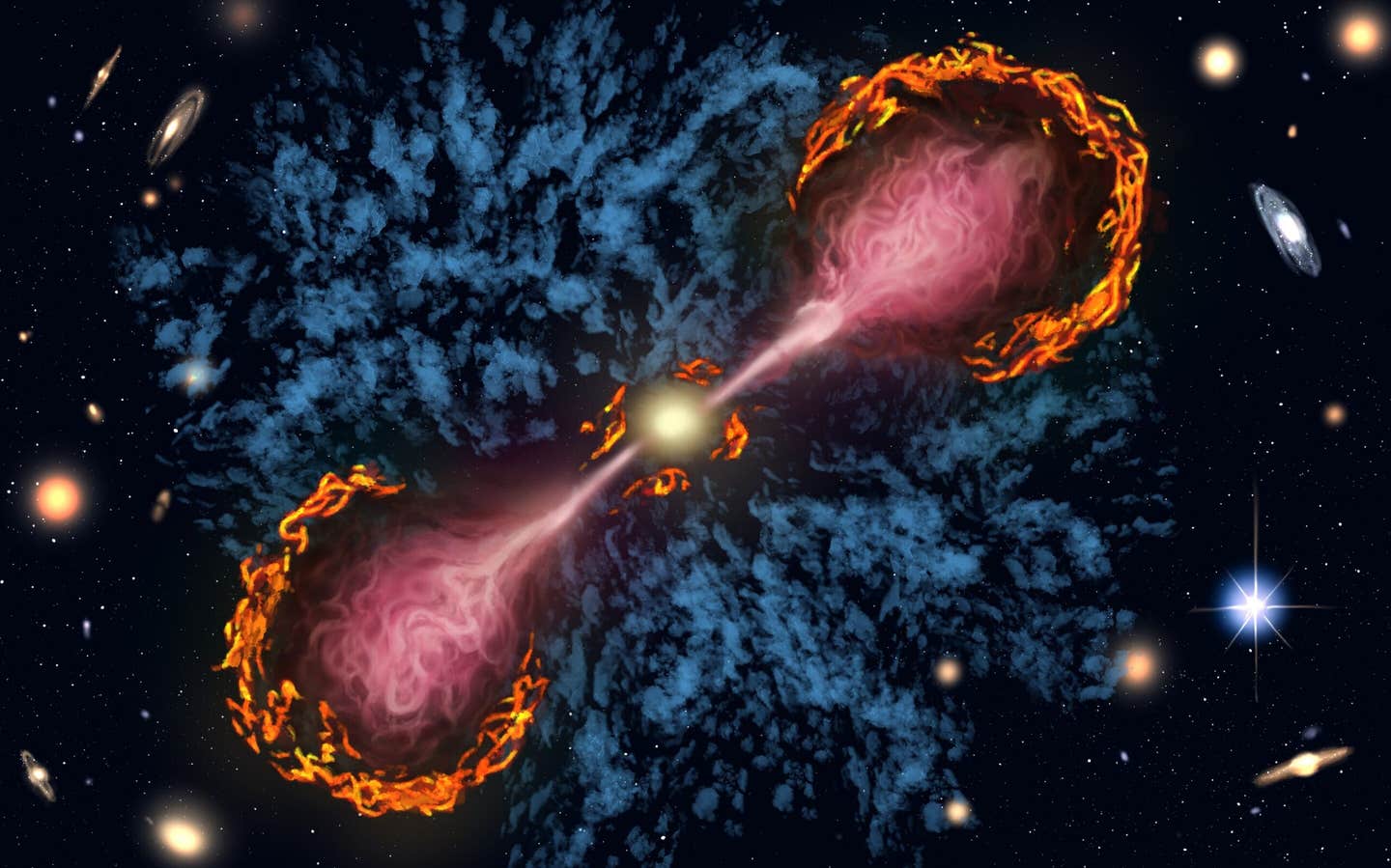
Artist’s illustration of a supermassive black hole at the center of a radio galaxy launching powerful jets (shown in pink) all the way into the galaxy’s CGM. (CREDIT: Hailey Nelson/ Arizona State University)
- Astronomers found a strong H-alpha glow from cool ionized gas only along the directions of radio jets launched by supermassive black holes, revealing a highly directional effect extending deep into galactic halos.
- The signal appeared in stacked observations of 324 radio galaxy and background-quasar pairs, with H-alpha more than five standard deviations above the noise along jet-aligned sight lines but undetected when all directions were averaged together.
- Magnesium absorption showed no comparable directional pattern, suggesting the jets do not create most of the cool gas but instead compress, heat or ionize clouds already distributed through the circumgalactic medium.
A supermassive black hole can occupy a region tiny compared with its host galaxy, yet jets launched near that black hole may alter gas hundreds of thousands of light-years away.
Astronomers have now found evidence that those narrow plasma jets leave a directional imprint on the circumgalactic medium, or CGM, the enormous reservoir of gas surrounding galaxies. Cool ionized gas glows much more strongly along the paths of the jets than it does elsewhere around the same galaxies.
The study, published in The Astrophysical Journal Letters, combined optical spectra from the Dark Energy Spectroscopic Instrument, or DESI, with radio observations from the LOFAR Two-meter Sky Survey. Researchers identified a strong H-alpha emission signal along radio-jet directions, while averaging the same galaxies in every direction caused the signal to nearly disappear.
“This is a pathbreaking result that solves the long-standing mystery of how black holes influence galaxies, their stars and life as we know it,” said Sanchayeeta Borthakur of Arizona State University, who led the research with Namrata Roy of the Raman Research Institute.
A vast reservoir surrounds every large galaxy
The visible disk of a galaxy represents only a small part of its gaseous environment. Far beyond its stars lies the CGM, which can extend 10 to 20 times farther than the luminous galaxy itself.
This halo contains gas spanning a wide range of temperatures and densities. Some of that material can cool, fall toward a galaxy and eventually provide fuel for new stars. Other gas is expelled from galaxies and later recycled through the halo.
That raises a longstanding question. Massive galaxies often contain enormous surrounding gas reservoirs, yet many have stopped forming stars. Something must prevent enough of that material from cooling and returning to the galaxy.
Feedback from active galactic nuclei has long been a leading explanation. When gas falls toward a supermassive black hole, a fraction of the energy released can emerge as narrow relativistic jets that travel far beyond the central galaxy.
Astronomers have seen such jets heat hot gas in galaxy clusters. Their effect on cooler material in the CGM around more typical radio galaxies has been much harder to measure because that gas is extraordinarily faint.
Background quasars exposed the jet's path
The researchers solved that problem statistically rather than trying to image individual halos directly.
They began with radio galaxies detected by LOFAR and used the radio emission to determine the orientation and extent of each galaxy's jets. They then searched DESI observations for distant quasars whose sight lines passed through the foreground galaxies' halos.
The final sample contained 324 radio galaxy and quasar pairs spanning projected distances of roughly 20 to 800 kiloparsecs. Seventy-four quasar sight lines passed within 20 degrees of the projected radio-jet axes.
Each individual spectrum contained far too little CGM emission for a secure measurement. By shifting many spectra into the foreground galaxies' rest frames and stacking them together, however, the researchers could search for extremely faint H-alpha light from ionized hydrogen.
The result changed dramatically depending on direction.
Sight lines within 20 degrees of a radio jet showed H-alpha emission detected at greater than five-sigma significance. The mean integrated flux was about 1.19 × 10^-17 ergs per square centimeter per second.
When the researchers combined sight lines from all directions around the galaxies, the signal dropped below two sigma and was no longer considered a significant detection.
The glow appears in two preferred regions
The H-alpha emission was not equally bright along the entire jet.
The strongest signal appeared near the galaxy just outside its visible stellar region, where an expanding jet first encounters denser surrounding material. There, the detection exceeded seven sigma.
The emission then weakened at intermediate distances before growing stronger again near and beyond the projected radio lobes. Those outer regions are where jets and their surrounding cocoons can deposit energy into the CGM.
This two-part pattern gives researchers clues about how mechanical energy travels outward. Near the center, a jet may compress and disturb gas as it escapes the galaxy. Farther out, radio lobes can drive shocks, turbulence and pressure changes into surrounding halo material.
“What excites me most is the scale of the connection,” Roy said. “A black hole is incredibly small compared to a galaxy, but its impact can reach hundreds of thousands of light-years, far into the galaxy's outer reaches.”
Magnesium revealed a different picture
The team also examined magnesium absorption in the same quasar spectra.
Magnesium II traces cool, metal-enriched gas clouds whether or not those clouds are glowing brightly in H-alpha. Unlike the hydrogen emission, magnesium absorption showed no statistically significant preference for the jet direction.
About 22% of jet-aligned sight lines contained candidate magnesium absorbers, compared with about 16% of off-axis sight lines. Their equivalent widths, column densities and velocity widths were also broadly similar.
That contrast is crucial.
If jets were simply creating much more cool gas along their paths, magnesium absorption should also have shown a strong directional enhancement. Instead, the observations favor a scenario in which cool clouds already exist throughout the CGM, while jets dramatically alter only the clouds they encounter.
Compression increases gas density, while shocks and radiation can increase ionization. Because H-alpha brightness depends strongly on the density of ionized gas, relatively modest physical changes can make jet-affected clouds much brighter without greatly increasing the total amount of cool material.
Black holes could regulate future star formation
The jet-aligned H-alpha surface brightness was nearly one to two orders of magnitude above measurements around comparable normal galaxy halos. Yet producing that radiation requires only a tiny fraction of the mechanical power available from the jets.
The researchers estimate that roughly six ten-thousandths of the average jet power would be sufficient to explain the observed H-alpha emission. Most of the remaining energy could go into hotter gas, bulk motion, turbulence or other components invisible to this measurement.
That matters for galaxy evolution because the CGM provides the raw material for future stars. Heating or disturbing it can prevent gas from cooling efficiently and falling back toward the galaxy, helping maintain the low star-formation rates seen in many massive galaxies.
The study does not prove that the observed jets permanently shut down star formation. It instead provides statistical evidence that jets physically influence cool halo gas far outside their host galaxies and do so in strongly preferred directions.
The finding also explains why earlier studies could miss the effect. Averaging a galaxy's halo in every direction washes out a signal concentrated narrowly along the radio axis.
A supermassive black hole may be minuscule compared with the galaxy surrounding it, but its influence is anything but local. By channeling energy through narrow plasma jets, it can reshape gas on scales approaching the full extent of a galactic halo.
Dig deeper into black hole jets and the circumgalactic medium
These recent resources explore how radio jets interact with gas inside and beyond galaxies and how that feedback can alter future galaxy growth.
Jet Feedback on kpc Scales: A Review: This recent review examines how relativistic jets drive shocks, turbulence, outflows and heating across multiphase galactic environments. (Galaxies, 2025)
Modelling the cool gas clumps in the circumgalactic medium: This study models the three-dimensional density and distribution of cool CGM clouds using hydrogen and magnesium absorption, providing context for the clumpy reservoir affected by radio jets. (Monthly Notices of the Royal Astronomical Society, 2025)
Widespread AGN feedback in a forming brightest cluster galaxy at z = 4.1, unveiled by JWST: JWST observations reveal spatially resolved ionized gas and strong jet interactions in a powerful radio galaxy during the early universe. (Monthly Notices of the Royal Astronomical Society, 2024)
Global preventive feedback of powerful radio jets on galaxy formation: This theoretical study explores how large radio structures can suppress gas accretion and influence galaxy formation well beyond their host systems. (Proceedings of the National Academy of Sciences, 2024)
Closing the feedback-feeding loop of the radio galaxy 3C 84: Observations of the Perseus cluster show how jet-driven feedback can cool, move and recycle multiphase gas while also helping feed the central black hole. (Nature Astronomy, 2024)
Research findings are available online in the journal Astrophysical Journal Letters.
The original story "Supermassive black holes leave a glowing trail far beyond their host galaxies" is published in The Brighter Side of News.
Related Stories
- Twelve fading galaxies expose a missing stage in the life of black hole jets
- Cosmic first: Astronomers observed real-time formation of black hole jets
- ‘Dancing jets’ from black hole reveal their immense power
Like these kind of feel good stories? Get The Brighter Side of News' newsletter.
Joseph Shavit
Writer, Editor-At-Large and Publisher
Joseph Shavit, based in Los Angeles, is a seasoned science journalist, editor and co-founder of The Brighter Side of News, where he transforms complex discoveries into clear, engaging stories for general readers. With vast experience at major media companies like The Los Angeles Times, Times Mirror and Tribune Publishing, he writes with both authority and curiosity. His writing focuses on space science, planetary science, quantum mechanics, geology. Known for linking breakthroughs to real-world markets, he highlights how research transitions into products and industries that shape daily life.