Chang’e-6 samples reveal a form of magnetic iron never before found on the Moon
Rare γ-iron trapped in lunar impact glass forms stable magnetic vortices that could help decode the Moon’s disputed magnetic history.
 CAS Writer: Na Chen

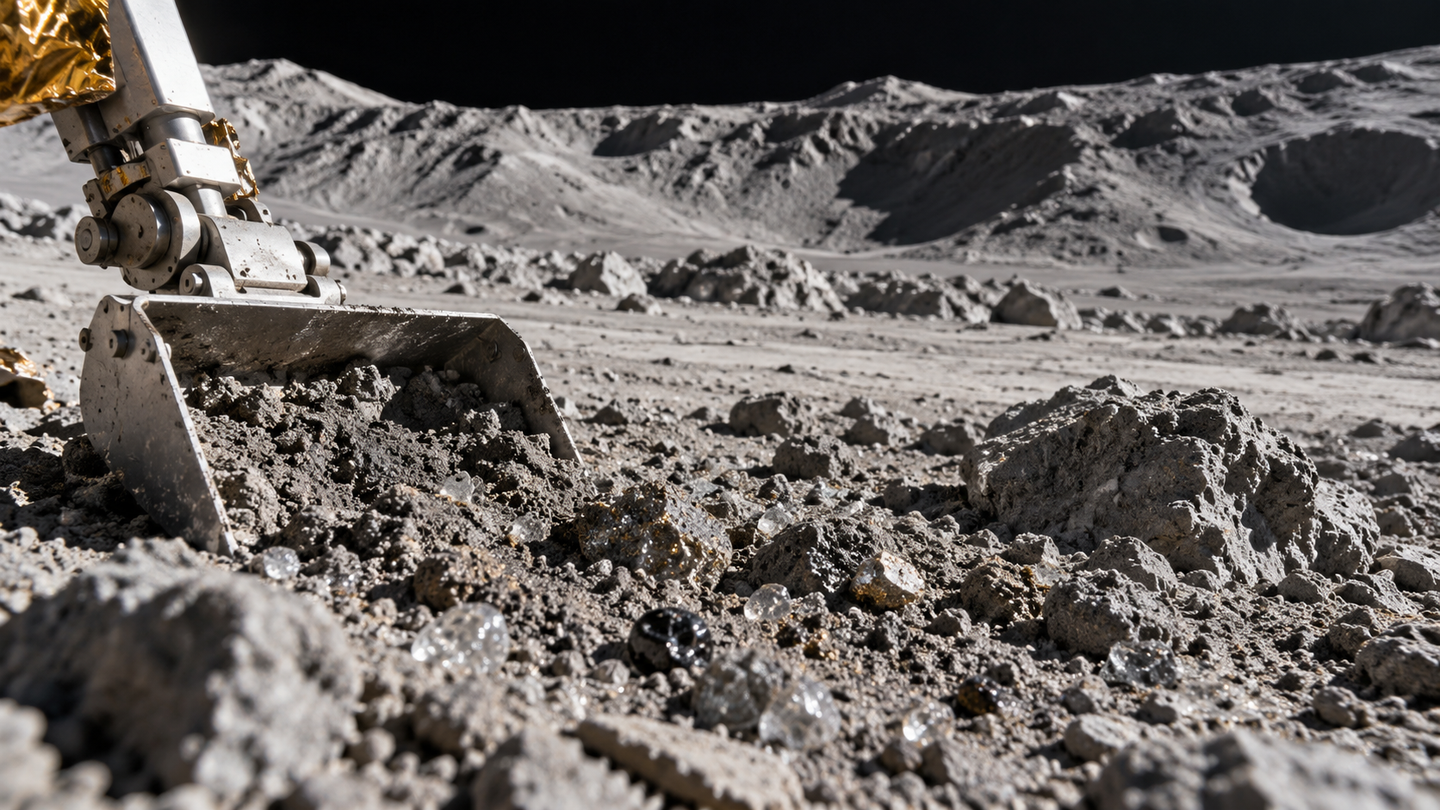
Chang’e-6 samples contain the first natural lunar γ-iron, a magnetic nanoparticle phase that may preserve clues to the Moon’s ancient fields. (CREDIT: Shutterstock)
- Researchers identified face-centered cubic γ-iron in natural lunar material for the first time, preserved as nanoparticles inside impact glass returned from the Moon’s far side by Chang’e-6.
- Electron holography showed that larger γ-Fe particles can form stable magnetic vortex states, suggesting they may preserve ancient magnetic information alongside better-known lunar iron minerals.
- The discovery could eventually help scientists separate magnetic signals created by the Moon’s ancient core dynamo from short-lived fields generated during major impacts, although that possibility remains unproven.
Tiny spheres of iron trapped inside glass from the Moon’s far side may contain a previously unrecognized record of ancient lunar magnetism.
Researchers examining soil returned by China’s Chang’e-6 mission have identified γ-iron, or gamma iron, in natural lunar material for the first time. Unlike the common form of metallic iron found on the Moon, this crystal structure normally survives only at high temperatures and should transform as it cools.
The discovery, published in Proceedings of the National Academy of Sciences, came from an international team led in part by scientists at the High Magnetic Field Laboratory of the Chinese Academy of Sciences. Their analyses show that some γ-Fe nanoparticles not only survived lunar surface conditions but also developed stable magnetic vortex states.
“This tiny magnetic fossil may help us better understand the Moon’s ancient magnetic history,” team member Long Li said.
Chang’e-6 brought back a different lunar archive
Chang’e-6 returned the first samples ever collected from the Moon’s far side in 2024. The spacecraft sampled material from Apollo crater inside the enormous South Pole-Aitken basin, one of the Moon’s oldest and deepest impact structures.
That location is especially valuable for studying lunar magnetism. The Moon has no global magnetic field today, but portions of its crust remain magnetized, preserving evidence of fields that existed billions of years ago.
Scientists have traditionally relied on metallic α-iron and iron-nickel alloys as magnetic recorders in lunar rocks. Those minerals can lock in remanent magnetization, allowing researchers to estimate the strength and history of past magnetic fields.
Pure γ-Fe presented a different problem. It has a face-centered cubic atomic structure and is normally stable only between roughly 912 and 1,394 degrees Celsius at low pressure. During ordinary cooling, it transforms into the more stable body-centered cubic α-Fe phase.
Finding it intact in lunar soil was therefore unexpected.
Nanoparticles survived inside impact glass
The researchers selected three iron-bearing particles from a Chang’e-6 soil sample. Two were fragments of impact glass, while the third was basalt.
Focused ion beam techniques allowed the team to cut extremely thin sections from the particles for transmission electron microscopy. Inside the two glass fragments, scientists found abundant spherical metallic iron particles embedded in a silica-rich matrix.
The particles ranged from less than 10 nanometers to about 140 nanometers across and contained very little nickel. High-resolution imaging and diffraction revealed both α-Fe and γ-Fe.
When the team randomly examined 50 iron particles from the two impact-glass samples, γ-Fe was the dominant structure. It accounted for 64% of the analyzed particles in one sample and 76% in the other.
The basalt sample told a different story. Its much larger metallic iron grain consisted entirely of α-Fe, consistent with formation during ordinary cooling of magma rather than a violent impact.
That contrast strengthened the argument that the unusual γ-Fe formed or survived through impact-related processes.
Violent impacts may have frozen iron in place
The researchers propose that two conditions worked together to preserve γ-Fe.
One is the presence of small amounts of elements capable of stabilizing the face-centered cubic phase. Nickel can perform this role, but the particles contained less than 0.8% nickel by weight, far below levels typical of the fcc iron-nickel alloy taenite.
Carbon is therefore a leading candidate. Laboratory research has shown that small amounts can stabilize nanoscale γ-Fe at room temperature, and carbon-rich impactor material has previously been identified in lunar samples.
The second requirement is extremely rapid cooling.
Meteorite impacts generate intense, short-lived heating that can melt lunar soil. On an airless Moon, tiny droplets and fragments can then lose heat extremely quickly. Rapid quenching may prevent atoms from rearranging into the more stable α-Fe structure.
The surrounding impact glass may also mechanically trap the particles. Differences in thermal contraction between iron and glass can leave the nanoparticles under tension, potentially helping stabilize both their structure and magnetic behavior.
Some particles contain magnetic vortices
The team then used off-axis electron holography to examine magnetic fields within individual particles.
Iron grains larger than about 100 nanometers displayed vortex structures, in which magnetic moments curl around inside the particle instead of pointing uniformly in one direction. Both α-Fe and γ-Fe particles showed this behavior.
When researchers applied progressively stronger magnetic fields, the vortex patterns changed in a consistent way before approaching magnetic saturation. The experiment demonstrated that the γ-Fe nanoparticles were ferromagnetic under the conditions tested and could maintain stable magnetic configurations.
That makes them interesting as possible paleomagnetic recorders. Single-vortex particles can retain magnetization over long periods while being less vulnerable to some of the instabilities that affect more complicated multidomain grains.
The γ-Fe particles also showed a stronger magnetic phase shift than nearby α-Fe particles, indicating potentially high saturation magnetization.
A new clue in the lunar dynamo debate
Exactly how long the Moon maintained an internally generated magnetic field remains contentious.
Some paleomagnetic studies indicate that a strong lunar dynamo persisted for billions of years, with recent Chang’e-6 basalt measurements supporting magnetic field strengths of roughly 5 to 21 microteslas around 2.8 billion years ago. Other analyses of individual crystals argue that a core dynamo may have ended within roughly the Moon’s first 140 million years.
Impacts further complicate the record because major collisions can generate brief magnetic fields lasting seconds to minutes. Rocks magnetized during those events could potentially be mistaken for evidence of a long-lived dynamo.
The newly identified γ-Fe may eventually help untangle those signals. Because γ-Fe and α-Fe form and become magnetically blocked under different conditions, they could record different moments during the rapid cooling that follows an impact.
The authors describe that possibility as a hypothesis rather than a demonstrated method. The magnetic ordering temperatures of nanoscale γ-Fe remain poorly constrained, and more experiments and micromagnetic simulations are needed.
Still, the discovery expands the list of minerals capable of carrying lunar magnetic information. For a Moon whose ancient magnetic history remains one of planetary science’s enduring debates, even nanoparticles only a few dozen nanometers wide could preserve an important part of the story.
Dig deeper into lunar magnetism and Chang’e-6
These recent studies explore the competing evidence for the Moon’s ancient dynamo, impact-generated fields and the minerals that preserve magnetic information.
A reinforced lunar dynamo recorded by Chang’e-6 farside basalt: Chang’e-6 basalts produced paleointensity estimates of roughly 5 to 21 microteslas at about 2.8 billion years ago, supporting renewed or persistent lunar dynamo activity. (Nature, 2025)
Impact-generated magnetite in Chang’e-5 soil as a potential recorder of lunar magnetism: Researchers identified impact-formed magnetite capable of preserving stable remanence, expanding the known inventory of lunar magnetic recorders. (Communications Earth & Environment, 2025)
Magnetic signatures and origins of ferromagnetic minerals in Chang’e-6 lunar farside soils: This study maps the origins and magnetic properties of iron-bearing minerals in Chang’e-6 material from the South Pole-Aitken basin. (Nature Communications, 2025)
Impact plasma amplification of the ancient lunar dynamo: Simulations show that giant impacts could temporarily amplify an existing lunar magnetic field, offering another explanation for strong localized crustal magnetization. (Science Advances, 2025)
A lunar core dynamo limited to the Moon’s first ~140 million years: Single-crystal paleomagnetic measurements challenge long-lived dynamo models and argue that some younger lunar magnetic signals may instead have impact-related origins. (Communications Earth & Environment, 2024)
Research findings are available online in the journal PNAS.
The original story "Chang’e-6 samples reveal a form of magnetic iron never before found on the Moon" is published in The Brighter Side of News.
Related Stories
- Chang’e-6 moon rocks reveal a 3.9-billion-year decline in asteroid impacts on the dark side of the Moon
- Chang’e-6 samples reveal how Earth's magnetosphere changed the solar wind reaching the Moon
- Chang’e-6 samples show ancient lunar impacts left rust on the Moon
Like these kind of feel good stories? Get The Brighter Side of News' newsletter.
Joseph Shavit
Writer, Editor-At-Large and Publisher
Joseph Shavit, based in Los Angeles, is a seasoned science journalist, editor and co-founder of The Brighter Side of News, where he transforms complex discoveries into clear, engaging stories for general readers. With vast experience at major media companies like The Los Angeles Times, Times Mirror and Tribune Publishing, he writes with both authority and curiosity. His writing focuses on space science, planetary science, quantum mechanics, geology. Known for linking breakthroughs to real-world markets, he highlights how research transitions into products and industries that shape daily life.