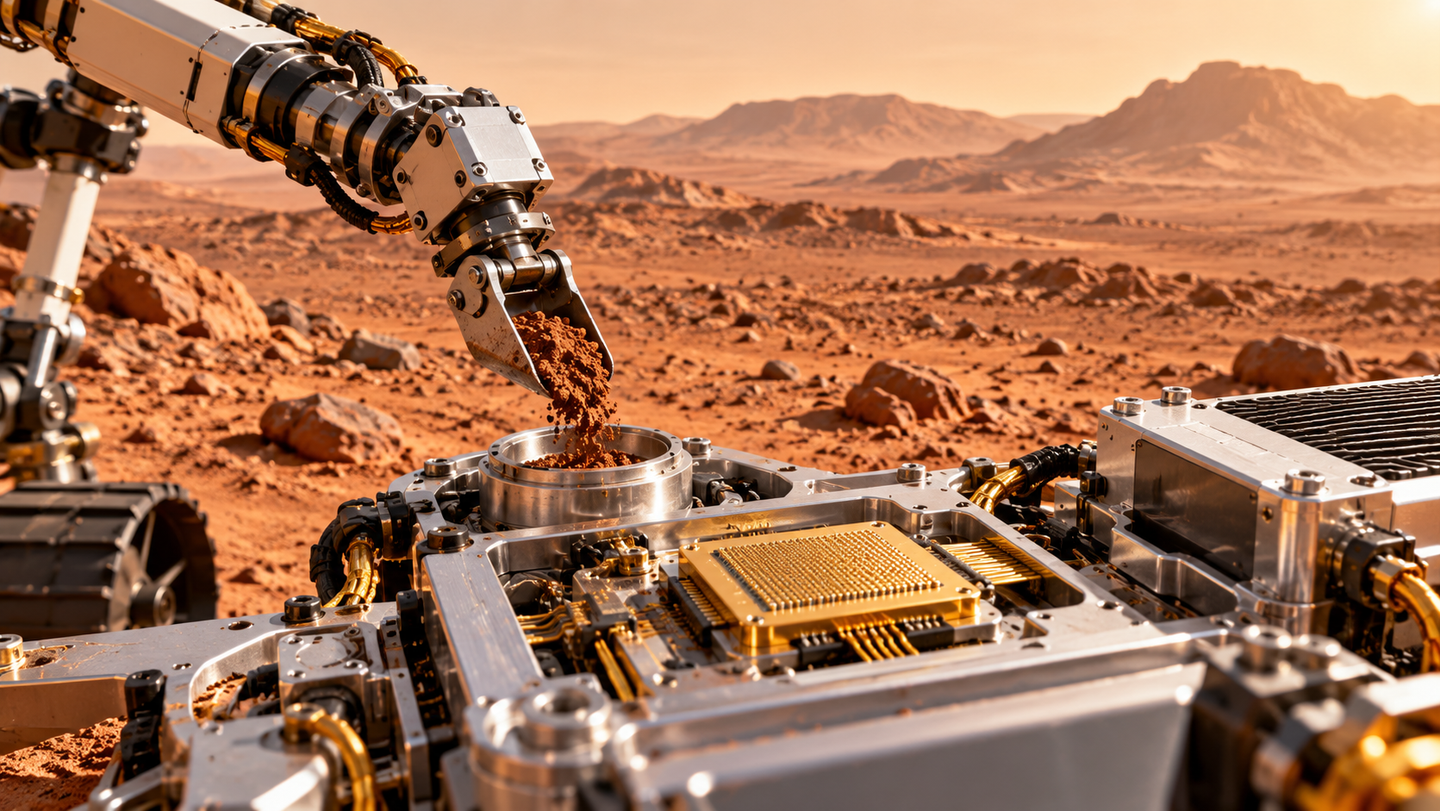
China’s Chang’e-7 targets the Moon’s South Pole in search of usable water ice
China’s next lunar mission will combine orbiting, roving and hopping to explore some of the Moon’s coldest and hardest terrain.
 Macquarie University Writer: Richard de Grijs

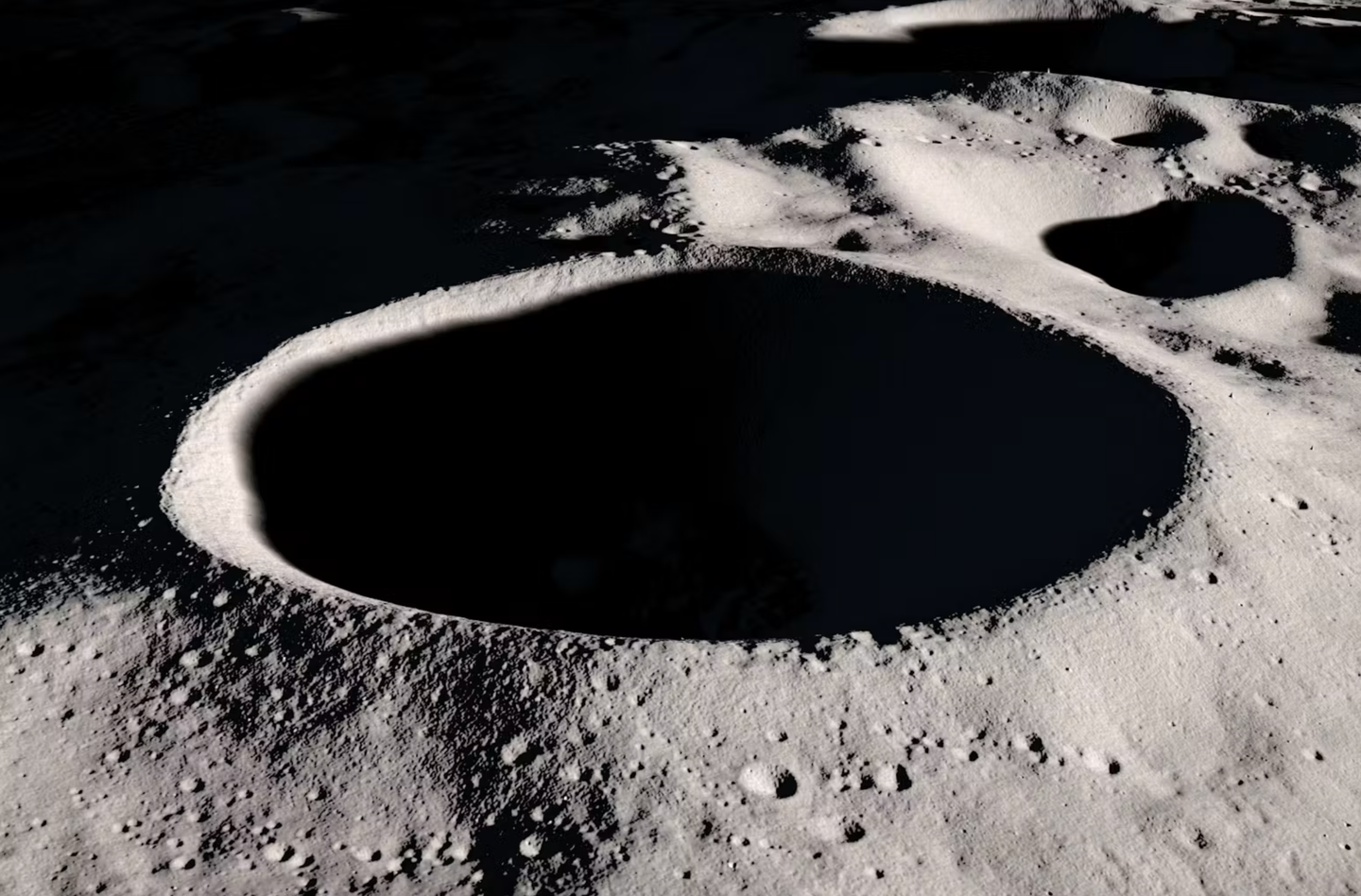
Shackleton crater on the Lunar South Pole. The Chang’e-7 Moon mission will send a hopper toward shadowed south pole craters in search of accessible lunar water ice. (CREDIT: NASA’s Scientific Visualization Studio)
- China’s Chang’e-7 mission will use an orbiter, lander, rover and jumping robot to investigate water ice near the Moon’s south pole.
- The hopper is designed to leap into steep, permanently shadowed craters where temperatures fall below minus 200 degrees Celsius and ordinary rovers may struggle to travel.
- The mission could help determine whether lunar water and other resources can support later Chinese missions, including a planned human Moon landing by 2030.
Some of the Moon’s most valuable terrain sits where sunlight never reaches. Deep inside permanently shadowed craters near the lunar south pole, temperatures can fall below minus 200 degrees Celsius, preserving water ice for billions of years.
The question is no longer whether water exists there. Evidence for lunar polar water has built for nearly two decades. The harder problem is learning where the ice lies, how much is accessible, how deeply it is buried and whether future explorers could realistically use it.
China’s Chang’e-7 mission is designed to tackle that problem with an unusually complex robotic package. It combines an orbiter, lander, rover and hopping vehicle, giving the mission several ways to investigate terrain that conventional machines may struggle to enter.
A launch is targeted for Aug. 24 Beijing time aboard a Long March 5 Y14 rocket from Wenchang. A recent failure involving another Chinese rocket, however, has introduced some uncertainty over the exact timing.
A hopper built for lunar shadows
Chang’e-7 is expected to target the lunar south pole, with the edge of Shackleton Crater identified as the lander’s destination. A site on or near an illuminated ridge would place the mission close to permanently shadowed ground while keeping parts of the spacecraft in sunlight.
The hopper is the element that sets the mission apart. Instead of relying on wheels, it is designed to leap across broken terrain and descend into craters where sunlight never reaches.
Chinese officials say the hopper will use active shock-absorption technology to land safely on slopes. The lander will also deploy China’s first deep-space “landmark image navigation” system.
Ye Peijian, an academician with the Chinese Academy of Sciences, said scientists around the world believe water ice exists on the Moon, but no one has definitively located and fully evaluated the resource.
“Now China is going to look for it, [...] And we're using many methods, from searching the surface to exploring inside craters,” Ye told China Central Television.
Several layers of exploration
Chang’e-7 will combine orbital observations, landing, surface travel and hopping. That approach lets the mission examine the lunar south pole at several scales while searching for resources and studying the surrounding environment.
Communication will rely in part on Queqiao-2, a lunar relay satellite launched in March 2024. It previously supported Chang’e-6 and is already positioned to relay signals between Earth and the Chang’e-7 surface elements.
A Russian Academy of Sciences package on the lander will detect lunar dust and measure nearby plasma. Italy’s Laboratori Nazionali di Frascati is providing a laser retroreflector array.
The lander will carry a compact wide-field optical telescope developed by the International Lunar Observatory Association in Hawaii and the Laboratory for Space Research at the University of Hong Kong. Known as ILO-C, it is intended to capture color images of the Milky Way’s galactic plane from the lunar surface.
“The HKU Lab for Space Research is proud to partner with ILOA for this historic lunar mission and we look forward to working with them to maximize the scientific return this exceptional wide field optical lunar camera will deliver,” said Quentin Parker, professor emeritus of the University of Hong Kong.
International instruments widen the view
Other instruments will operate from orbit. LunaHcam, developed jointly by the Bahrain Space Agency and Egyptian Space Agency, will produce high-resolution hyperspectral images of the lunar surface.
Thailand’s Moon Aiming Thai-Chinese Hodoscope, or MATCH, will measure high-energy particles linked to space weather and cosmic radiation from the Sun. Switzerland’s Physical Meteorological Observatory has provided a Moon-based Dual-channel Earth Radiation Spectrometer.
The ILO-C camera has another goal. Elisa Perednia, president and chair of ILOA, said it is designed to conduct the first astronomical color imaging from the Moon.
The camera project was pioneered by ILOA founding director Steve Durst, who died earlier this year. The Beijing Institute of Space Mechanics & Electricity built the camera to the team’s specifications.
“We are proud to have joined the mission and to help realize Steve's wonderful vision,” Parker said.
A path toward human activity
Chang’e-7 is part of a broader Chinese lunar program that has expanded over two decades.
James Head, a lunar scientist at Brown University, called Chang’e-7 a new benchmark.
“Chang'e-7 is the most ambitious, comprehensive, and complex robotic lunar mission ever attempted by any nation or entity,” Head said.
After launch, the orbiter is expected to spend several months circling the Moon before releasing the lander for an attempted touchdown near the end of the year. The mission is also intended to help prepare for China’s planned first human lunar landing by 2030.
Zhang Jingbo, a spokesman for the China Manned Space Agency, said the program will “fully leverage the technological expertise and practical experience accumulated over decades” to “spare no effort to strive for the goal of achieving the first Chinese landing on the moon by 2030.”
Chang’e-8, potentially launching around 2028, is expected to test technologies for building habitats with lunar soil. Together, Chang’e-7 and Chang’e-8 are intended to support the International Lunar Research Station, led by the China National Space Administration and Russia’s Roscosmos.
Practical implications of the research
The value of Chang’e-7 lies in testing whether some of the Moon’s most difficult terrain can be explored in a practical way. Permanently shadowed craters combine darkness, severe cold, steep slopes and communication problems in places where water ice may be concentrated.
A successful mission could narrow down where useful deposits are located and show whether hopping vehicles can reach terrain that wheeled rovers cannot. It could also provide experience for later missions that aim to use lunar materials rather than simply detect them.
That marks a broader shift in lunar exploration. Reaching the Moon is no longer the only test. The next challenge is learning how robotic and eventually human explorers can work in places that have remained dark and undisturbed for billions of years.
Dig deeper into lunar water ice and south pole exploration
These studies examine how lunar ice accumulates, where it may be buried, how impacts reshape deposits and how spacecraft can map the Moon’s dark south polar terrain.
Observational constraints on the history of lunar polar ice accumulation
Observations from the Lunar Reconnaissance Orbiter suggest polar ice accumulated gradually for at least about 1.5 billion years rather than arriving in a single event, helping explain how deposits evolved inside permanent shadows. (Nature Astronomy, 2026)
Impacts into the lunar permanently shadowed regions
Researchers modeled how impacts disturb, excavate and redistribute ice within permanently shadowed terrain near the south pole, identifying relatively undisturbed areas that could become valuable targets for future exploration. (npj Space Exploration, 2026)
Shallow subsurface water-ice distribution in the lunar south polar region: analysis based on Mini-RF and multi-metrics
Radar analysis identified possible shallow water-ice deposits roughly 1 to 3 meters beneath the surface, with most detections clustered inside permanently shadowed regions targeted by future lunar missions. (Geo-spatial Information Science, 2025)
Shape-from-shading with secondary illumination for 3D reconstruction of permanently shadowed regions at the lunar south pole
Using ShadowCam imagery of Shackleton Crater, researchers developed detailed 3D maps of terrain normally concealed by darkness, achieving meter-scale accuracy that could help spacecraft navigate future water-ice exploration sites. (Acta Astronautica, 2026)
Upper limit of ice content at the lunar south pole as revealed by the Earth-based SYISR–FAST bistatic radar system
Earth-based radar observations placed an estimated upper limit of 0 to 6 percent by weight on water ice in surveyed south polar terrain, underscoring how uncertain the quantity and distribution of accessible lunar ice remain. (Science Bulletin, 2025)
The original story "China's Chang’e-7 targets the Moon’s South Pole in search of usable water ice" is published in The Brighter Side of News.
Related Stories
- NASA's Lunar Trailblazer begins mission to find hidden water on the moon
- New study reveals the origin and location of water on the Moon
- Scientists found far more water on the Moon than previously expected
Like these kind of feel good stories? Get The Brighter Side of News' newsletter.
Joseph Shavit
Writer, Editor-At-Large and Publisher
Joseph Shavit, based in Los Angeles, is a seasoned science journalist, editor and co-founder of The Brighter Side of News, where he transforms complex discoveries into clear, engaging stories for general readers. With vast experience at major media companies like The Los Angeles Times, Times Mirror and Tribune Publishing, he writes with both authority and curiosity. His writing focuses on space science, planetary science, quantum mechanics, geology. Known for linking breakthroughs to real-world markets, he highlights how research transitions into products and industries that shape daily life.