Mercury’s polar water ice may have arrived in one giant impact
Mercury’s polar ice may trace back to one giant impact that briefly created a water-rich atmosphere around the planet.

 Edited By: Joseph Shavit

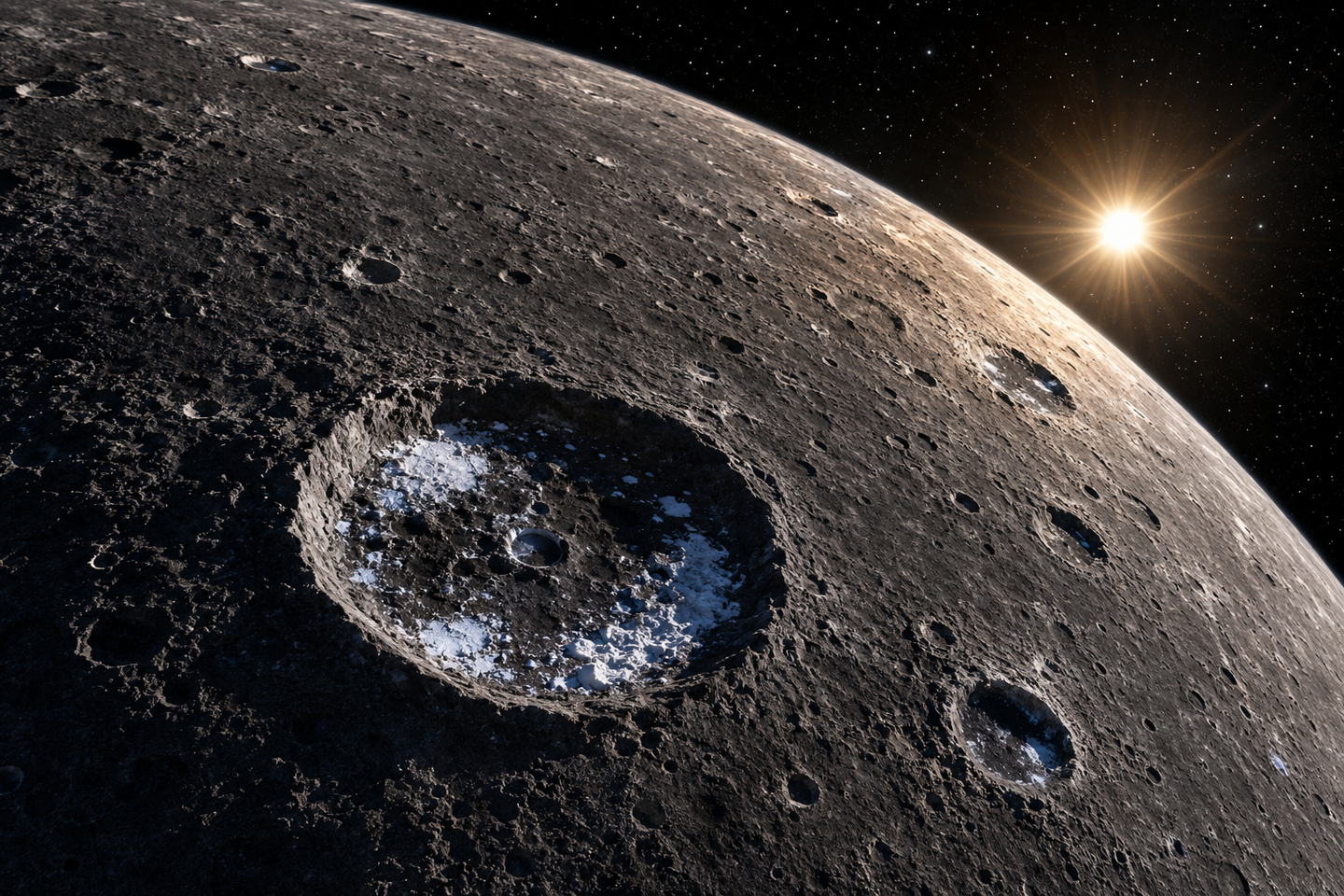
New models suggest Mercury’s polar ice may have been delivered by one major impact and trapped within a single Mercurian day. (CREDIT: AI-generated image / The Brighter Side of News)
Mercury’s water ice has always looked like a contradiction.
By day, the planet’s surface can soar to about 430 degrees Celsius, hot enough to destroy the idea of stable surface water almost on contact. Mercury also lacks a true atmosphere, leaving it with only a fragile exosphere. This exosphere offers little protection. Yet near its poles, inside craters that never see sunlight, water ice appears to persist. The puzzle has never been whether the cold traps can hold ice. It has been how the ice got there. Additionally, it is why it seems so concentrated.
A new modeling study points to a dramatic answer. Instead of building up slowly over immense spans of time, much of Mercury’s polar water may have been delivered in one major impact event. It may have been redistributed across the planet within a single Mercurian solar day. That day is equal to 176 Earth days.
That idea is not entirely new. However, what sets this work apart is that the team fully modeled the aftermath of a large Hokusai-like impact. They tested not just how much water could be released but also how it would move through Mercury’s harsh environment. Moreover, they tested how much of it could actually survive long enough to become trapped.
A hot world with frozen shadows
The strange case of Mercury’s ice began decades ago, when radar observations from Earth revealed bright regions near the poles. These regions were consistent with water ice. Later measurements by NASA’s MESSENGER mission strengthened that picture, mapping permanently shadowed regions, or PSRs. This included detecting signs of elevated hydrogen near the poles.
Those shadowed craters act as cold traps. Even on Mercury, their temperatures stay low enough for ice to survive. The harder question has been the source.
Scientists have proposed several possibilities over the years, including steady delivery by micrometeoroids, contributions from the solar wind, or a single volatile-rich impact from a comet or asteroid. The apparent purity of some deposits, along with signs that at least some may be geologically young, has kept the impact idea in play. If the ice had accumulated very slowly from mixed sources, it might not look the way it does.
The new study by Parvathy Prem, and his team at Johns Hopkins Applied Physics Laboratory, focused on Hokusai crater, a 97-kilometer-wide young crater on Mercury that earlier work had already flagged as a possible source. The researchers modeled what would happen if the crater had been created by a 17-kilometer impactor. This impactor would strike at 30 kilometers per second.
They tested two main cases. In one, water released by the impact entered a thin exosphere and moved largely through ballistic hops. In the other, the impact created a temporary, dense atmosphere rich in water vapor. This case found that collisions between molecules and shielding from solar radiation became important.
That difference turned out to matter a great deal.
How a brief atmosphere changes everything
In the thinner, collisionless case, the outcome was harsh. By the end of one Mercurian solar day, about 96 percent of the released water had been destroyed by photolysis, the breakup of water molecules by sunlight. Only 3.4 percent of the non-escaping vapor ended up trapped in polar cold traps. Most of it stayed in the north, closer to the impact site.
The denser impact-generated atmosphere told a different story.
The model showed that in less than an hour, the vapor cloud from a Hokusai-scale impact could spread around the entire planet. This briefly created a water-rich atmosphere. Because that atmosphere was optically thick, the water vapor partly shielded itself from solar ultraviolet radiation. Consequently, that self-shielding sharply reduced photolysis and gave more water time to migrate poleward.
“The large amount of water released in a Hokusai-scale impact means that this self-shielding effect has a strong influence; by the end of one solar day, ∼96% of the water vapor released in the collisionless, optically thin simulation was photodestroyed, compared to ∼46% in the impact-generated atmosphere simulation.”
That change had a major effect on delivery efficiency. The authors write, “Due to the efficacy of atmospheric self-shielding from photolysis, much more water—22.4% of the mass modeled (i.e., ∼31% of non-escaping vapor)—is cold-trapped in the aftermath of the Hokusai-like impact, compared to 3.4% of non-escaping vapor in the baseline simulation. The slower rate of photolysis also allows more water from the northern hemisphere impact to reach the south polar cold traps than in the baseline, optically thin scenario.”
In other words, the temporary atmosphere did not just help more water survive. It also spread the water more evenly between the poles.
The team estimated that about 2.33 × 10¹³ kilograms of water could be delivered to Mercury’s polar cold traps in such an event. That falls within the lower end of published estimates for the total water currently thought to exist there.
Enough ice, but perhaps not thick enough
That would seem to support the single-impact idea. But the modeling also revealed a problem.
The total mass of water reaching the poles looked plausible, yet the deposits themselves came out too thin. In the simulations, the thickest ice measured roughly 30 centimeters in the north and 37 centimeters in the south. Observations suggest radar-bright deposits on Mercury may need to be several meters thick.
That mismatch led the researchers to an important conclusion. A single Hokusai-like impact could plausibly deliver the right order of total water, but not necessarily in thick enough layers. This is especially true if the impactor was as small and fast as the model assumed.
The authors put it plainly: “While the total mass of water found to be delivered to the poles in this work is consistent with previous estimates, we also find that the resulting deposits may be too thin (37 cm at most, compared to the several meters required to be radar-bright). This suggests that if a single impact did indeed deliver the bulk of Mercury's polar water, a slower impactor larger than that modeled here may be required.”
A slower impact would allow more vapor to remain gravitationally bound to Mercury instead of escaping into space. However, to carve out a crater like Hokusai at lower speed, the object would need to be larger. The paper notes that a slower, larger projectile could potentially deliver much more water. It could deliver enough water to build deposits consistent with the estimated upper thickness limits.
What Mercury’s ice may still be hiding
The study also highlights how quickly an episodic delivery could reshape Mercury’s poles. Most of the redistribution and trapping happened within one solar day. This made the planet’s frozen deposits a surprisingly fast record of a violent event.
Still, the model leaves out some important complications. It treats only water, not other volatiles that may have arrived with the impactor. In addition, it does not include long-term processes such as impact gardening, space weathering, burial, or thermal diffusion. All of these could alter deposits after they form. The authors also note that impact speed, angle, timing, and composition remain uncertain enough that more work is needed.
That makes Mercury’s polar ice less like a solved mystery than a narrowing case. The ice may indeed record a recent large impact. However, pinning that down will require better constraints on deposit thickness, composition, and distribution.
Future observations could help settle the question. The researchers point to BepiColombo, the European-Japanese mission now studying Mercury, as a promising source of new evidence. If it can sharpen estimates of how thick the ice really is, and how it is arranged between the north and south poles, it may reveal whether Mercury’s frozen shadows were filled slowly over ages. On the other hand, it may show they were flooded by one extraordinary collision.
Practical implications of the research
This work sharpens one of the biggest questions about Mercury’s polar deposits: whether they formed gradually or were delivered in a geologically recent burst. That matters because the ice is more than a curiosity. It is a record of how water and other volatiles moved through the inner solar system.
The study also shows that large impacts may create short-lived atmospheres on airless worlds, changing how water survives, spreads, and settles. That idea could shape how scientists think about volatile delivery on other bodies, including the Moon.
For future missions, the most useful next step is better measurement. If BepiColombo can improve maps of deposit thickness, composition, and north-south differences, researchers may be able to test whether Mercury’s ice fits the signature of one large slow impact or a more gradual supply over time.
Research findings are available online in the journal JGR Planets.
The original story "Mercury’s polar water ice may have arrived in one giant impact" is published in The Brighter Side of News.
Related Stories
- Mercury has a 10-mile-thick layer of diamonds under its surface
- JWST finds a dark, airless exoplanet covered in rock like Mercury
- Mercury Is Not Dead: Bright Streaks Reveal Ongoing Activity
Like these kind of feel good stories? Get The Brighter Side of News' newsletter.
Joshua Shavit
Writer and Editor
Joshua Shavit is a NorCal-based science and technology writer with a passion for exploring the breakthroughs shaping the future. As a co-founder of The Brighter Side of News, he focuses on positive and transformative advancements in technology, physics, engineering, robotics, and astronomy. Having published articles on AOL.com, MSN, Yahoo News, and Ground News, Joshua's work highlights the innovators behind the ideas, bringing readers closer to the people driving progress.