China’s Tiangong space station sets a record with 9.7-picokelvin quantum gas
Researchers aboard Tiangong prepared a rubidium quantum gas with an equivalent temperature of 9.7 picokelvin. The cloud remained visible after seven seconds, offering a promising platform for quantum simulations and precision measurements.

 Edited By: Joshua Shavit

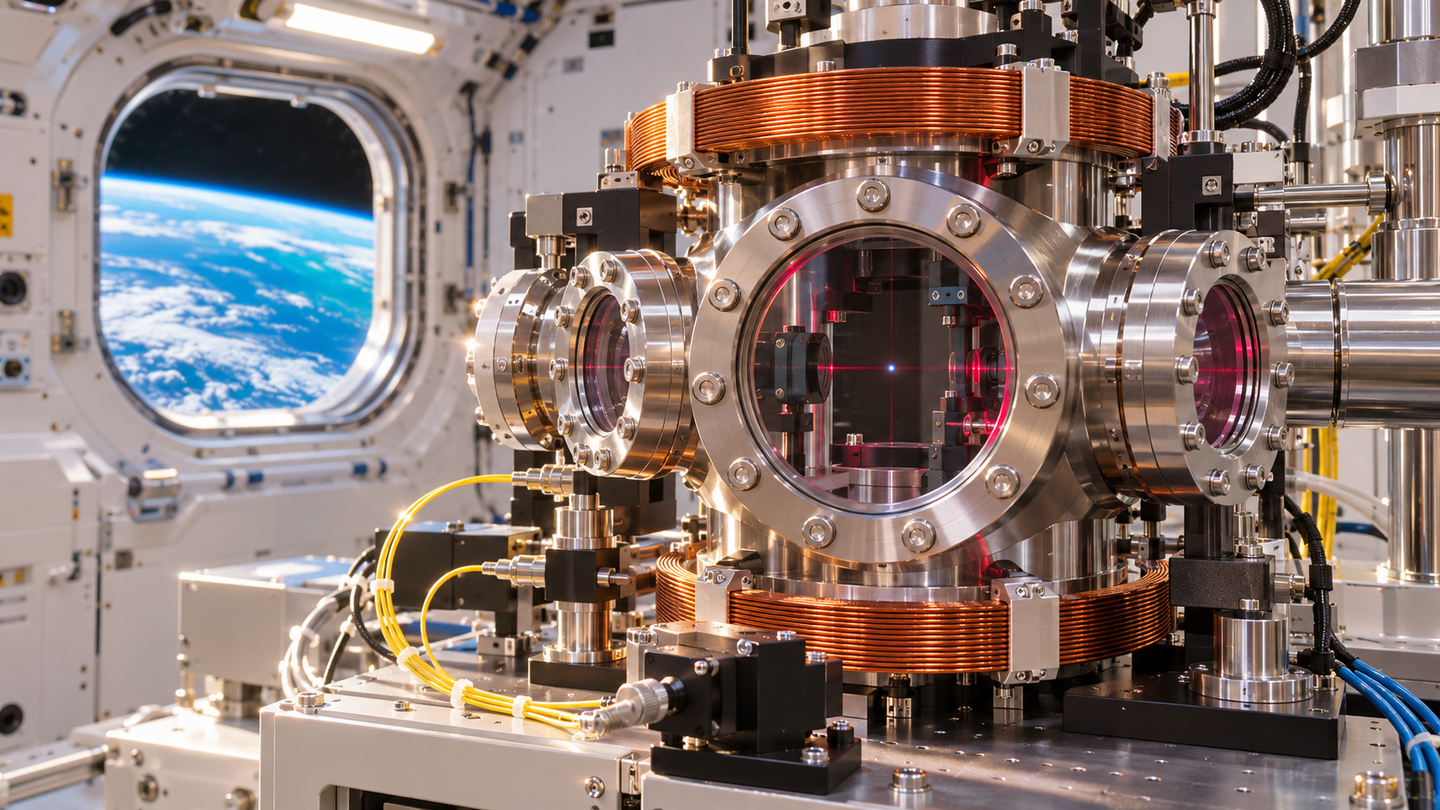
Reconstruction of an ultracold-atom experiment aboard Tiangong, where researchers used laser traps to prepare a rubidium cloud with a record-low equivalent temperature of 9.7 picokelvin. (CREDIT: The Brighter Side of News)
- Researchers aboard Tiangong produced a rubidium cloud with a record-low equivalent temperature of 9.7 picokelvin, based on its slow expansion.
- Laser traps helped create and release the quantum gas, which remained visible after seven seconds of free expansion.
- The platform could support quantum simulations and precision measurements, but those proposed experiments were not demonstrated in this study.
A tiny cloud of atoms aboard China’s Tiangong space station has pushed an extreme-cold record to a new level. Researchers measured an equivalent temperature of 9.7 picokelvin, describing how slowly the atoms spread after their confinement was switched off. One picokelvin is one-trillionth of a kelvin.
The study, published in Science, involved researchers from Peking University, the Shanghai Institute of Optics and Fine Mechanics and the Technology and Engineering Center for Space Utilization of the Chinese Academy of Sciences. Wei Xiong, Tang Li and Shengjie Jin share first authorship.
The experiment created a Bose–Einstein condensate, or BEC, using optical dipole traps in orbit. Roughly 20,000 rubidium atoms formed the final ultracold cloud. Corresponding authors Xiaoji Zhou, Weibiao Chen and Xuzong Chen helped lead the collaboration, which used Tiangong’s Cold Atom Physics Rack.
The result concerns a carefully prepared atomic sample, rather than the temperature of the station or its surroundings. It also does not mean the atoms reached absolute zero. As explained in BSN’s guide to the lower limit of cold, quantum physics makes extreme cooling more subtle than simply stopping all motion.
What the Tiangong temperature record measures
Temperature usually describes the statistical distribution of energy in a system. For an expanding quantum gas, researchers often use a different measure: equivalent temperature. They measure the cloud’s expansion, calculate the associated kinetic energy and express that energy using temperature units. It is a useful way to compare cold-atom experiments.
The Tiangong temperature record was 9.7 picokelvin, with an uncertainty extending from 7.0 to 12.9 picokelvin. That is roughly one-quarter of the previous 38-picokelvin benchmark reported in a drop-tower experiment. The authors describe their result as the lowest equivalent temperature measured, rather than a conventional thermometer reading.
Earlier work aboard the International Space Station reached an effective temperature of 52 picokelvin using magnetic confinement and matter-wave lensing. These comparisons concern particular atomic preparations and measurements. They should not be read as temperatures achieved throughout a spacecraft, an instrument rack or the surrounding vacuum.
The distinction connects the new result with earlier matter-wave cooling experiments and NASA’s Cold Atom Laboratory. In each case, the practical objective extends beyond a record number: slower expansion gives scientists more time to manipulate and examine a quantum sample.
Why microgravity changes the cooling problem
On Earth, gravity pulls an atomic cloud downward. Weakening its trap may reduce its energy, but eventually the trap cannot retain the atoms. Magnetic levitation can counter that pull, although residual magnetic curvature introduces another restriction. These effects complicate efforts to prepare gases at extremely low expansion energies.
An orbiting laboratory is continuously falling around Earth, creating a microgravity environment for experiments inside. That allows much weaker confinement without the same gravitational sag. It also provides longer opportunities to observe released atoms than terrestrial free-fall facilities, whose experimental windows end when their available drop distance runs out.
Tiangong’s apparatus sits inside the Mengtian laboratory module, launched in October 2022. It combines vacuum chambers, laser systems, magnetic coils, imaging equipment and electronic controls. The researchers used two crossed-beam optical trap arrangements, designed for different stages of the cooling process rather than a single fixed confinement volume.
Space-based quantum gases were already established through BEC production aboard the ISS. The Tiangong advance adds direct condensate preparation in an optical dipole trap under microgravity, expanding the available approaches alongside recent upgrades to NASA’s orbital laboratory.
Two laser traps bring the cloud’s energy down
The first stage combined laser cooling with evaporative cooling in a tightly focused optical trap. Evaporation lets higher-energy atoms escape, reducing the average energy of those left behind. By lowering the trap depth, the researchers brought the gas into the regime where a condensate formed.
A BEC develops when many atoms occupy the same quantum state, allowing their collective wave behavior to become measurable. Optical confinement offers flexibility because it can hold atoms in internal states that magnetic traps cannot retain in the same way. That opens additional possibilities for studying spin-dependent quantum behavior.
Microgravity also created a complication: evaporation became less efficient without gravity tilting the trap. The team applied a magnetic-field gradient during the initial cooling stage to assist selective evaporation. This produced a condensate concentrated in a magnetically insensitive internal state, reducing its sensitivity to certain magnetic disturbances.
For the next stage, the atoms moved into a wider optical trap, whose confinement was then weakened. This lowered the cloud’s expansion energy before release. The approach complements other methods used for orbital quantum-gas mixtures and matter-wave manipulation, rather than showing that one trap design fits every experiment.
Seven seconds of expansion opens a longer window
After switching off the second trap, the researchers photographed the expanding cloud from two directions. Together, those views provided its size along three spatial axes. Once interactions became negligible, the measured expansion rates supplied the information needed to calculate the cloud’s three-dimensional equivalent temperature.
The atoms remained visible after seven seconds of free expansion. That extended visibility is significant, but the temperature estimate did not rely on the entire seven-second record. The researchers fitted expansion data between 300 and 1,600 milliseconds; later images had lower signal-to-noise ratios and served to demonstrate continued visibility.
The decompression timing also mattered. A duration of 1.175 seconds gave the lowest measured expansion energy in the tested sequence. Faster decompression introduced additional excitation, while longer decompression allowed disturbances to accumulate. Finding that balance was part of making the orbital experiment work reliably.
Longer observation can help atom interferometers, which split and recombine matter waves to measure small effects. ISS interferometry experiments have already demonstrated related capabilities. NASA’s account of orbital quantum sensing explains why such instruments are useful, although visibility alone does not establish a particular precision gain.
Practical implications for quantum experiments
The Tiangong temperature record provides a platform for future research, rather than completing the proposed experiments itself. Carefully shaped laser fields could let scientists investigate unusual quantum phases or simulate complicated many-particle systems. The authors also suggest increasing atom numbers with traps whose volumes can be adjusted.
Another possibility is an atom Mach–Zehnder interferometer for testing fundamental physics. Such an instrument could contribute to studies of the equivalence principle, which underlies the expectation that different objects fall alike under gravity. The new paper did not report a completed equivalence-principle test or a new measurement of gravity.
Earlier dual-species experiments in space and pathfinder atom-interferometry measurements show the broader research direction. Turning this colder source into a working sensor will require additional control sequences, careful management of disturbances and measurements demonstrating what the complete instrument can achieve.
The Tiangong temperature record therefore combines two useful advances: exceptionally low expansion energy and prolonged observation in an optical platform. Together, they give researchers more room to prepare, manipulate and follow quantum matter. The next milestone will be using that control to answer a physics question that was previously out of reach.
Dig deeper into ultracold atoms and space quantum experiments
These resources explain orbital cold-atom facilities, earlier temperature benchmarks and atom interferometry. Entries appear from newest to oldest and exclude the current study.
NASA’s Quantum Lab Aboard Space Station Gets Chilly Upgrade
This update describes new hardware and research capabilities aboard the ISS Cold Atom Lab. (NASA, June 2026)
Pathfinder experiments with atom interferometry in the Cold Atom Lab onboard the International Space Station
Researchers demonstrate orbital atom-interferometry techniques and examine the effects of the space station’s vibration environment. (Nature Communications, August 2024)
Quantum gas mixtures and dual-species atom interferometry in space
This study reports simultaneous rubidium and potassium condensates in orbit and explores interactions and dual-species interferometry. (Nature, November 2023)
Collective-Mode Enhanced Matter-Wave Optics
This experiment established the earlier 38-picokelvin expansion-energy benchmark using matter-wave control in a drop tower. (Physical Review Letters, August 2021)
Observation of Bose–Einstein condensates in an Earth-orbiting research lab
This foundational ISS study demonstrates condensate production and extended free expansion in an orbiting laboratory. (Nature, June 2020)
Research findings are available online in the journal Science.
The original story "China’s Tiangong space station sets a record with 9.7-picokelvin quantum gas" is published in The Brighter Side of News.
Related Stories
- Beam Me Up Scotty: NASA 'Holoported' a doctor onto the International Space Station
- First fully private mission reaches International Space Station
- Space station studies into the origins of life and the early universe
Like these kind of feel good stories? Get The Brighter Side of News' newsletter.
Joseph Shavit
Writer, Editor-At-Large and Publisher
Joseph Shavit, based in Los Angeles, is a seasoned science journalist, editor and co-founder of The Brighter Side of News, where he transforms complex discoveries into clear, engaging stories for general readers. With vast experience at major media companies like The Los Angeles Times, Times Mirror and Tribune Publishing, he writes with both authority and curiosity. His writing focuses on space science, planetary science, quantum mechanics, geology. Known for linking breakthroughs to real-world markets, he highlights how research transitions into products and industries that shape daily life.