CERN’s upgraded detector finds evidence of a one-in-10-billion particle decay
An upgraded LHCb detector has revealed evidence of a beauty meson decay predicted once in 10 billion cases, giving physicists a sharper test of existing theory.

 Edited By: Joshua Shavit

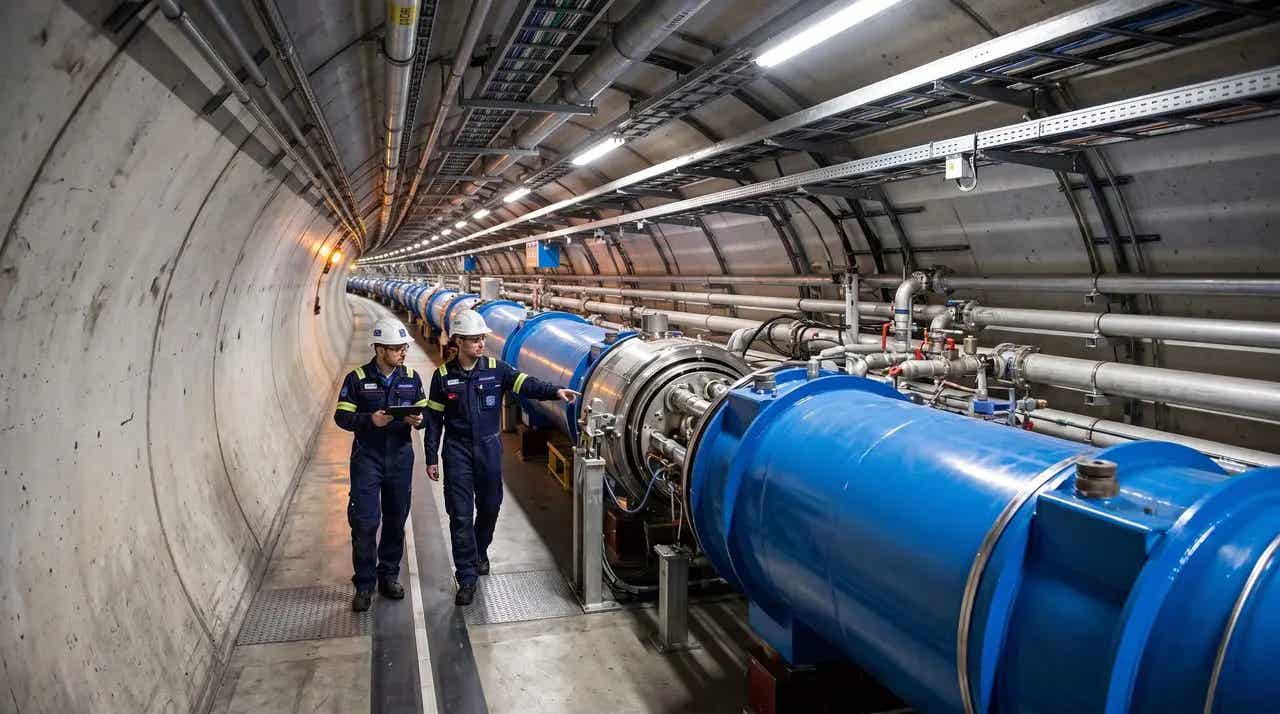
Inspectors examining equipment in the LHCb underground cavern. Upgraded detector technology helped physicists identify evidence of an exceptionally rare beauty meson decay into two muons. (CREDIT: CERN)
- LHCb has found the first single-experiment evidence of a beauty meson decaying into two muons, a process predicted roughly once per 10 billion such mesons.
- An upgraded detector, including the UK-built Vertex Locator, helped separate the rare signal from other collision activity.
- The result agrees with the Standard Model and reaches 3.2 sigma, below the threshold required for a discovery.
A particle that almost never decays into two muons has finally left a signal strong enough to count as evidence. After a search spanning more than four decades, CERN’s LHCb collaboration has identified the extraordinarily rare transformation in its own collision data. Physicists expect it only about once in every 10 billion decays of the relevant particle.
The result concerns a neutral beauty meson called Bd, also written B0. The collaboration describes its analysis in a preprint submitted to Physical Review X. Its statistical strength falls short of a discovery, and the measurements agree with existing theory rather than revealing an unexpected particle.
The achievement depended on an international detector upgrade, with important contributions from the University of Liverpool and the University of Manchester. Their work helped LHCb record collisions faster and reconstruct fleeting particle journeys more precisely. Together, those improvements made an exceptionally faint signal easier to distinguish from the surrounding activity.
Why this rare beauty decay matters
LHCb studies particles containing beauty quarks, heavier relatives of the up and down quarks found in ordinary matter. These particles form during high-energy collisions inside the Large Hadron Collider. They survive only briefly before transforming into other particles, leaving researchers to reconstruct their identities from what remains.
In the decay under investigation, the final products are a muon and its antiparticle. Muons resemble electrons but are heavier. The important quantity is the branching fraction, the probability that a particle follows one particular decay route rather than another.
The Standard Model describes known fundamental particles and their electromagnetic, weak and strong interactions. It is a powerful framework, but not a complete account of nature. Gravity lies outside it, and important questions remain about the matter that fills the universe.
The Standard Model predicts that this route is extremely unlikely. That rarity makes it valuable because additional particles could influence its probability through quantum effects. Such particles might be too heavy to produce directly at the collider, yet still change how known particles behave.
This creates an indirect search strategy alongside efforts to make new particles in collisions. Physicists compare a measured decay probability with a theoretical prediction and examine any mismatch. Agreement also matters, since it restricts how strongly hypothetical particles could influence the process.
A detector five millimeters from the beams
The upgraded experiment includes the Vertex Locator, or VELO, a silicon pixel detector assembled by the Liverpool team. It sits just five millimeters from the LHC beams. From that position, it helps track particles emerging from collisions and identify where short-lived particles decay.
Those locations provide essential clues about what happened. Researchers need to distinguish a particle’s production point from the place where it transformed into daughter particles. VELO supplies precise tracking information that helps the wider experiment reconstruct this sequence amid many overlapping signals.
Liverpool physicist Tara Shears, the LHCb-UK spokesperson, credited the staff who built the detector. She described the result as evidence of their skill and craftsmanship. The benefit extends across the collaboration because researchers analyzing different processes can use the same precise tracking measurements.
Manchester researchers also contributed detector technology and construction expertise to the international project. Stefano De Capua, who led detector construction there, said the effort involved nearly 90 UK companies. Chris Parkes led the collaboration through construction of the upgrade and its approval of the new result.
More data, with less background
The upgrade lets LHCb collect data at up to five times its earlier rate. Increased recording capacity is especially important when the target decay occurs so rarely. The same upgraded experiment also supports other investigations of short-lived particles, making the detector improvements useful beyond this analysis.
The collaboration must therefore improve both the quantity and usefulness of its measurements. More collisions provide more chances for the desired process, while precise tracking helps researchers interpret those chances. Neither task replaces the other when only a tiny share of decays follow the route being sought.
Speed alone does not establish a rare decay. Other processes can produce signals that resemble the desired outcome, creating what physicists call background. Improved particle identification and machine-learning techniques helped the team suppress this background while retaining candidate decays.
The new analysis used proton collisions recorded in 2024 and 2025. Those data alone produced evidence at three standard deviations, or three sigma. Combining them with earlier LHCb measurements raised the significance to 3.2 sigma, above the conventional evidence threshold but below discovery level.
Five sigma remains the standard benchmark for claiming a discovery in particle physics. The distinction reflects how convincingly an apparent signal can be separated from background fluctuations. It does not mean researchers have found a new force with 3.2-sigma significance; the evidence concerns the decay itself.
What the earlier search established
The phrase “first evidence” needs an important qualification. A previous joint analysis from LHCb and CMS, reported in Nature, had already suggested the Bd decay. Later measurements did not confirm that hint, so the new milestone is specifically the first evidence from a single experiment.
That earlier collaboration also established a related process, Bs decaying into two muons. Bs and Bd are different beauty mesons, and the Bs route occurs more often. Measuring both offers complementary ways to test the theory rather than treating every beauty-particle decay as interchangeable.
The latest analysis also produced the most precise measurements yet of the Bs decay probability and effective lifetime. Both quantities agree with Standard Model expectations. Lifetime measurements add information because possible new interactions need not change every property of a decay in the same way.
For now, the measurements tighten constraints rather than establish a contradiction. They narrow the room available to some explanations involving undiscovered particles. As with other searches for new physics, the conclusion applies to what the experiment can test, rather than excluding every possible extension of existing theory.
What exploring the Zeptoverse means
Researchers describe the opportunity as probing the “Zeptoverse,” referring to distances around a billionth of a trillionth of a meter. This is a scale at which unknown physics might leave indirect effects. The detector is not photographing a hidden realm or resolving tiny particles as visible objects.
Its task is to measure familiar processes accurately enough to expose unfamiliar influences. That requires increasingly detailed reconstructions of particle collisions, along with reliable predictions for comparison. The present result shows how instrument improvements can extend that approach without immediately producing a theoretical surprise.
Manchester physicist Conor Fitzpatrick called the decay a promising route for investigating effects beyond current knowledge. The aim is to turn the elusive signal into a dependable precision measurement. That step requires further evidence rather than a stronger label for the present result.
More data should strengthen the test and establish whether the Bd signal reaches discovery significance. A further planned LHCb upgrade could increase collection rates by another factor of 10. The next challenge is to confirm the decay, then measure its frequency precisely enough to learn whether an unseen influence is present.
Dig deeper into rare particle decays
These resources explain the detector upgrades, earlier milestones and theory behind the search.
LHCb Upgrade II Scoping Document
An overview of the design choices and scientific goals for the next major detector upgrade. (LHCb, April 2025)
Upstream Tracker closing completes installation of the LHCb Upgrade 1 detector
Explains how tracking systems help reconstruct particles and support rapid selection of collision events. (LHCb, April 2023)
First single experiment observation of the decay Bs0→ μ+μ-
Describes the earlier single-experiment milestone for the related Bs decay and its role in precision tests. (LHCb, February 2017)
Observation of the rare Bs0 → μ+μ− decay from the combined analysis of CMS and LHCb data
The foundational joint analysis established the Bs decay and reported the earlier, subsequently unconfirmed Bd hint. (Nature, May 2015)
The Standard Model
CERN introduces the particles and interactions described by the theory these measurements test. (CERN)
The original story "CERN’s upgraded detector finds evidence of a one-in-10-billion particle decay" is published in The Brighter Side of News.
Related Stories
- CERN scientists find no evidence that the Large Hadron Collider created microscopic black holes
- Physicists find Einstein’s 'spooky' quantum effect inside Higgs boson decays
- CERN physicists recreate matter from the early universe using ‘Little Big Bangs’
Like these kind of feel good stories? Get The Brighter Side of News' newsletter.
Joseph Shavit
Writer, Editor-At-Large and Publisher
Joseph Shavit, based in Los Angeles, is a seasoned science journalist, editor and co-founder of The Brighter Side of News, where he transforms complex discoveries into clear, engaging stories for general readers. With vast experience at major media companies like The Los Angeles Times, Times Mirror and Tribune Publishing, he writes with both authority and curiosity. His writing focuses on space science, planetary science, quantum mechanics, geology. Known for linking breakthroughs to real-world markets, he highlights how research transitions into products and industries that shape daily life.