AI uses Northridge and Kobe earthquake records to spot hidden building risks
A five-story building simulation shows why earthquake shaking, soil conditions and column capacity need to be assessed together, with engineers in control.
 UEL Writer: Kiera Hay


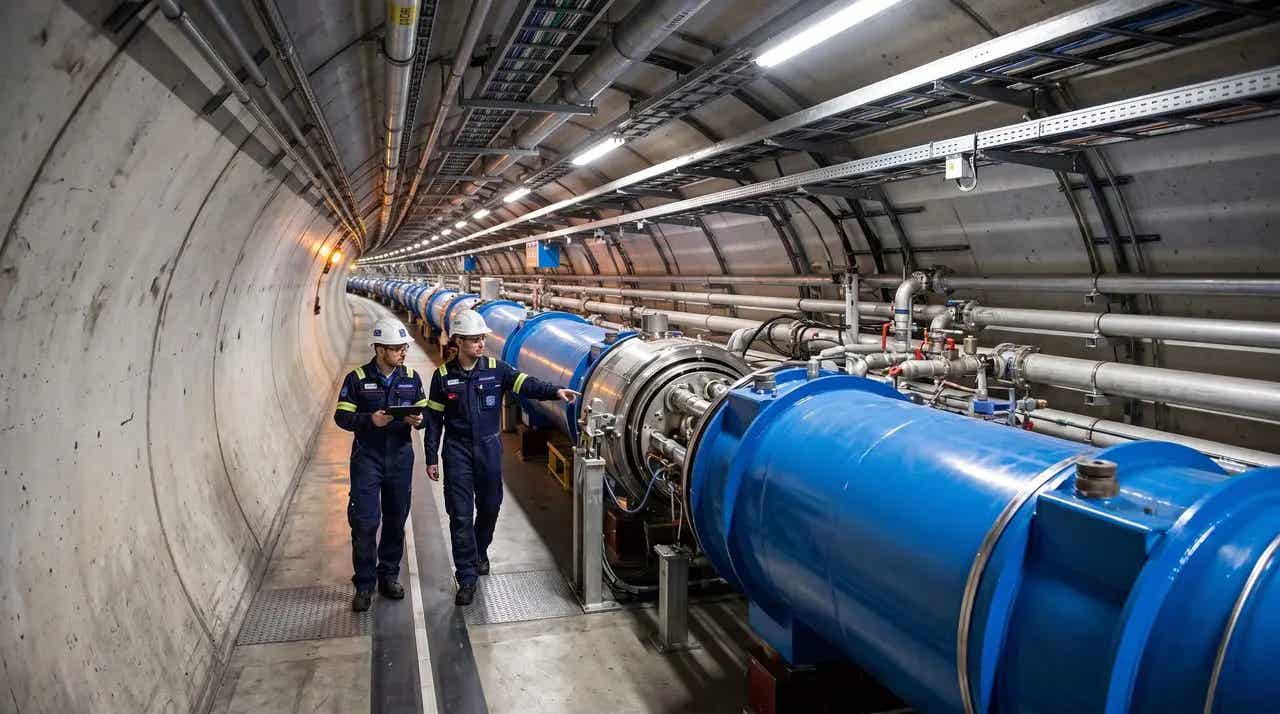
An engineer reviews a structural model beside a concrete building in this illustrative scene. A University of East London study connects soil conditions, earthquake shaking and column capacity to assess seismic vulnerability. (CREDIT: The Brighter Side of News)
- A human-supervised engineering framework connects soil interpretation, earthquake recordings, building simulations and concrete-column checks.
- Tests using Northridge and Kobe records showed that a 3.4-fold difference in spectral demand produced only 32% higher maximum drift.
- The proof of concept used one soil profile and two recordings, with manual transfers between tools and further validation needed.
A building’s response to an earthquake cannot be read from the strength of the shaking alone. The ground beneath it, its preferred rhythm of vibration and its columns all matter. A new engineering framework brings those considerations into one assessment, highlighting vulnerabilities that a building-wide movement calculation could leave unexplained.
Led by Dr. Jawed Qureshi, a senior lecturer in structural engineering and design at the University of East London, the research appears in Buildings. The team tested a computer model of a five-story reinforced-concrete frame. Its workflow connects four specialist tools, from interpreting soil measurements to checking the deformation capacity of construction materials.
The researchers describe their approach as Proto-Artificial General Intelligence, or Proto-AGI. That name refers to their proposed framework for coordinating different engineering tasks. The demonstration itself remained human-directed, with engineers transferring information and interpreting results rather than an autonomous AI making structural decisions.
The central question was whether reading specialist results together could produce a more informative assessment. A movement calculation describes what the frame does during a particular input. A separate capacity calculation asks what a component can withstand. Connecting them helps explain both the apparent reserve in the modeled response and the conditions that might limit it.
Following the chain from soil to structure
The workflow starts with a cone penetration test, which measures resistance as an instrument pushes into the ground. A Viktor.ai application interprets those measurements to classify soil layers. Understanding underground conditions helps engineers assess how a site might influence shaking, although this study’s soil assessment remained qualitative rather than a full calculation of local amplification.
A second tool, the Fayaz RotD script, examines the directional characteristics of recorded ground motion. It rotates two horizontal components mathematically to calculate shaking measures across different orientations. OpenSeesPy then simulates the building’s response, while another Viktor.ai application checks the capacity of a reinforced-concrete column under combined loading and bending.
Together, the tools connect questions that engineers often address in separate software. However, the building model had a fixed base, and the researchers did not simulate a fully coupled soil-and-foundation system. Soil interpretation therefore provided context, without demonstrating the complete physical interaction between deforming ground, foundations and the building above them.
The soil investigation extended 17 meters below the surface and identified three distinct layers. Their depth and contrasting stiffness informed the researchers’ interpretation of potential amplification. Quantifying that effect would require additional information, including the speed of shear waves through the ground, and a site-response analysis. Those missing calculations remain important before drawing site-specific conclusions.
What two earthquake records revealed
The researchers selected recordings from California’s 1994 Northridge earthquake and Japan’s 1995 Kobe earthquake. These captured different ground-movement characteristics, including a near-fault Northridge record and a more distant Kobe record. Both recorded inputs were applied to the model without changing their amplitude, allowing the team to compare how the same modeled structure responded to those particular inputs.
The frame’s natural period was 0.41 seconds, approximately the time needed for one vibration cycle. Near that period, the Northridge recording produced roughly 3.4 times the Kobe recording’s median spectral demand. Here, “median” describes the middle value across shaking directions, not an average across California earthquakes or a measure of earthquake magnitude.
Yet maximum interstory drift was only about 32% higher under the Northridge input. Drift measures how far one floor moves sideways relative to the floor below, divided by story height. It reached 0.45% under Northridge and 0.34% under Kobe, with the largest values occurring at the second story in both simulations.
The simulations also tracked roof displacement through time, revealing different motion patterns under the two records. Northridge produced a strong pulse, while Kobe produced more sustained oscillations. These differences help explain why a single comparison of spectral values cannot fully describe the response. The reported ratios summarize this particular model and these inputs, rather than a universal conversion between shaking and damage.
Small movements can conceal another constraint
Both drift results fell below the 1% immediate-occupancy threshold used in the study’s performance comparison. That classification applies to the modeled response under the selected records. It does not certify a real building as safe or establish how every component would behave during a different earthquake, particularly one with more demanding characteristics.
Checking a ground-floor column added a different perspective on structural strength. The analysis examined how far the section could continue bending after its reinforcement began yielding. Its curvature ductility factor was 2.3, below the study’s cited recommended minimum of 3 for seismic columns, indicating limited capacity for additional inelastic deformation.
That distinction matters when assessing building materials and structural components together. A frame can show modest overall movement while a column has restricted deformation capacity. Reading those results together identifies a potential constraint under stronger loading, although the study did not establish the precise shaking level at which that column would fail.
What the AI label actually means
The paper’s terminology needs a careful distinction between software coordination and machine intelligence. OpenSeesPy and the RotD script perform deterministic numerical calculations. The Viktor.ai applications use rule-based engineering calculations configured through natural language, an interface that can make computer modeling more accessible without making the underlying calculations independently intelligent.
The authors use Proto-AGI to describe coordination across engineering disciplines, rather than demonstrating the broad capabilities associated with adaptive AI systems. Engineers connected the outputs at every boundary between tools. No component independently selected a complete assessment strategy, revised the other models or took responsibility for the final interpretation.
“The goal was never to replace engineering judgement with AI,” Qureshi said. “It was to give engineers a clearer, more complete picture before they make their decisions. That is what this research delivers.” The practical contribution is a documented approach to joining calculations, with human expertise still essential to interpreting their assumptions and limits.
Testing beyond a demonstration
The analysis used one soil profile and two earthquake recordings chosen for contrasting characteristics. Those inputs cannot represent the full variety of sites or earthquake scenarios engineers encounter. Larger sets of recordings, different structures and more detailed site calculations would be needed to assess how reliably the workflow generalizes.
The researchers also interpreted the smaller drift difference qualitatively through factors including frequency content, pulse characteristics and nonlinear structural behavior. They did not calculate the energy dissipated through repeated inelastic deformation to establish each contribution. Future work could combine those checks with inspection photographs, written reports and structural monitoring data, extending beyond the numerical inputs used here.
Automating transfers between tools is another proposed step, alongside tracking uncertainty as information passes through the assessment. For now, the study offers a limited demonstration of coordinated engineering analysis. The next test is whether broader, independently checked cases preserve that useful connection between site conditions, building movement and the component limits that can govern performance.
Dig deeper into earthquake engineering and human-supervised computation
These resources explain the calculations, recorded motions and professional responsibilities behind seismic assessment.
Policy statement 573 - Artificial Intelligence and engineering responsibility
This professional policy explains why engineers retain responsibility for safety and judgment when using AI. (American Society of Civil Engineers, July 2024)
The Effect of Soil-Structure Interaction on the Seismic Response of Structures Using Machine Learning, Finite Element Modeling and ASCE 7-16 Methods
This research compares approaches for examining how soil and structures influence earthquake response. (Sensors, February 2023)
Earthquake Hazards 201 - Technical Q&A
These explanations distinguish ground acceleration, spectral acceleration and factors affecting building response. (U.S. Geological Survey, August 2019)
PEER Strong Ground Motion Databases
This resource describes the recorded earthquake motions used to analyze buildings and other infrastructure. (Pacific Earthquake Engineering Research Center)
Open System for Earthquake Engineering Simulation - Home Page
The project website introduces the open-source framework behind structural and geotechnical earthquake simulations. (OpenSees)
Research findings are available online in the journal Buildings.
The original story "AI uses Northridge and Kobe earthquake records to spot hidden building risks" is published in The Brighter Side of News.
Related Stories
- Scientists solve the 30-year mystery of 'clockwork' earthquakes
- Scientists create the first global map of rare, deep-mantle earthquakes
- Tiny earthquakes reveal hidden faults where San Andreas meets Cascadia
Like these kind of feel good stories? Get The Brighter Side of News' newsletter.
Shy Cohen
Writer