Why cold has a limit, even if the universe does not
Absolute zero sets a limit on cold, even if space expands forever. Learn why cosmic radiation keeps cooling and whether the universe can ever reach zero kelvin.

 Edited By: Joshua Shavit

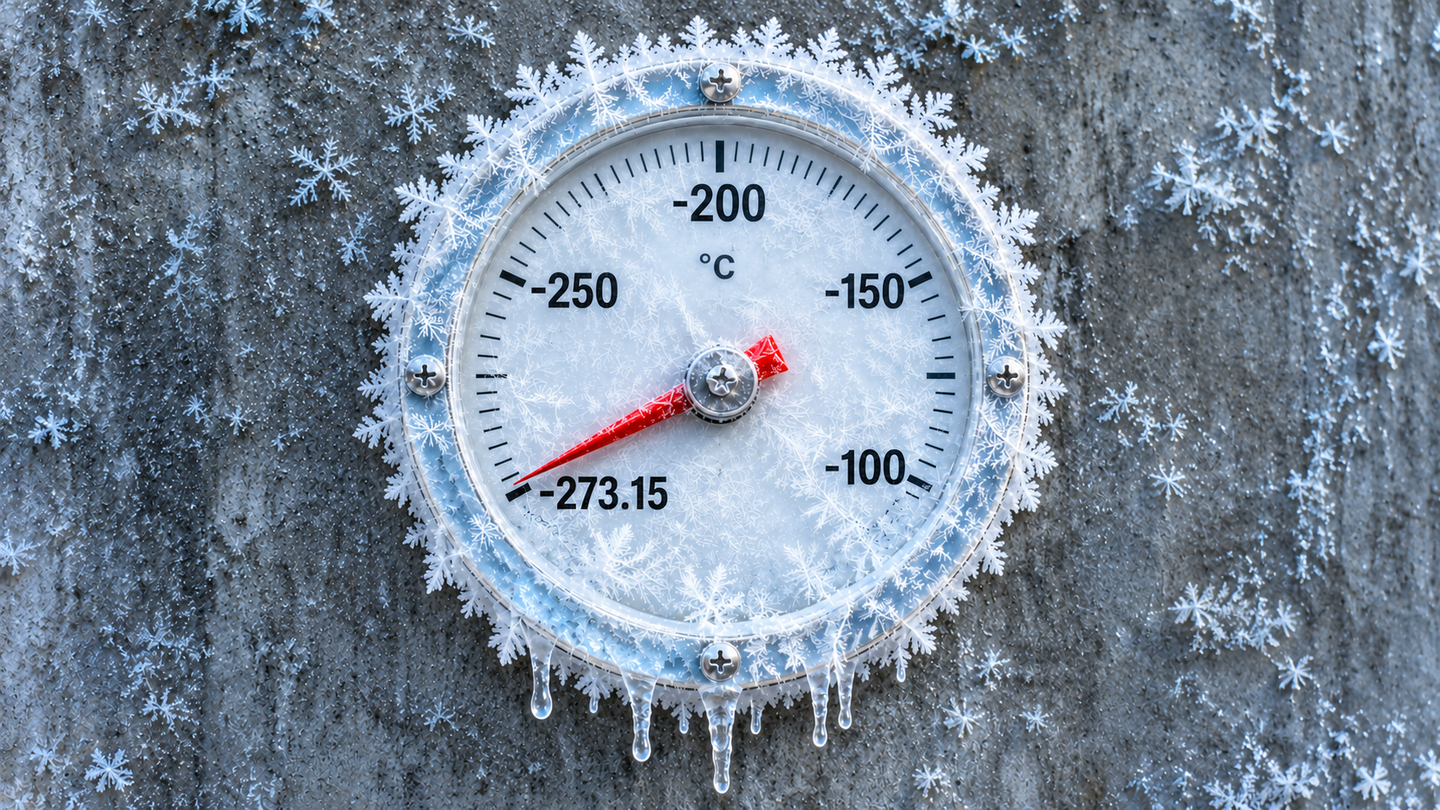
A frost-covered conceptual thermometer points near absolute zero, −273.15°C, the lowest possible temperature. (CREDIT: The Brighter Side of News)
- Absolute zero is the coldest limit of ordinary temperature, where a system occupies its lowest available energy state.
- Gas experiments helped scientists identify the boundary, while quantum physics explains why some motion survives there.
- Cosmic expansion cools background radiation, but standard cosmology does not predict that the universe reaches absolute zero.
A freezer turns water into ice. Laboratory refrigerators go much colder. Why can’t better refrigerators keep lowering temperatures forever?
Numbers suggest no stopping point. Count backward past zero and there is always another negative number. If the universe may be infinite, why should cold have a limit?
Absolute zero is −273.15 degrees Celsius, or −459.67 degrees Fahrenheit. The freezer offers a starting point. What changes when something gets colder?
What the freezer takes away
Water molecules constantly move, even when a glass looks still. Freezing organizes them into a structure, but they still vibrate. Further cooling reduces those thermal vibrations.
A freezer transfers energy from its interior into the warmer room. It does not pour a substance called cold into the ice. It removes energy, bringing the material closer to its lowest possible energy state, called the ground state.
Absolute zero is the lowest possible temperature, where a system has no thermal energy above its ground state. Once there, no further energy can be removed through cooling. It is a limit on thermal energy, not a requirement for empty space.
A collection of atoms would be at absolute zero if it occupied that lowest permitted energy state. The atoms would still exist and could retain energy and quantum motion. What would be absent is the thermal excitation that raises their energy above that minimum.
Why nothing can be colder than absolute zero
Quantum physics adds a restriction: a system can occupy only the energy states its physical laws permit. Cooling reduces the population of higher-energy states. Going below absolute zero would require a state beneath the lowest permitted one, which is precisely what the system does not possess.
Picture a staircase with a bottom step. Descending brings someone closer to that step, but a stronger push cannot produce another step beneath it. A refrigerator likewise transfers energy; it cannot create a new, lower energy state for the material it cools.
The remaining quantum motion is called zero-point motion. As the National Institute of Standards and Technology explains, it is not heat-driven. A stronger refrigerator cannot remove it, because it belongs to the ground state itself.
Who worked out where the bottom was
French physicist Guillaume Amontons found an early clue in the 1700s: cooling air reduced its pressure. Gas particles produce pressure by striking their container’s walls. Cooling a gas in a fixed container reduces the average energy of those impacts.
A balloon generally shrinks when cooled and expands when warmed. Extending gas measurements toward colder temperatures suggested a common endpoint. Real gases liquefy or solidify first, so a balloon would not actually shrink into nothing.
William Thomson, later called Lord Kelvin, helped establish an absolute temperature scale in 1848, placing the boundary near −273 degrees Celsius. The modern Kelvin scale starts there: absolute zero is exactly 0 kelvin, written 0 K. A change of one kelvin equals one Celsius degree, but the scales begin at different places.
Where negative numbers belong
Negative numbers raise an objection: why can’t temperatures also fall below zero? They can on the Celsius scale, where zero marks water’s freezing point. But a winter day at −20 degrees Celsius is 253.15 K, well above absolute zero.
Distance offers a useful comparison: a separation cannot be negative, even though negative numbers exist. Ordinary temperature similarly has a lower boundary. Infinitely many values fit between 0 K and 1 K, so an infinite range of values can still have a bottom.
Negative Kelvin temperatures also exist in specially prepared systems, but they do not extend the cold range. Researchers at Ludwig Maximilian University of Munich and the Max Planck Institute of Quantum Optics demonstrated such a state in Science. Their atoms favored higher-energy states over lower ones within a restricted range of accessible energies.
That reversed distribution produces a negative temperature in its statistical description. Such a system would transfer heat to positive-temperature systems. It is hotter, rather than a colder state reached by cooling through zero.
Getting closer without arriving
Knowing where the boundary lies does not mean a refrigerator can reach it. The unattainability principle, a formulation of the third law of thermodynamics, rules out reaching absolute zero through a finite physical cooling process. Scientists can approach it without arriving exactly there.
Cooling already has practical value. Researchers use ultracold atoms to study quantum behavior. Webb’s Mid-Infrared Instrument operates below 7 K, suppressing signals from its own warmth to detect faint light.
Whether heat has an upper limit
Can heating continue forever? In many standard models, positive temperature has no finite ceiling: adding more energy can keep raising it. But an unlimited range in an equation does not establish that nature can realize every temperature in that range.
Heating also changes the material being heated. Molecules can break apart, and atoms can lose their electrons, so an extremely hot gas no longer behaves like the air in a kitchen. At roughly 1.4 × 10³² K, the Planck temperature, understanding the physics requires a quantum description of gravity that remains incomplete.
That scale is not a proven maximum matching the certainty of absolute zero. The careful answer is that ordinary models allow temperatures to rise without bound, while the ultimate physical limit remains unresolved. Infinity itself is not a temperature that an oven, star or experiment could reach.
Why the expanding universe gets colder
An expanding universe need not be infinite; astronomers do not know its full extent. A finite universe can expand, and an infinite one can expand too. Either way, increasing distances between unbound galaxies do not give matter an energy state beneath its ground state.
Expansion does, however, cool the cosmic microwave background, the radiation left from the early universe. Its temperature today is about 2.725 K. Space stretches the radiation’s wavelengths, reducing the energy of its photons, light packets.
When cosmic distances double through expansion, that background temperature halves. Another doubling halves it again: roughly 2.7 K becomes 1.35 K, then 0.675 K. This describes the background radiation, not every object; stars and other local systems can remain hot.
Will endless expansion ever reach absolute zero?
Following that pattern leads to the final question: if expansion continues forever, will the universe eventually reach absolute zero? In standard ever-expanding models, the cooling background does not reach zero at any finite time. Each finite expansion leaves a positive temperature, however small.
Even a trillion halvings leave a positive remainder. Mathematically, the temperature approaches zero as a limit. Infinity is not a future date when that remainder disappears.
Constant dark energy adds another complication in the usual cosmological model. Accelerated expansion produces a cosmic event horizon, beyond which signals emitted now can never reach an observer. Quantum theory associates this horizon with a nonzero temperature.
Gary Gibbons and Stephen Hawking established this horizon-temperature connection in work published in Physical Review D. If that model describes the far future, an observer’s surroundings approach a nonzero horizon temperature even as the original background radiation fades. That prediction depends on dark energy’s long-term behavior, which remains uncertain.
The answer is no in the standard picture. The original background approaches zero, while constant dark energy supplies a nonzero horizon temperature. Neither implies one uniform temperature everywhere.
That is why cold has a limit, even if the universe does not. Absolute zero allows matter and quantum motion, but no thermal excitation above the ground state. Endless expansion can drive background radiation toward that boundary without reaching it, just as repeated halving never makes a positive number zero.
Dig deeper into absolute zero
These resources explain temperature measurement, cosmic cooling and the universe’s possible thermal future.
Kelvin: Introduction
Explains the absolute temperature scale and why quantum motion can persist at zero kelvin. (NIST, updated January 2026)
How Big is Space? We Asked a NASA Expert: Episode: 61
Distinguishes the observable universe from the unknown extent of the entire universe. (NASA, May 2025)
How Low Can Temperature Go? Lord Kelvin and the Science of Absolute Zero
Connects historical gas experiments with modern laser cooling and precision measurements. (NIST, June 2024)
Quantum thermodynamics of de Sitter space
Examines the thermal environment predicted for observers in an idealized, exponentially expanding universe. (Physical Review D, December 2023)
Expansion of the Universe
Explains how expansion stretches photons’ wavelengths and lowers the cosmic background temperature. (University of Chicago)
The original story "Why cold has a limit, even if the universe does not" is published in The Brighter Side of News.
Related Stories
- New, cold-resistant, metal alloys tolerate extreme temperatures up to −253°C
- The universe was already warm before the first stars lit the sky
- 6,800 feet below ground, in the search for dark matter, something has gone very, very cold
Like these kind of feel good stories? Get The Brighter Side of News' newsletter.
Joseph Shavit
Writer, Editor-At-Large and Publisher
Joseph Shavit, based in Los Angeles, is a seasoned science journalist, editor and co-founder of The Brighter Side of News, where he transforms complex discoveries into clear, engaging stories for general readers. With vast experience at major media companies like The Los Angeles Times, Times Mirror and Tribune Publishing, he writes with both authority and curiosity. His writing focuses on space science, planetary science, quantum mechanics, geology. Known for linking breakthroughs to real-world markets, he highlights how research transitions into products and industries that shape daily life.