Climate change is literally changing the way Earth spins, scientists warn
Geophysical Research Letters study used polar motion to check groundwater depletion estimates, linking lost underground water to nearly 80 centimeters of rotational-pole drift.

 Edited By: Joshua Shavit

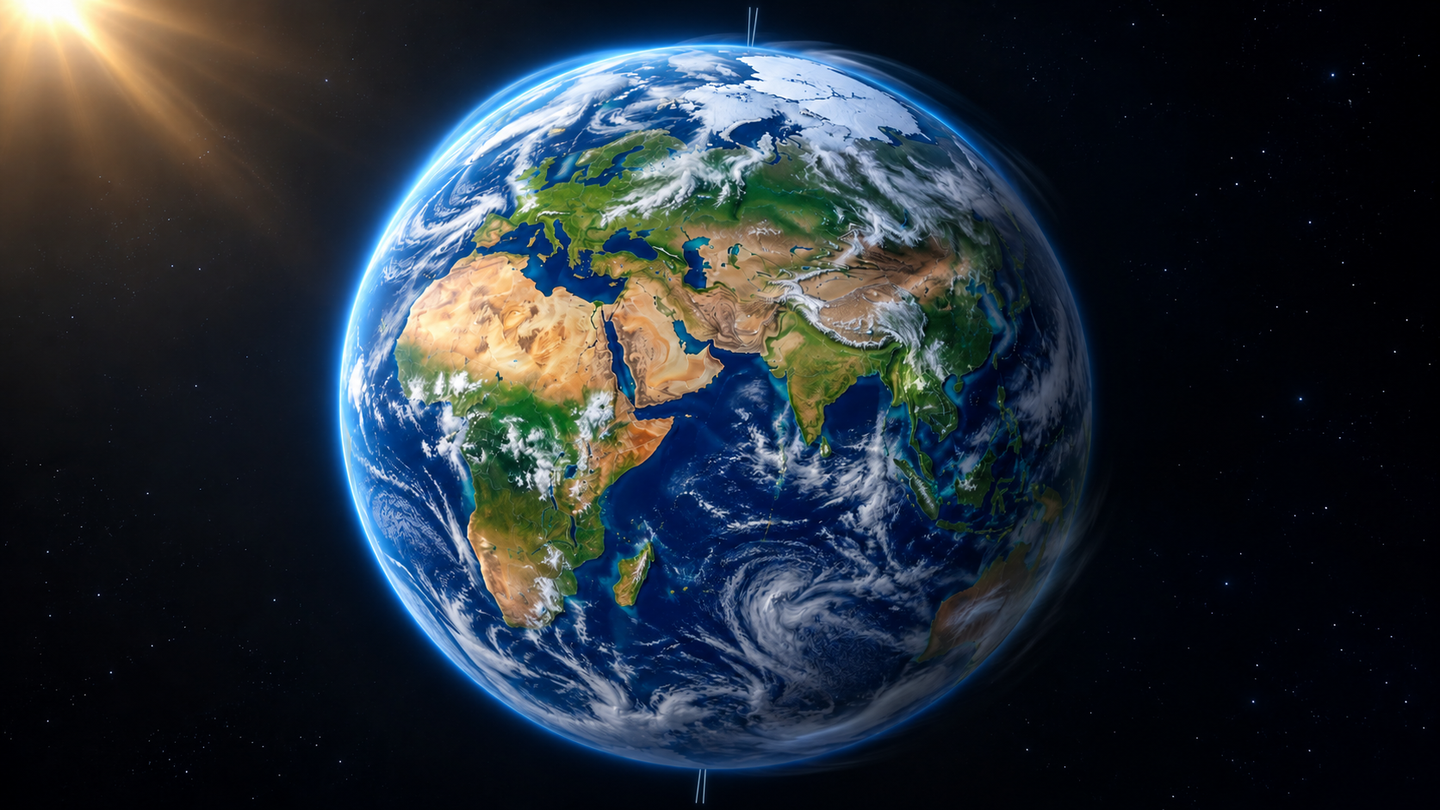
An artistic view of Earth uses subtle axis lines to illustrate polar motion linked to groundwater depletion. The lines are conceptual and not to scale. (CREDIT: The Brighter Side of News)
- The study links groundwater depletion to roughly 78.5 centimeters of eastward rotational-pole drift between 1993 and 2010.
- Including an estimated 2,150 gigatons of depleted groundwater brought modeled polar motion into much closer agreement with observations.
- The findings support groundwater’s contribution to sea-level rise, without indicating a dangerous change in Earth’s seasonal tilt.
Water pumped from an underground aquifer can irrigate a field or supply a city. Across the planet, those withdrawals also move enough mass to leave a measurable signature in Earth’s rotation. Researchers linked groundwater depletion between 1993 and 2010 to nearly 80 centimeters of drift in the planet’s rotational pole.
The study, published in Geophysical Research Letters, was led by Ki-Weon Seo of Seoul National University. His team compared observed polar motion with calculations of how water, ice and other processes redistribute mass. Groundwater helped explain a mismatch that remained without it.
The result adds a planetary perspective to groundwater loss. Groundwater pumping also contributed an estimated 6.24 millimeters to global mean sea-level rise during the study period. Water transferred from land joins other contributions, including polar ice loss, in raising ocean mass.
The 80-centimeter figure needs careful interpretation. It describes the rotational pole’s position relative to Earth’s crust, not a large change in the angle responsible for the seasons. Nor does it mean the whole planet moved sideways through space. The signal concerns the changing balance of a rotating world.
Groundwater pumping changes how Earth’s mass is arranged
Earth rotates around an axis, and that axis meets the surface at the rotational poles. Those locations move relative to the crust through a process called polar motion. Redistributing weight changes the planet’s balance, much as shifting a small weight can affect a spinning object.
Water is one source of that redistribution. Underground storage can decline when withdrawals exceed replenishment. After extraction, water moves through farms, rivers, the atmosphere and other parts of the water cycle. Over time, some of the water lost from continental storage reaches the oceans, altering the global arrangement of mass.
Related research on Earth’s rotation also examines how moving water and ice affects the planet. Different measurements capture different effects, however. A change in rotational speed, expressed through day length, is distinct from the position of the rotational pole investigated here.
The researchers calculated how changes in groundwater storage on land, together with the associated redistribution into the oceans, should affect polar motion. They then combined that prediction with other contributions. The goal was to explain a measured trend using independently estimated changes in the planet’s water and ice.
A missing contribution comes into view
Earlier modeling estimated net groundwater depletion of 2,150 gigatons during 1993–2010, equivalent to about 2.15 trillion metric tons. That number represents lost groundwater storage, rather than the total amount extracted. Some pumped water returns underground, and recharge replenishes part of what people withdraw.
Checking such estimates globally is difficult. Monitoring wells cover only parts of the world, and measurements vary in availability. Satellite gravity observations offer another perspective on freshwater storage, but the GRACE mission began in 2002. It could not directly observe the entire earlier study period.
Seo’s team therefore used the pole’s motion as an independent constraint. Their calculations included ice sheets, mountain glaciers, soil moisture and water impounded behind dams. They also accounted for atmospheric and oceanic effects and the solid Earth’s continuing adjustment to past ice-sheet changes. Groundwater was one part of a larger budget.
With groundwater included, the modeled trend agreed much better with observations. Its estimated contribution was about 4.36 centimeters annually toward 64.16 degrees east longitude, totaling roughly 78.5 centimeters. This agreement strengthens the case that aquifer depletion was large enough to influence both rotation and sea level.
The location of water matters as much as its amount
Equal masses do not have equal effects wherever they move. Their influence depends on where they start and finish relative to the rotation axis. In the study, groundwater redistribution in the middle latitudes had a particularly strong effect on the rotational pole’s drift.
Western North America and northwestern India stood out as major areas of depletion during the analysis period. Their locations helped give groundwater a substantial rotational signature. The findings connect regional water use with a global measurement, showing why a worldwide total alone cannot fully describe the physical consequences.
These regional pressures belong within a wider discussion of water scarcity. Yet polar motion cannot identify an individual well’s withdrawal or replace local monitoring. It tests large-scale patterns after researchers estimate the contributions of other moving masses.
The sea-level response is geographically uneven, too. Losing land-based water changes gravitational attraction and deforms Earth, affecting nearby ocean levels differently from distant ones. Research on rivers likewise illustrates the importance of geography in water movement. The 6.24-millimeter estimate is a global average, not a uniform coastal rise.
A detectable signal does not mean changing seasons
The rotational pole naturally moves several meters over roughly a year. Groundwater’s smaller contribution emerges through careful analysis of the longer-term drift. Its scientific importance comes from what it reveals about water redistribution, rather than from evidence that ordinary seasonal conditions are about to change.
Earth’s seasonal cycle involves its orientation and orbit relative to the Sun. This study did not identify groundwater-driven changes capable of rearranging that cycle. Likewise, it did not measure a comparable change in the magnetic pole, which belongs to a different physical system.
Large shifts discussed over geological timescales concern different magnitudes and histories. They should not be confused with this decades-long calculation. Here, groundwater ranked second among the modeled contributions to the polar-motion excitation trend, behind the solid Earth’s adjustment to ancient ice loss.
The calculation also has limits. The authors did not include natural-lake storage changes, mantle convection or earthquake effects in their accounting. Those processes could help explain remaining differences. Testing several alternative ice-loss and Earth-adjustment estimates nevertheless preserved the main finding: omitting groundwater made agreement worse.
Practical implications for water research and conservation
The immediate benefit is a second way to evaluate difficult groundwater estimates. Observed polar motion records the combined response to many changing masses. When a plausible water budget reproduces that response, it gives researchers additional confidence beyond what any single measurement system can provide. Agreement is particularly valuable for years when satellite gravity measurements were unavailable and direct observations of aquifers were sparse.
The results also connect groundwater depletion with ocean change. “On the other hand, as a resident of Earth and a father, I’m concerned and surprised to see that pumping groundwater is another source of sea-level rise,” Seo said. Groundwater pumping transfers existing water between reservoirs; seawater’s thermal expansion raises sea level by increasing its volume as it warms.
Seo suggested that sustained reductions in depletion, particularly in sensitive regions, could theoretically change the drift contribution over decades. That possibility is not an immediate way to steer Earth’s axis. The broader practical value remains protecting water supplies and reducing the losses reflected in continental drying.
Longer historical records offer another opportunity. Polar-motion measurements reach back to the late 19th century, potentially helping scientists reconstruct past continental water changes. Separating the different influences remains essential. Even so, Earth’s subtle wobble offers a record of human water use that extends beyond the places where pumping occurs.
Dig deeper into groundwater and Earth’s rotation
These resources explain groundwater losses, sea-level contributions and rotational changes. They exclude the featured paper and appear newest first.
Unprecedented continental drying, shrinking freshwater availability, and increasing land contributions to sea level rise
Researchers use satellite gravity measurements to examine continental water losses and their implications for freshwater availability and ocean mass. (Science Advances, July 2025)
The increasingly dominant role of climate change on length of day variations
This study investigates how water and ice redistribution affects rotational speed, a separate measurement from the pole’s position. (Proceedings of the National Academy of Sciences, July 2024)
Rapid groundwater decline and some cases of recovery in aquifers globally
An analysis of monitoring wells documents widespread groundwater decline alongside examples of recovery following changes in management and water supply. (Nature, January 2024)
Climate-driven polar motion: 2003–2015
Satellite gravity observations help researchers investigate how terrestrial water storage and ice changes contribute to the rotational pole’s movement. (Science Advances, April 2016)
Global depletion of groundwater resources
This foundational modeling study estimates groundwater withdrawals beyond replenishment and examines the resulting contribution to sea-level rise. (Geophysical Research Letters, October 2010)
Research findings are available online in the journal Geophysical Research Letters.
The original story "Climate change is literally changing the way Earth spins, scientists warn" is published in The Brighter Side of News.
Related Stories
- Scientists find evidence for several Earth axis shifts during the age of dinosaurs
- The Moon could solve a stubborn GPS navigation problem for satellites around Earth
- Slow orbital wobbles drove drastic climate swings on Earth
Like these kind of feel good stories? Get The Brighter Side of News' newsletter.
Joseph Shavit
Writer, Editor-At-Large and Publisher
Joseph Shavit, based in Los Angeles, is a seasoned science journalist, editor and co-founder of The Brighter Side of News, where he transforms complex discoveries into clear, engaging stories for general readers. With vast experience at major media companies like The Los Angeles Times, Times Mirror and Tribune Publishing, he writes with both authority and curiosity. His writing focuses on space science, planetary science, quantum mechanics, geology. Known for linking breakthroughs to real-world markets, he highlights how research transitions into products and industries that shape daily life.