Ancient keepsakes may have helped shape human memory and identity
A new hypothesis links collected stones and old tools with personal memory, proposing a possible feedback between material culture and human cognition.
 Tel-Aviv University Writer: Noga Shahar

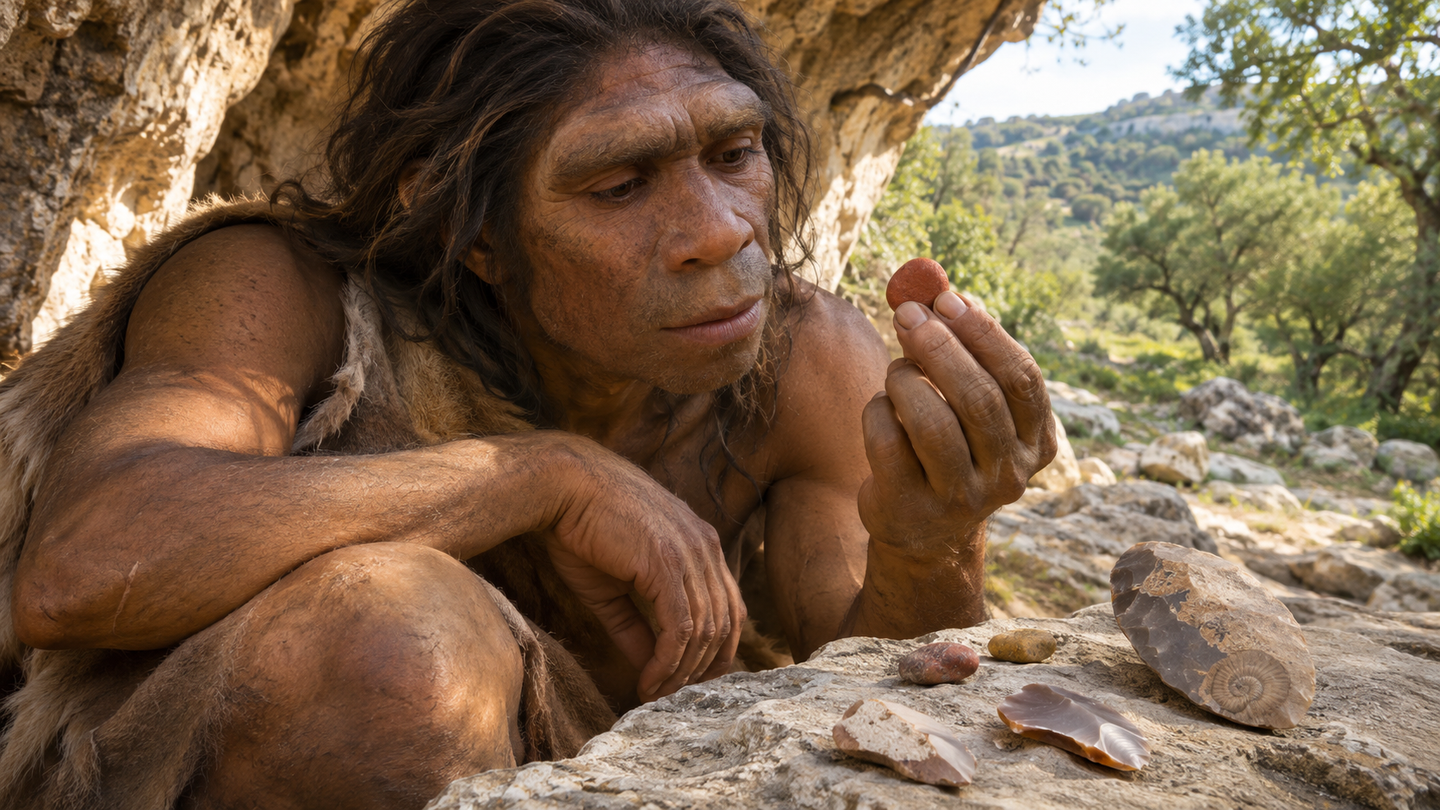
An artistic reconstruction shows an early human examining a colorful pebble beside collected stones and flint tools. Researchers propose that such keepsakes may have helped people recall personal experiences and supported the evolution of autobiographical memory. (CREDIT: The Brighter Side of News)
- A new hypothesis proposes that collected stones, fossils and older tools helped early humans recall personal experiences.
- Archaeological examples include colorful pebbles and tools whose weathered surfaces or distinctive features were preserved.
- The paper suggests a possible evolutionary influence on memory, while acknowledging alternative explanations and the need for testing.
A stone carried home from a journey can become valuable without becoming useful in any ordinary practical sense. Its color, texture and origin may bring back a particular place or encounter. Researchers now propose that similar relationships with objects could reach back roughly half a million years into human prehistory.
The argument appears in Evolutionary Anthropology. The team includes Yoav Ram, Ran Barkai, Ella Assaf and Liad Mudrik of Tel Aviv University, Bar Efrati of the University of Oxford, and Tal Simon. They combine archaeological observations with ideas from psychology, neuroscience and evolutionary theory.
Their central proposal is that ancient keepsakes offered portable prompts for remembering personal experiences. If routinely used, those objects might also have influenced selection on the cognitive abilities needed to connect memories with reliable sources. Research into everyday memories helps frame that question, without directly answering what happened in prehistory.
This is a hypothesis about familiar finds, rather than proof that ancient people remembered exactly as we do. The paper does not date the origin of autobiographical memory or argue that keepsakes created identity alone. It asks whether some stone artifacts carried personal significance beyond their immediate function.
Ancient keepsakes leave suggestive material clues
The authors describe a possible threshold around 500,000 years ago in some regions, when collecting and retaining distinctive objects became more visible archaeologically. That does not make every example equally old, or establish a single worldwide starting point. The evidence spans different sites, materials and periods rather than one newly excavated collection.
At Qesem Cave in Israel, people brought in small, round, colorful pebbles during an occupation extending from around 400,000 to 200,000 years ago. No practical use has been identified for these objects. That leaves aesthetic, emotional and memory-related explanations open, alongside the possibility that an unknown practical role has escaped detection.
In the Sakhnin Valley, roughly ten of more than 200 surveyed handaxes were shaped around fossils or unusual geological features. Those features remained visible and touchable near the center of a face. Preserving them could make manufacture more difficult, raising questions about why the makers selected and retained them.
Such choices broaden how researchers examine early technology. An object can perform a task while also attracting attention through its appearance or history. Studies of carefully maintained tools likewise show why manufacturing choices deserve analysis beyond a simple inventory of shapes.
Old tools may have carried more than cutting edges
Other examples involve tools collected after weathering had altered their surfaces. At Revadim, Jaljulia and Qesem Cave, people sometimes refreshed an edge while preserving much of the older surface and earlier workmanship. Contrasting colors and textures reveal separate episodes of modification, producing what archaeologists call double patina.
These were not necessarily heirlooms passed directly between generations. Weathering can indicate that an object was discarded, remained exposed and was later found again. Its collector might recognize earlier human work without knowing who made it. The object could still connect that person to a remembered landscape or encounter.
The paper argues that some items show relatively light secondary use, consistent with retaining rather than exhaustively exploiting them. However, useful cutting and memory-related value need not be mutually exclusive. Comparable research on elephant-bone tools demonstrates how material selection and technological choices can invite several levels of interpretation.
Archaeology can identify old surfaces, renewed edges and movement away from an object’s source. It cannot directly recover the collector’s feelings. The proposed keepsake interpretation therefore rests on patterns across artifacts. Evidence from prehistoric woodworking also illustrates how preservation limits the behaviors researchers can reconstruct with confidence.
An object could help link a memory to its source
Autobiographical memory connects personal experiences and self-relevant information into a sense of continuity through life. A keepsake could support that process by linking a durable object with a specific event. Seeing or handling it later might restore details that are difficult to retrieve without an external cue.
The authors place particular emphasis on source monitoring: judging whether a recollection came from firsthand experience, someone else’s account or imagination. An object physically associated with a journey might help its owner evaluate that distinction. This does not make recollection infallible or turn a souvenir into objective proof of every remembered detail.
“When early humans brought a colorful stone or an old tool they had found in the landscape back to their cave, that object may have helped them remember a significant event or encounter for the rest of their lives,” Ram said. Work on recollection examines some of the processes behind remembering, while leaving this evolutionary proposal untested.
The hypothesis also allows a social role. Showing an object might lend credibility to a personal account concerning a place, relationship or obligation. Reliable recall could matter for cooperation and trust. Research into memory formation addresses another part of this broader system, rather than demonstrating the proposed ancient social benefits.
From a personal habit to an evolutionary proposal
The larger claim concerns repeated behavior across generations. If people routinely relied on objects to recall and evaluate experiences, that practice could create advantages for cognitive systems that integrate external cues effectively. Cultural behavior would then help shape the conditions under which biological selection operated, a proposed feedback between culture and cognition.
That requires more evidence than showing that modern people treasure souvenirs. Changes produced by learning within one lifetime are not automatically inherited evolutionary changes. The authors draw on evidence that training can reshape neural activity and structure, but use it to motivate a pathway requiring further tests, not to establish prehistoric genetic selection.
Barkai suggests environmental disruption could have made personal connections to places especially important. In the Levant, declining large prey and the disappearance of elephants may have encouraged new hunting strategies and territories. Studies of early hunting provide wider context, but do not prove this particular explanation for keepsake collecting.
The paper proposes checking whether the practice tracks ecological disruption across places and periods. Other discoveries involving ancient landscapes show why regional circumstances matter. A possible connection between changing resources and collecting behavior still needs independent evidence linking those events.
Practical implications for studying ancient keepsakes
The immediate contribution is a set of testable predictions. Researchers can compare candidate keepsakes with ordinary tools, examining wear, residues, source locations and preserved surfaces. They can also test whether distinctive items cluster around repeatedly occupied living areas or hearths rather than simply appearing in raw-material stores.
Alternative explanations include attractive appearance, stockpiling stone and practicing a craft. No single unusual object can eliminate those possibilities. The paper argues that a stronger case would combine several observations. Research on ancient hearths illustrates the value of placing individual finds within a broader pattern of activity.
Modern experiments could compare personally meaningful keepsakes with matched neutral objects, asking whether they improve recall, source judgments or credibility in cooperative tasks. Longer training studies could investigate neural changes. Studies of remembered events provide methods for examining memory without assuming that modern results reveal ancient motives directly.
For now, the stones preserve choices more clearly than thoughts. Their selection, transport and careful reworking invite questions about personal attachment, but cannot settle them alone. The new hypothesis gives those questions a clearer structure: test what objects helped people remember, then investigate whether that relationship could have influenced memory’s evolution.
Dig deeper into artifacts, memory and the extended mind
These resources provide archaeological case studies and cognitive frameworks behind the proposal, listed newest first.
Lower Palaeolithic Tools of Potency: Handaxes Shaped around Fossils and Other Extraordinary Features at Sakhnin Valley, Israel
Researchers examine handaxes whose makers retained fossils or distinctive geological features in the selected stone. (Tel Aviv, March 2026)
Function, life histories, and biographies of Lower Paleolithic patinated flint tools from Late Acheulian Revadim, Israel
Wear and surface analysis investigate old tools collected and modified during later episodes of use. (Scientific Reports, March 2022)
Memory Scrapers: Readymade Concepts and Techniques as Reflected in Collecting and Recycling Patinated Lower Palaeolithic Items at Qesem Cave, Israel
An earlier interpretation explores how preserved surfaces on recycled scrapers might connect users with places and the past. (Cambridge Archaeological Journal, May 2021)
Research findings are available online in the journal Evolutionary Anthropology Issues News and Reviews.
The original story "Ancient keepsakes may have helped shape human memory and identity" is published in The Brighter Side of News.
Related Stories
- New research finds early humans first used fire over one million years ago
- Ancient teeth unlock million-year-old secrets of where early humans evolved
- Early humans started making and using tools 2.75 million years ago
Like these kind of feel good stories? Get The Brighter Side of News' newsletter.
Rebecca Shavit
Writer
Based in Los Angeles, Rebecca Shavit is a dedicated science and technology journalist who writes for The Brighter Side of News, an online publication committed to highlighting positive and transformative stories from around the world. Having published articles on MSN, AOL News, and Yahoo News, Rebecca's reporting spans a wide range of topics, from cutting-edge medical breakthroughs to historical discoveries and innovations. With a keen ability to translate complex concepts into engaging and accessible stories, she makes science and innovation relatable to a broad audience.