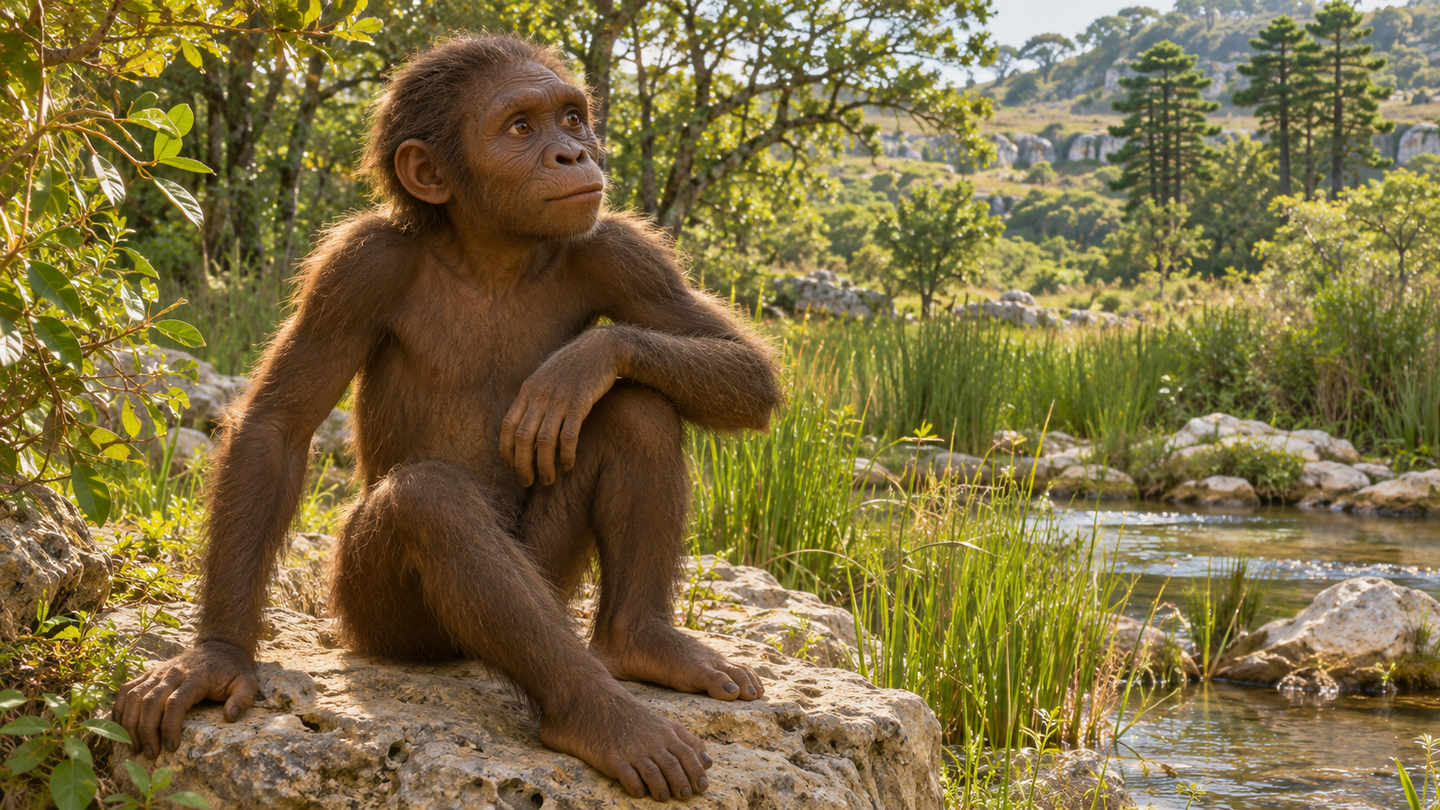
Chimpanzees learn vocal communication much like humans learn words
A study of 91 chimpanzees links adult role models to shared use of raspberry-like calls, offering a precise parallel with one aspect of human communication.

 Edited By: Joshua Shavit

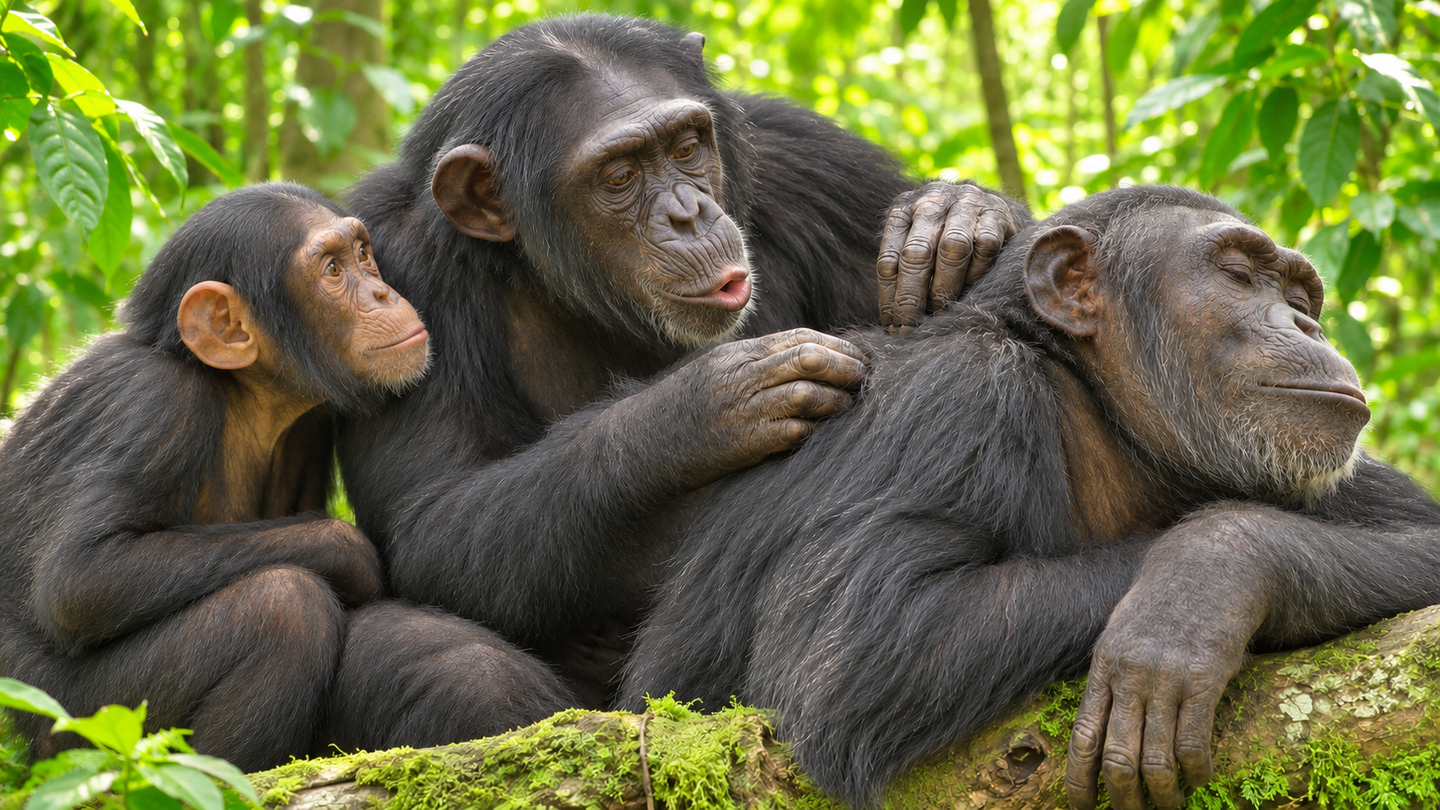
A young chimpanzee watches an adult grooming another in this illustrative scene. Research suggests adult role models help shape when chimpanzees use raspberry-like calls. (CREDIT: The Brighter Side of News)
- Researchers compared unvoiced call use among 91 chimpanzees in four wild communities and four sanctuary groups.
- Groups with adult role models showed more shared, stable usage, usually during grooming.
- The findings support learned communication conventions, but do not establish human-like words or identical meanings among listeners.
A chimpanzee blowing a raspberry may be doing more than making an instinctive noise. New research suggests that adults help shape when younger animals use this and related sounds. The findings point to a social ingredient in communication that researchers once considered more rigidly tied to biology.
The study in PNAS involved researchers from the CNRS Institute of Cognitive Sciences, the University of Warwick and the Taï Chimpanzee Project. Led by first author Antoine Valet and senior colleagues including Catherine Crockford, the team investigated how existing sounds acquire shared patterns of use.
The researchers compared 91 chimpanzees, ranging from infancy to 55 years old, across eight communities in West Africa. Some grew up surrounded by adult models; others spent much of their development without them. The comparison adds to evidence that social learning helps shape chimpanzee behavior.
The important distinction is between learning a sound and learning its use. Chimpanzees have limited ability to acquire entirely new call forms. This research instead asks whether a familiar sound’s connection to a social activity can be learned. Related studies of ape communication explore different components of the larger puzzle of language evolution.
Chimpanzee calls varied with social experience
The study examined unvoiced calls, a category that includes raspberry-like sounds. These are shaped with oral movements without engaging the vocal cords. Although the raspberry features prominently in the researchers’ announcements, the paper’s main analyses combine several unvoiced call forms, rather than treating one sound as the entire communication system.
Four communities lived in Taï National Park, Côte d’Ivoire. Four other groups lived at Tacugama Chimpanzee Sanctuary in Sierra Leone. In three sanctuary groups, individuals had been peer-raised or raised alone without adult role models for most of their immature years. All sampled sanctuary chimpanzees were wild-born and had some early adult exposure.
Across the wild communities, 97% of recorded unvoiced calls occurred during grooming. Groups without adult models used them in a broader range of settings, including aggression, feeding, play, vigilance and rest. This makes a simple, fixed association with grooming harder to sustain. Research on primate friendships highlights how varied their social activities can be.
The researchers did not create those developmental differences experimentally. They used existing circumstances as a quasi-experiment, avoiding deliberate manipulation of ape communities. That approach provides valuable comparisons, but the animals’ histories differ in more ways than adult exposure alone. Studies of great ape cognition similarly require attention to group background and testing context.
An adult model was followed by greater convergence
One sanctuary group provided a particularly informative comparison. An adult had joined it roughly two years before the first observations analyzed for this question. During sampling in 2022, that adult produced 15 unvoiced calls: 14 during grooming and one during rest. The group still used calls across several contexts.
By the second sampling period in 2024, every group member who produced these calls used them during grooming. The group’s overall use had narrowed toward the adult’s pattern. This was not a before-and-after experiment surrounding the introduction itself, but it documented increasing convergence after adult exposure had already begun.
Other sanctuary groups did not show equivalent convergence over the observed interval. Age alone also did not clearly explain the diversity of usage. The researchers interpret these results as evidence that experienced individuals can guide a community toward more consistent communication, extending questions already explored through tool learning.
The findings do not establish that adults deliberately teach calls, or that youngsters consciously follow a rule. Several forms of social learning could produce the pattern. Evidence involving chimpanzee tool use likewise raises questions about how observation, interaction and individual practice work together across development.
What makes a sound a convention
The authors tested three ingredients: flexibility in the relationship between sound and use, evidence of social learning, and stability over time. A convention emerges when community members settle on a shared pattern among possible alternatives. Stability alone is insufficient, because an inherited behavior could also remain consistent across generations.
Human words offer a familiar comparison. English speakers say “dog,” while French speakers say “chien,” because their communities maintain different sound–meaning associations. Chimpanzees need not possess human-like vocabularies for learning to influence their calls. Research on vocal labels in other primates examines another route to socially patterned communication.
The researchers used behavioral context as a proxy for communicative function. Calls during grooming, aggression and solitary rest plausibly serve different purposes, but observing those contexts does not directly establish what receivers understand. The paper explicitly leaves experimentally confirming shared communal meaning as a task for future work.
“Even aspects of chimpanzee vocal communication that seemed fixed and unlearned may be shaped by learning, suggesting that there is still much to discover about their vocal repertoire,” Valet said. Comparisons involving laughter rhythms also reveal continuities with humans while leaving important differences between sound production, social use and language intact.
Why grooming might attract the same sounds
A learned convention can still be influenced by anatomy and practical circumstances. Grooming involves lips, teeth and movements that may make certain unvoiced sounds easy to produce. If those sounds help coordinate or extend an interaction, different communities could independently favor similar usage without inheriting a rigid sound–function connection.
Crockford proposes this as one possible explanation for the strong grooming association in wild populations. It remains a hypothesis to test. Similar grooming-related ideas appear in discussions of mouth contact, but neither comparison turns an evolutionary proposal into a demonstrated historical sequence.
Captivity also requires careful interpretation. Sanctuary life differs from forest life in social histories and daily conditions. The narrowing of call use within one unchanged captive setting strengthens the adult-model explanation, but does not eliminate every alternative influence. Peer learning might also produce convergence over longer periods than researchers observed.
Earlier work had already documented socially influenced chimpanzee signals. This study’s contribution is its combined test of flexibility, learning and stability in natural communication. It should not be described as the first evidence of any vocal learning in chimpanzees, or as showing that human language and chimpanzee calls are equivalent.
Practical implications for communication research
The immediate opportunity is to test what listeners make of the sounds. Playback experiments could compare responses in communities with different social histories. Following individuals for longer could also clarify how quickly usage changes, whether mothers are especially influential, and whether peers can establish conventions without an experienced adult.
Researchers can also investigate other sounds and call combinations using the same framework. Work on animal vocalizations demonstrates why researchers must separate acoustic form from function. More detailed observations could help determine which aspects are inherited, individually developed or maintained through social exposure.
Conservation matters because losing a community may also erase opportunities to understand its learned behavior. Roman Wittig, director of the Taï Chimpanzee Project, emphasized preserving wild populations to study how communication is learned and maintained. Protecting ape cultures therefore supports both animal survival and the scientific record of their behavioral diversity.
The study’s central insight is specific but important: producing a familiar call and knowing when to use it can depend on different processes. Biology supplies capacities, while social experience may help organize their use. That gives researchers a more precise way to investigate the evolutionary foundations of communication without calling chimpanzee signals human words.
Dig deeper into chimpanzee communication and social learning
These resources explore observational learning, call combinations and earlier evidence of socially influenced signals, listed newest first.
Chimpanzee culture beyond the conspicuous: Evidence for broad-scale observational social learning in wild individuals
Researchers examine close observation of others across everyday behaviors, broadening the study of chimpanzee cultural learning. (iScience, June 2026)
Versatile use of chimpanzee call combinations promotes meaning expansion
This study investigates how combinations of calls relate to a wider range of situations than their components alone. (Science Advances, May 2025)
Chimpanzees produce diverse vocal sequences with ordered and recombinatorial properties
An analysis describes the diversity and ordering of vocal sequences in wild chimpanzees. (Communications Biology, May 2022)
Vocal learning of a communicative signal in captive chimpanzees, Pan troglodytes
Earlier research examines flexibility and learning in attention-getting signals among captive chimpanzees. (Brain and Language, December 2013)
Social learning of a communicative signal in captive chimpanzees
This paper presents earlier evidence connecting chimpanzee communicative signals with social learning. (Biology Letters, August 2012)
Research findings are available online in the journal PNAS.
The original story "Chimpanzees learn vocal communication much like humans learn words" is published in The Brighter Side of News.
Related Stories
- Humans walk very differently from chimpanzees, helping our ancestors to conquer the world
- Wild monkeys challenge a long-held assumption about the common ancestor of humans and chimpanzees
- Chimpanzees apply insects to wounds, a potential case of medication?
Like these kind of feel good stories? Get The Brighter Side of News' newsletter.
Hannah Shavit-Weiner
Medical & Health Writer
Hannah Shavit-Weiner is a Los Angeles–based medical and health journalist for The Brighter Side of News, an online publication focused on uplifting, transformative stories from around the globe. Having published articles on AOL.com, MSN and Yahoo News, Hannah covers a broad spectrum of topics—from medical breakthroughs and health information to animal science. With a talent for making complex science clear and compelling, she connects readers to the advancements shaping a brighter, more hopeful future.