Dark energy model links cosmic acceleration to the strong nuclear force
UBC and Sheffield researchers tested a dark-energy framework rooted in the strong-force quantum vacuum. It fits cosmological data competitively, but relies on assumptions and two additional transition parameters.
 UBC Writer: Peter Meiszner

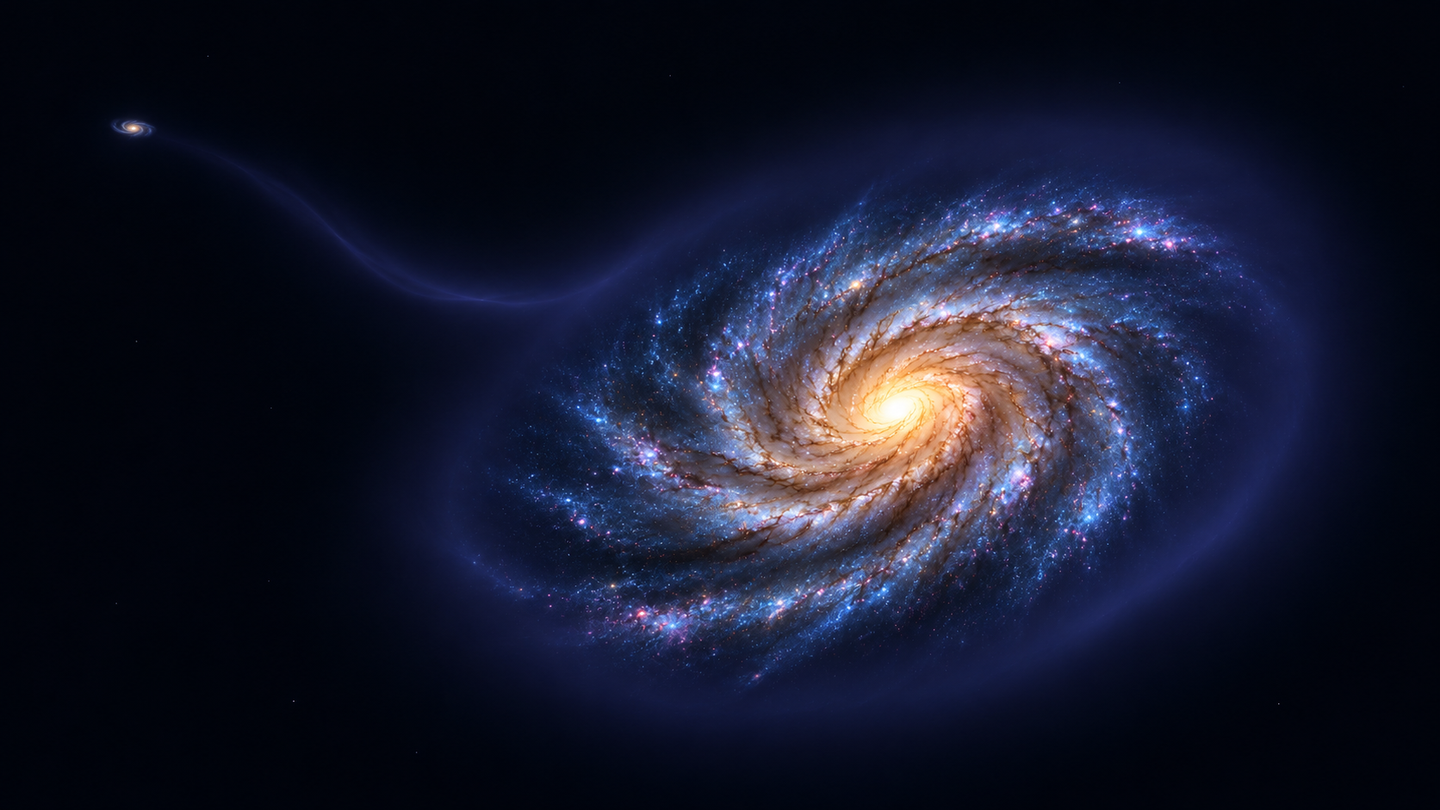
A dark energy model connects cosmic acceleration to QCD vacuum physics. Data fits are promising, but its mechanism remains unproven. (CREDIT: The Brighter Side of News)
The physics that binds quarks inside protons and neutrons may also help explain why the universe’s expansion accelerates. A new dark energy model connects cosmic acceleration with the quantum vacuum of the strong nuclear force. Its comparison with astronomical observations is encouraging, but does not establish that this mechanism operates in nature.
Researchers at the University of British Columbia developed the underlying proposal, which the team tested in The Astrophysical Journal. Lead author Dong Ha Lee worked with Carsten van de Bruck, Eleonora Di Valentino, Ludovic Van Waerbeke and Ariel Zhitnitsky.
Lee is a doctoral researcher at the University of Sheffield. The collaboration brings a proposed particle-physics mechanism into contact with measurements used to reconstruct the universe’s history.
Dark energy accounts for roughly 70% of today’s cosmic energy budget in standard cosmology. It names the component associated with accelerated expansion, while leaving its physical origin unresolved. Evidence for evolving dark energy has renewed interest in whether its behavior changes over time.
Proposals involving black holes illustrate the range of explanations under investigation. This team instead starts with quantum chromodynamics, or QCD, the established theory of quarks and gluons. The new claim concerns how its vacuum might behave across an expanding universe.
A dark energy model built from QCD
Quarks are elementary particles, while gluons carry the strong interaction between them. QCD explains their behavior inside protons, neutrons and other composite particles. Investigations of gluon behavior test aspects of that theory through high-energy collisions.
A quantum vacuum is the lowest-energy state of quantum fields. It retains physical structure even when no ordinary particles are present. Research probing quark confinement examines the complex strong-force physics that prevents isolated quarks from appearing under normal conditions.
The authors focus on distinct mathematical configurations of the QCD vacuum, described as topological sectors. Quantum tunneling between these configurations contributes to vacuum energy. Their proposal is that this contribution depends on the large-scale geometry of spacetime, allowing cosmic expansion to change it.
“Our theoretical framework suggests no new particles may be required at all,” Zhitnitsky said. The proposed relationship combines the strong-force energy scale with gravity to estimate a dark-energy scale near the observed value. That agreement concerns an approximate physical scale, rather than a complete experimental identification of dark energy. The proposal still needs to establish that its assumed vacuum contribution has the required behavior in our universe.
How expansion could change vacuum energy
The model compares QCD vacuum energy in expanding spacetime with its value in flat, nonexpanding spacetime. The difference supplies the proposed dark-energy contribution. Under the authors’ assumptions, that difference can depend on the cosmic expansion rate.
This is a global vacuum effect, rather than ordinary nuclear energy leaking out of atoms. The tunneling describes quantum configurations, not bubbles spreading across space. Nothing in the proposal suggests that splitting nuclei in a reactor reproduces the universe’s accelerated expansion.
Other proposals involving spacetime topology likewise investigate connections between microscopic theory and cosmic behavior. Sharing that broad motivation does not make the mechanisms equivalent. The QCD proposal specifically attributes the effect to the vacuum structure of the strong interaction.
Experiments using quantum simulations show why strongly interacting systems demand specialized tools. The paper acknowledges that a direct QCD vacuum calculation for arbitrary expanding geometries remains technically infeasible. Extending calculations from more tractable settings to the real universe therefore requires theoretical assumptions.
What the astronomical tests measured
The team compared its dark energy model with several datasets that constrain cosmic history. These included the cosmic microwave background, radiation released when the universe first became transparent. Its patterns help constrain the universe’s contents and early conditions. Combining these early measurements with later distance observations tests whether a model can describe multiple periods consistently.
The analysis also used the second data release from the Dark Energy Spectroscopic Instrument, or DESI. It measures baryon acoustic oscillations, a characteristic distance pattern left by early-universe sound waves. Comparing that pattern across epochs helps reconstruct how cosmic distances and expansion evolved.
Type Ia supernovae provided another distance measure, using their standardized brightness to estimate how far away they are. Related supernova analyses show why calibration and dataset choice matter. The researchers tested both Pantheon+ observations and a recalibrated Dark Energy Survey compilation.
Studies of the expansion gap demonstrate that changing dark energy does not automatically resolve every cosmological discrepancy. Here, Bayesian comparisons found the QCD model broadly competitive with standard cosmology. Combining early- and late-universe observations produced mild to moderate preference, depending on the dataset, within the comparisons performed.
New fields and fitted parameters are different
The standard benchmark is ΛCDM, which combines a cosmological constant with cold dark matter. The cosmological constant represents a dark-energy density that stays fixed as space expands. The simplest version uses six cosmological parameters to describe a wide range of observations.
The fitted QCD model uses eight parameters, adding two that describe a transition in its vacuum contribution. One sets the transition’s location in cosmic history; the other sets its width. These describe a phenomenological switching function, a mathematical representation of behavior the theory does not yet calculate fully. They allow the proposed component to remain small early in cosmic history and become important later.
Independent cosmological analyses highlight how different data combinations can test evolving-energy descriptions. A model with more flexibility may fit measurements better without identifying the correct physics. Bayesian evidence weighs agreement with observations alongside how broadly a model distributes its predictions.
Calculations involving the strong interaction also illustrate the difference between an established theory and a difficult quantitative prediction. Here, avoiding a new fundamental field does not mean avoiding fitted cosmological parameters. The promising energy-scale estimate and the eight-parameter observational model are related claims that require separate evaluation.
Practical implications
The findings give cosmologists a physically motivated alternative to test against a constant dark-energy density. They also identify a task for particle theorists: calculating more precisely how the QCD vacuum responds to cosmic expansion. Better calculations could replace assumptions with predictions that observations can distinguish. Matching the present energy scale is one target; predicting the detailed time dependence is another, more demanding test.
Future observations from the Roman telescope could help sharpen measurements of cosmic distances and expansion. Additional data would test whether the present hints of evolution persist. Agreement across independent observing methods would matter more than a good fit to one compilation.
Work on lensed supernovae offers another approach to measuring expansion through gravitationally delayed light. Such measurements can help challenge cosmological frameworks from different directions. They would still test predicted cosmic behavior rather than directly observe the proposed QCD vacuum mechanism.
The next step is to make this dark energy model more predictive and assess it with improved data. Its appeal is the possible connection between established particle physics and an unexplained cosmic phenomenon. Establishing that connection will require both stronger theoretical foundations and observational tests that separate it from competing explanations.
Dig deeper into dark energy and cosmic acceleration
These studies examine the QCD proposal, modern cosmological constraints and the original supernova evidence for acceleration.
DESI results and dark energy from QCD topological sectors: The companion theoretical paper develops the proposed connection between QCD vacuum structure and an evolving dark-energy contribution. (Physical Review D, 2026)
DESI DR2 results. II. Measurements of baryon acoustic oscillations and cosmological constraints: DESI uses galaxy and quasar distance patterns to constrain expansion history and test dark-energy descriptions. (Physical Review D, 2025)
Planck 2018 results. VI. Cosmological parameters: The final full-mission analysis constrains standard cosmological parameters using early-universe radiation. (Astronomy & Astrophysics, 2020)
Measurements of Ω and Λ from 42 High-Redshift Supernovae: The Supernova Cosmology Project reports distance measurements supporting a cosmological-constant contribution to the universe’s expansion. (The Astrophysical Journal, 1999)
Observational Evidence from Supernovae for an Accelerating Universe and a Cosmological Constant: This landmark study uses distant and nearby supernovae to investigate accelerated expansion. (The Astronomical Journal, 1998)
Research findings are available online in The Astrophysical Journal.
The original story "Dark energy model links cosmic acceleration to the strong nuclear force" is published in The Brighter Side of News.
Related Stories
- 2,884 exploding stars deepen the mystery of dark energy
- Dark energy reversal cannot close the universe’s expansion gap
- Dark Energy Survey delivers its most precise cosmic map yet
Like these kind of feel good stories? Get The Brighter Side of News' newsletter.
Joseph Shavit
Writer, Editor-At-Large and Publisher
Joseph Shavit, based in Los Angeles, is a seasoned science journalist, editor and co-founder of The Brighter Side of News, where he transforms complex discoveries into clear, engaging stories for general readers. With vast experience at major media companies like The Los Angeles Times, Times Mirror and Tribune Publishing, he writes with both authority and curiosity. His writing focuses on space science, planetary science, quantum mechanics, geology. Known for linking breakthroughs to real-world markets, he highlights how research transitions into products and industries that shape daily life.