Shroud of Turin DNA study reveals a complex record of human contact
Sequencing of 1978 Shroud samples identifies mixed biological traces and a strong genetic match to the collector. The findings do not establish the cloth’s age, origin or authenticity.
 Editor: Joseph Shavit

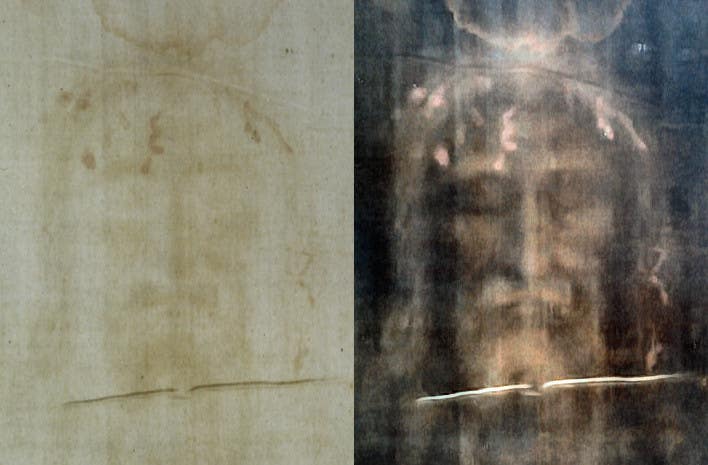
The Shroud of Turin: modern photo of the face, positive (left), and digitally processed image (right). (CREDIT: Wikimedia / CC BY-SA 4.0)
Shroud of Turin DNA recovered from 1978 samples reveals a crowded biological record, including human traces, skin microbes, crops and domestic animals. Yet one of the strongest human signals points to someone researchers could identify: the scientist who collected the samples in 1978.
The international study, published in Scientific Reports, used broad genetic sequencing to examine material associated with the linen. Gianni Barcaccia and colleagues investigated both human ancestry markers and DNA from other organisms. Their findings emphasize how handling and environmental exposure complicate efforts to reconstruct an object’s past.
Noemi Procopio, professor of forensic science at the University of Lancashire, participated in the research. “The Shroud represents a rich archive of genetic information that has accumulated over centuries of human interaction and environmental exposure,” she said. The challenge is determining which parts of that archive can support a particular historical claim.
The cloth bears images of a man and is venerated by many Christians as Jesus’s burial shroud. Its documented medieval history provides a separate line of evidence from molecular analysis.
As studies of museum DNA demonstrate, recovering readable sequences does not automatically establish when or how the material arrived. Researchers must assess the molecules themselves alongside the object’s collection history and available controls.
Reading Shroud of Turin DNA
The researchers examined official samples collected by Pierluigi Baima Bollone in 1978. They obtained sequencing data from seven samples after testing a collection of twelve. Their approach, shotgun metagenomics, reads mixed DNA rather than restricting the search to one organism or selected genetic marker.
The sequencing libraries used a PCR-free protocol. PCR, or polymerase chain reaction, makes copies of selected DNA, and omitting that amplification step can reduce associated biases. It cannot remove contamination that already entered a sample, including DNA deposited during collection or earlier handling. The team extracted DNA in clean rooms, helping control new laboratory contamination while leaving earlier contributions to be evaluated.
Other DNA surveys show how genetic reference collections help identify biological sources. Here, researchers compared sequences with databases and used several analytical approaches. Short, degraded fragments and similarities between related organisms still made some identifications uncertain.
Work with cave sediment illustrates another problem: mixed samples can preserve contributions from multiple people. Shroud of Turin DNA presents that difficulty alongside centuries of possible exposure. A sequence’s presence therefore supplies only part of the information needed to interpret it.
Human traces point to sample handling
Mitochondrial DNA, inherited mainly through the maternal line, helped researchers compare human genetic signatures. A predominant lineage in three samples matched Baima Bollone’s mitochondrial sequence. Further genetic comparisons indicated that those samples and the collector represented the same individual or a first-degree relationship.
The authors concluded that human DNA in the tested specimens mostly came from the main collector, with additional contamination. Other mitochondrial lineages appeared, but they did not supply identities or a reliable travel itinerary. A lineage found in several modern regions cannot uniquely locate an undocumented historical event.
Contamination also challenged research on Dragon Man, where researchers needed to distinguish ancient sequences from modern material. The Shroud team examined characteristic chemical damage to make that distinction. Most human reads lacked strong post-mortem damage, while only a small fraction passed more stringent thresholds. More than 98.3% of human reads in each sample received low damage scores under the model the researchers applied.
These findings limit comparisons with studies of Neanderthal diversity, where authenticated ancient molecules can inform population history. The Shroud samples do not provide an identified original individual’s genome. Nor does a short DNA fragment become demonstrably ancient simply because it came from a historic object.
Microbes reflect a mixed biological record
The researchers also identified bacteria, fungi and archaea, microorganisms representing a separate branch of cellular life. Several bacterial species commonly inhabit human skin. The fungal signals included skin-associated organisms and species able to tolerate dry or salty conditions.
Research on the skin microbiome helps explain why touch can leave more than human DNA. People carry diverse microbial communities that can contribute material to handled surfaces. Detecting their DNA does not establish that those organisms remain alive or actively damage the cloth.
Some archaea belonged to salt-tolerant groups, and the yeast Debaryomyces hansenii also suited dry, stressful environments. The authors discuss possible links with storage or textile processing. Those ecological associations remain hypotheses, rather than evidence of a uniquely identifiable location or manufacturing practice.
Studies of ancient pathogens show why authenticating microbial molecules matters before assigning historical significance. In this study, examined skin-associated bacterial sequences showed no detectable characteristic deamination damage. That result further cautions against treating every microbial signal as an ancient record.
Plant and animal DNA needs context
The sequence matches included cultivated plants such as wheat, carrots, maize, bananas and peanuts. Animal signals included dogs, cats, chickens and livestock, alongside Mediterranean red coral. These findings broaden the picture of biological material associated with the samples, without establishing direct contact with every organism.
Environmental studies can use plant DNA to reconstruct past vegetation when sample context supports that interpretation. The Shroud’s mixed exposure history offers fewer constraints. Food residues, transported particles, handling and sample storage could contribute signals without the cloth visiting a species’ native region.
Research into Doggerland forests likewise depends on connecting biological traces with their sedimentary setting. Here, the researchers found no detectable terminal deamination in examined plant and animal reads. The species list alone cannot date their arrival on the material. Nor can the relative number of sequence matches be read as the amount of each organism originally present.
Red coral offers a particularly striking example. Its use in jewelry and decoration provides plausible ways for material to move far from Mediterranean waters. The finding suggests possible cultural contact, but cannot independently establish a route through specific ports, countries or centuries.
Practical implications
For conservators and forensic researchers, the study demonstrates both the reach and limits of sequencing historical textiles. Recording collection procedures, storage conditions and possible handlers can be essential to interpreting later results. The collector match shows how influential one documented sampling event can become.
The team also examined proteins, an approach used in research on ancient proteins. It did not identify authenticated ancient peptides in these samples. The reported protein findings instead reflected handling or treatment, reinforcing the need to distinguish biological detection from historical authentication.
Studies of Homo erectus demonstrate how protein evidence can answer different questions from DNA. Dating also requires its own evidence: the established 1988 radiocarbon tests placed sampled Shroud linen between 1260 and 1390 CE. The new paper separately dated two threads from the reliquary, rather than establishing a new age for the Shroud itself.
Future work could test how consistently biological signatures recur across independently documented samples. Shroud of Turin DNA currently reveals a mixture shaped by handling and exposure, with substantial modern contributions. Its scientific value lies in understanding that mixture while respecting the limits of what it can establish.
Dig deeper into Shroud of Turin research
These studies examine the Shroud’s image, linen, DNA and radiocarbon evidence.
Image Formation on the Holy Shroud: A Digital 3D Approach: Digital simulations compare how cloth contacts a three-dimensional body and a low-relief model, testing proposed explanations for the Shroud’s image. (Archaeometry, 2026)
X-ray Dating of a Turin Shroud’s Linen Sample: Researchers examine cellulose degradation in a linen sample using X-ray scattering, with the age interpretation depending on assumptions about historical storage conditions. (Heritage, 2022)
Radiocarbon Dating of the Turin Shroud: New Evidence from Raw Data: A statistical reanalysis investigates variation among the original radiocarbon measurements and its implications for interpreting the sampled material. (Archaeometry, 2019)
Uncovering the sources of DNA found on the Turin Shroud: The earlier genetic study identifies plant and human DNA associated with Shroud samples using targeted amplification methods. (Scientific Reports, 2015)
Radiocarbon dating of the Shroud of Turin: The original three-laboratory report describes radiocarbon measurements that placed sampled Shroud linen between 1260 and 1390 CE. (Nature, 1989)
Research findings are available online in the journal Scientific Reports.
The original story "Shroud of Turin DNA study reveals a complex record of human contact" is published in The Brighter Side of News.
Related Stories
- Medieval scholar declared the Shroud of Turin a fake centuries ago
- New tests show Jordan lead codices are not all modern fakes
- 500 year-old ‘Bible map’ reveals how maps reinvented faith and nations
Like these kind of feel good stories? Get The Brighter Side of News' newsletter.
Joshua Shavit
Writer and Editor
Joshua Shavit is a NorCal-based science and technology writer with a passion for exploring the breakthroughs shaping the future. As a co-founder of The Brighter Side of News, he focuses on positive and transformative advancements in technology, physics, engineering, robotics, and astronomy. Having published articles on AOL.com, MSN, Yahoo News, and Ground News, Joshua's work highlights the innovators behind the ideas, bringing readers closer to the people driving progress.