
Dog brains share a humanlike bias for consonants in speech
Dogs showed a consonant bias when tracking artificial speech patterns, but the EEG study does not establish humanlike understanding.
 Eötvös Loránd University Writer: Sara Bohm

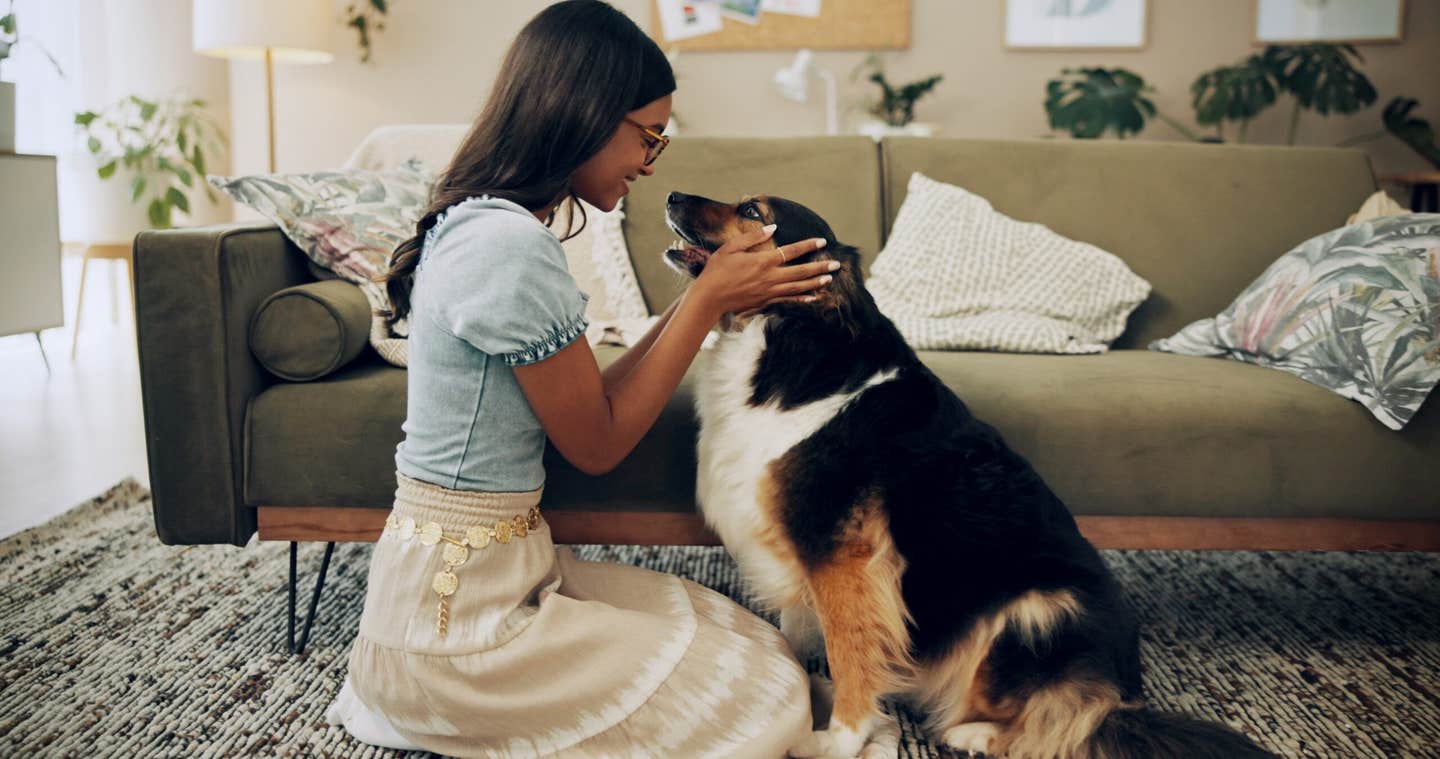
EEG recordings reveal a shared preference for consonant-defined word patterns in dogs and humans. How dogs develop the bias remains unresolved. (CREDIT: Shutterstock)
Dog brains followed hidden word patterns in a continuous stream of unfamiliar speech, especially when consonants supplied the repeating structure. Human listeners showed the same preference. The finding identifies a shared feature of speech processing, without showing that dogs understand language as people do.
The work came from the Neuroethology of Communication Lab at Eötvös Loránd University in Budapest. Published in Science, it compared electrical brain recordings from 20 companion dogs and 20 humans. Co-first authors Boglárka Morvai and Kinga G. Tóth worked with corresponding author Attila Andics, the lab’s head, to investigate canine cognition.
Their question concerned a listening strategy called consonant bias. Across many human languages, consonants provide especially useful clues to word identity, despite vowels being louder. Finding that preference in dogs challenges the idea that it requires the complex language abilities humans possess.
Finding boundaries without spaces
Written sentences contain spaces, but speech does not reliably pause between every word. Listeners must find recurring patterns within the flow of sound. This process, speech segmentation, concerns identifying possible word boundaries before addressing the separate challenge of word meaning.
Vowels and consonants contribute differently to that task. As Andics explained, “consonants usually form the skeleton of words.” A listener who detects a recurring consonant sequence may recognize a stable structure even when the vowels around it change.
Humans’ preference raises a question about its origins. It might depend on specialized language abilities, or develop through more general learning processes. Companion dogs provide a useful comparison because they regularly hear human voices while lacking human speech and grammar.
The comparison also moves beyond our closest evolutionary relatives. Previous research had not demonstrated this consonant preference in nonhuman primates. Dogs therefore offer another route for examining which ingredients of speech processing extend beyond humans, rather than treating evolutionary closeness as the only useful guide. A shared listening preference could arise through different developmental histories, so identifying the response is a starting point for explaining its origins.
Three streams separate sound from structure
The researchers constructed continuous streams of artificial three-syllable words. These sequences carried no familiar meanings, and no pauses marked their boundaries. That design isolated pattern detection from vocabulary knowledge, a distinction relevant to interpreting dogs’ word-learning abilities.
In one condition, consonant sequences repeated while the intervening vowels varied. In another, vowel sequences repeated while consonants changed. A random control stream contained no recurring word-level structure, allowing the team to compare patterned speech with otherwise similar unstructured sound. The crucial regularity extended across three syllables. Detecting one repeated sound alone would not demonstrate that a listener had grouped those syllables into the intended larger unit.
Individual speech sounds lasted approximately 125 milliseconds, and syllables lasted 250 milliseconds. The streams therefore contained four syllables per second, with each three-syllable word spanning about three-quarters of a second. These nested rhythms gave the EEG analysis distinct levels to examine.
This arrangement placed the competing explanations under the same test. If brains simply favored the more prominent sounds, vowels should have offered an advantage. A stronger response to consonant-defined patterns would instead suggest sensitivity to the information those sounds supplied.
The team recorded electroencephalography, or EEG, through electrodes on the scalp. This noninvasive method measures electrical activity without requiring an animal to report what it heard. Like other investigations of dog brains, it provides evidence about processing while leaving subjective experience unresolved.
Brain rhythms reveal the shared preference
The main measurement involved neural synchronization: brain activity can follow a repeating rhythm in incoming sound. When three syllables consistently form a larger unit, a response at the word rhythm suggests that the brain registers that grouping. This approach probes structure beyond simply detecting that speech sounds are present.
Both species synchronized more strongly with consonant-structured words than with vowel-structured or random streams. The random condition mattered because it helped distinguish tracking the repeated word pattern from responding to the individual syllables common to the streams.
A second analysis examined electrical responses after each artificial word began. Both species showed a distinct response around half a second after onset for consonant-structured words. Together, the rhythmic tracking and timed response support a consonant preference during segmentation. The two analyses ask complementary questions: whether activity follows the recurring word rhythm, and whether a consistent response develops after a word begins. Their agreement strengthens the interpretation within this controlled listening task.
These are neural measurements, rather than demonstrations that dogs could retrieve an object or explain a word. Such distinctions also matter in research on animal communication. Here, the evidence concerns recognizing regularities that could help a listener divide speech into units, without assigning those units meanings.
Shared patterns have important limits
The human and canine responses also diverged. Humans tracked vowel-defined words more strongly than random speech, although consonants produced the clearer response. Dogs did not show comparable reliable word-level tracking for the vowel condition, suggesting a difference in flexibility when processing language patterns.
That result should not become a claim that dogs cannot use vowel information. Failure to detect a reliable effect in this experiment does not establish a universal inability. Different tasks, training histories or measurements could reveal capacities this particular design did not capture.
Both species followed the syllable rhythm, but only humans showed clear tracking of the individual speech-sound rhythm. The pattern suggests finer temporal resolution in the human response under these conditions. It does not establish that syllables are always the smallest sound units a dog can distinguish.
The distinction helps explain why shared responses need careful interpretation. Studies of human communication often examine several processing stages, from detecting sound to anticipating meaning. Matching one feature across species does not demonstrate that every stage operates alike or uses identical neural mechanisms.
Experience remains an explanation to test
The researchers also considered dogs’ early environments. Dogs that spent their first three months in shelters or on the street showed a consonant preference, alongside dogs raised earlier in homes. Eleven dogs entered speech-rich environments before 12 weeks of age, while nine entered later. This comparison broadens the finding beyond one early history of exposure to human speech.
However, the groups were small, and early-life information was incomplete. Similar responses do not prove identical development or establish that early experience has no influence. All the tested dogs were companions by the time of the experiment, so this was not a comparison between lifelong speech exposure and none.
Statistical learning offers one plausible explanation. Through repetition, a brain can learn which sounds tend to occur together, without understanding a sentence. Regular exposure could help tune dogs to useful patterns, much as their ability to recognize familiar voices reflects sensitivity to the sounds surrounding them.
The experiment did not manipulate lifelong speech exposure or compare dogs with wolves, so it cannot separate learning from domestication or older auditory abilities. Future comparisons must establish when the preference develops and which experiences alter it. What is clearer now is that a nonspeaking species can share a neural bias useful for finding structure in human speech.
Dig deeper into dogs and speech processing
These studies examine canine word processing, speech recognition and the development of listening biases.
- Action instruction word processing in the dog brain entails both auditory form identification and meaning representation: Brain imaging investigates responses to action instructions, addressing meaning-related processing beyond recognizing recurring sound patterns. (NeuroImage, September 2025)
- Neural evidence for referential understanding of object words in dogs: EEG responses to matching and mismatching objects examine whether familiar labels evoke representations of objects. (Current Biology, March 2024)
- Speech naturalness detection and language representation in the dog brain: Brain imaging compares natural and scrambled speech alongside familiar and unfamiliar languages. (NeuroImage, March 2022)
- Neural processes underlying statistical learning for speech segmentation in dogs: Neural measurements explore dogs’ ability to detect regularities that help divide continuous speech into units. (Current Biology, December 2021)
- The role of linguistic experience in the development of the consonant bias: Earlier behavioral experiments with dogs reported a vowel preference, providing a useful contrast with the newer EEG findings. (Animal Cognition, October 2020)
Research findings are available online in the journal Science.
The original story "Dog brains share a humanlike bias for consonants in speech" is published in The Brighter Side of News.
Related Stories
- Why big dogs die younger: DNA study points to changes around jumping genes
- Brain scans reveal what dogs see when they look at a human face
- Spending time with a dog helps teens to better cope with social anxiety
Like these kind of feel good stories? Get The Brighter Side of News' newsletter.
Rebecca Shavit
Writer
Based in Los Angeles, Rebecca Shavit is a dedicated science and technology journalist who writes for The Brighter Side of News, an online publication committed to highlighting positive and transformative stories from around the world. Having published articles on MSN, AOL News, and Yahoo News, Rebecca's reporting spans a wide range of topics, from cutting-edge medical breakthroughs to historical discoveries and innovations. With a keen ability to translate complex concepts into engaging and accessible stories, she makes science and innovation relatable to a broad audience.