Antarctic researchers shed new light on space weather disruptions to satellites and power grids
A four-year project will maintain Antarctic magnetometers and compare their records with Greenland stations to investigate differences in Earth’s polar response to solar activity.
 UTA Writer: Greg Pederson

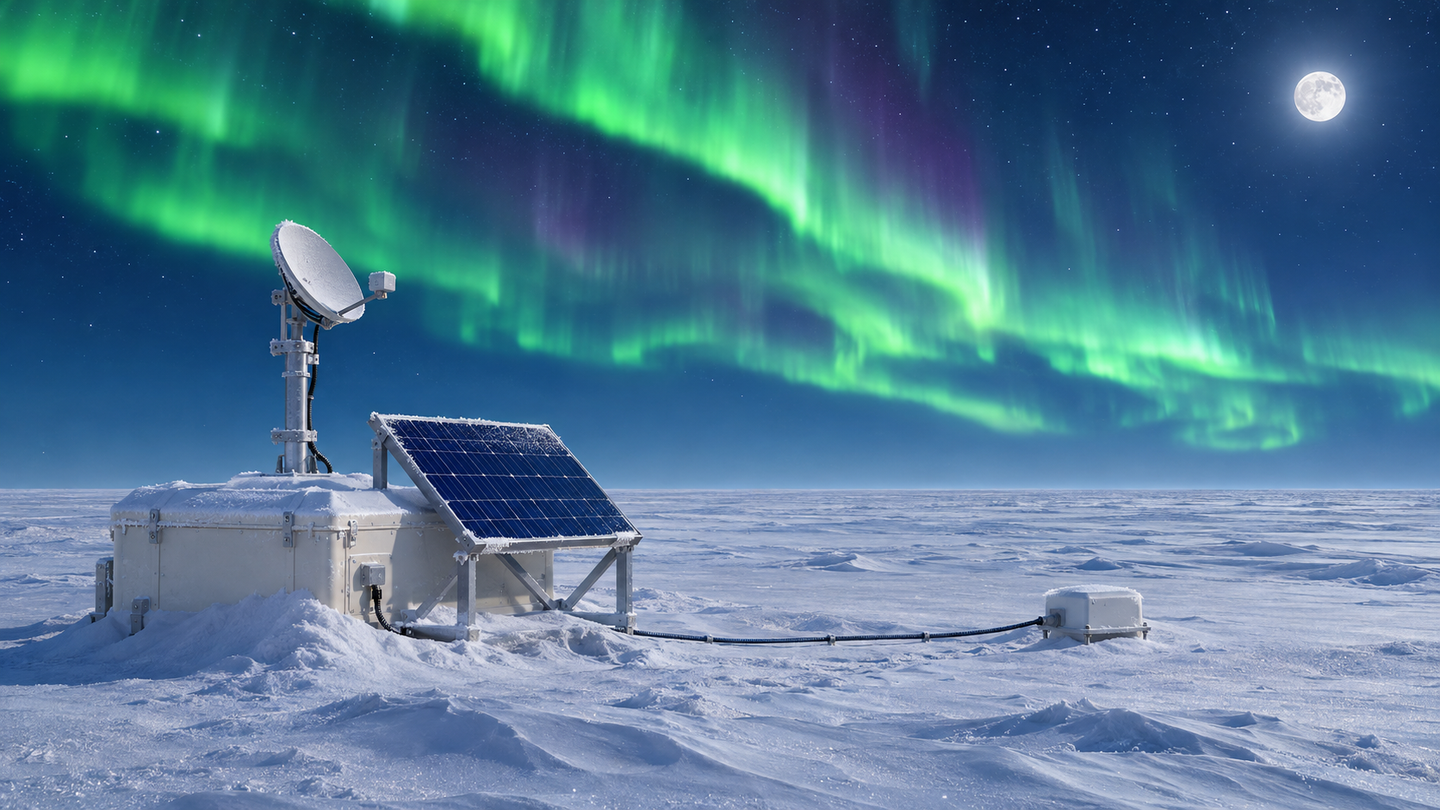
An illustrative reconstruction shows an autonomous Antarctic monitoring station beneath the aurora australis. Polar magnetometers help researchers study how solar-wind disturbances affect Earth’s magnetic environment. (CREDIT: The Brighter Side of News)
Two chains of magnetic observatories, one in Antarctica and another in Greenland, will help scientists investigate why Earth's poles respond differently to the same disturbance. The project follows energy arriving through the solar wind, the stream of charged particles flowing outward from the Sun.
Zhonghua Xu, an associate professor of physics at The University of Texas at Arlington, leads the four-year, $799,527 project. Maintaining existing Antarctic stations is central to the work, alongside investigating the physics behind unequal northern and southern responses.
Kevin Sterne, a senior research associate at the Virginia Tech National Security Institute, serves as co-principal investigator. The team will operate, restore and maintain the Antarctic PENGUIn magnetometer array while coordinating measurements with its northern counterpart.
The stakes extend beyond understanding auroras. Strong solar storms can disrupt satellites, affect aviation communications and threaten electrical infrastructure. This project aims to improve the observational foundation for understanding those disturbances, rather than announce a finished forecasting system.
Comparing two ends of Earth's magnetic field
Earth's magnetosphere is the region dominated by the planet's magnetic field. Its interaction with the solar wind drives changes in surrounding plasma and electrical currents. The ionosphere, an electrically conducting part of the upper atmosphere, connects those changes to conditions above the polar regions.
The Antarctic stations have counterparts along Greenland's west coast at magnetically conjugate locations. These sites lie near corresponding ends of magnetic field lines, rather than simply opposite geographic coordinates. Comparing their records lets researchers examine differences that measurements from one hemisphere alone could miss.
The comparison also depends on separating the incoming disturbance from each hemisphere's response. Polar space weather observations alone cannot explain every difference without information about the solar wind and upper atmosphere. Bringing those records together helps researchers test whether two unequal signals share the same external driver.
Research on magnetic geometry already shows why a disturbance need not produce a uniform response around Earth. Seasonal sunlight changes the electrical conductivity of the polar upper atmosphere. Magnetic-field structure also differs between hemispheres, complicating a straightforward mirror-image comparison.
Studies of Earth's changing magnetic field highlight the importance of tracking the field itself. Here, magnetometers record local magnetic variations that contain signatures of electrical currents above them. Those observations help researchers infer the response, rather than directly measuring the complete energy transfer from the Sun.
Keeping polar space weather observations running
The award comes from the National Science Foundation Office of Polar Programs. It supports an existing observing system in a region where routine maintenance requires substantial planning. PENGUIn stands for Polar Experimental Network for Geospace Upper atmosphere Investigations.
The stations span remote terrain high on the East Antarctic Plateau. Xu describes the array as the only autonomous, year-round network spanning the southern polar cap, cusp and auroral zones. These are distinct high-latitude regions through which scientists study Earth's connection with space.
“One important aspect is that these stations operate autonomously in extremely remote parts of Antarctica, so keeping the existing network functioning reliably is itself a significant part of the project,” Xu said. The network was installed over eight years beginning in 2008. Xu has made six Antarctic trips.
Keeping polar space weather observations comparable requires attention to the observing system as well as the physics. Researchers need to know when a station stopped recording, returned to service or supplied an incomplete record. Reliable operation therefore determines which events can support a meaningful north-south comparison.
Continuous records matter when researchers compare the timing and shape of disturbances between hemispheres. Work on space waves examines related pathways for transferring energy through Earth's magnetic environment. Missing observations can leave an incomplete picture of how an event developed.
Likewise, sustained solar monitoring helps researchers follow changes rather than rely on isolated snapshots. The Antarctic project applies that principle to ground measurements. Restoring a station preserves an opportunity to compare the same event from both poles.
Following shocks through Solar Cycle 25
One objective is to characterize the drivers and spatial structure of magnetic disturbances during extreme space weather. The second is to quantify how interplanetary shocks and ultra-low-frequency waves couple differently into the northern and southern hemispheres. These questions require observations across multiple events.
Interplanetary shocks are moving disturbances in the solar wind. They can accompany coronal mass ejections, large expulsions of solar plasma, or form where fast streams overtake slower material. Research on solar-storm structure illustrates why the incoming disturbance's properties matter alongside its strength.
Ultra-low-frequency waves are slow electromagnetic oscillations in Earth's space environment. Comparing their magnetic signatures at conjugate stations could help identify where northern and southern responses diverge. The project must then distinguish differences associated with incoming solar-wind conditions from those arising within Earth's own coupled system.
The observing period will cover active and declining portions of Solar Cycle 25. Studies using long solar records show the value of following activity over extended periods. The cycle began in December 2019 and belongs to an approximately 11-year pattern, whose exact duration varies.
The project description calls for combining conjugate magnetic records with upstream solar-wind data, ionospheric observations and magnetic-field tracing. Its planned analysis includes benchmark storms and a catalog of 75–100 interplanetary shocks. That number describes the proposed study sample, not an already completed analysis.
Practical implications
The immediate outcome will be continued access to polar space weather observations, including restored measurements where possible. Xu says the project will make its observations available to the global research community. Open records allow other teams to revisit events, test models and compare results using shared evidence.
The work will also train researchers through hands-on investigation and support planetarium activities and public outreach. Its educational role accompanies the science and infrastructure work. Maintaining specialized instruments requires expertise that future observing programs will also need.
A separate project led by Xu looks toward those future instruments. In 2024, he received a four-year, $1.63 million NSF award for AURORA, the Autonomous Remote Geospace Observation and Research Array. That effort develops small, low-power, multi-instrument platforms for remote high-latitude regions.
AURORA combines advances in solar panels, batteries, satellite communications, sensors and compact computers. Its goal is year-round measurements with cost-effective instruments in difficult locations. Those development aims differ from the current award's responsibility to maintain and restore PENGUIn.
Better solar magnetic maps address the upstream side of understanding storms, while Antarctic stations record Earth's response. Turning either improvement into better forecasts requires validation. This award does not itself establish a measured gain in warning accuracy or protection against particular hazards.
The distinction matters when assessing preparedness for extreme space weather. Better coverage can strengthen physical explanations and model testing, but operational decisions require further evidence. The research contributes observations toward that larger task.
AURORA also supports preparations for the fifth International Polar Year in 2032–33. Xu says successful instrument development could support a future proposal to deploy the new systems during that period. Such deployment would depend on a later project, leaving reliable present-day observations as the foundation for what comes next.
Dig deeper into magnetic observations at both poles
These studies examine conjugate magnetic measurements, hemispheric differences and autonomous Antarctic instruments.
A Comparative Study of Ground Magnetic Variability Between High-Latitude Conjugate Chains to Characterize Interhemispheric Asymmetry During Geomagnetic Activity: This study compares the timing and amplitude of magnetic variations recorded by paired Antarctic and Greenland stations. (Journal of Geophysical Research: Space Physics, 2026)
Magnetic Field Observations on Interhemispheric Conjugate Chains: This analysis shows similarities and differences between magnetically connected observing chains and explains why simultaneous measurements matter. (Earth and Space Science, 2023)
Geomagnetic Disturbances That Cause GICs: Investigating Their Interhemispheric Conjugacy and Control by IMF Orientation: This study investigates paired polar magnetic disturbances relevant to geomagnetically induced currents and their relationship with interplanetary magnetic-field orientation. (Journal of Geophysical Research: Space Physics, 2022)
Interhemispheric Comparisons of Large Nighttime Magnetic Perturbation Events Relevant to GICs: This research compares large nighttime magnetic disturbances in opposite hemispheres and examines conditions associated with their unequal amplitudes. (Journal of Geophysical Research: Space Physics, 2020)
An autonomous adaptive low-power instrument platform (AAL-PIP) for remote high-latitude geospace data collection: This instrument paper describes the autonomous platform developed to collect geospace observations in remote polar environments. (Geoscientific Instrumentation, Methods and Data Systems, 2014)
The original story "Antarctic researchers shed new light on space weather disruptions to satellites and power grids" is published in The Brighter Side of News.
Related Stories
- ETHOS satellite mission could transform how scientists predict space weather
- A delayed Victorian train reveals a 185 year-old error in space weather history
- Space weather near stars may be hiding alien signals from Earth
Like these kind of feel good stories? Get The Brighter Side of News' newsletter.
Joshua Shavit
Writer and Editor
Joshua Shavit is a NorCal-based science and technology writer with a passion for exploring the breakthroughs shaping the future. As a co-founder of The Brighter Side of News, he focuses on positive and transformative advancements in technology, physics, engineering, robotics, and astronomy. Having published articles on AOL.com, MSN, Yahoo News, and Ground News, Joshua's work highlights the innovators behind the ideas, bringing readers closer to the people driving progress.