
An ancient rift is reawakening inside Africa’s Kalahari Craton in eastern Botswana
Fault trenches, electrical imaging and borehole records reveal an ancient failed rift undergoing renewed deformation inside Botswana’s Kalahari Craton.

 Editor: Joshua Shavit

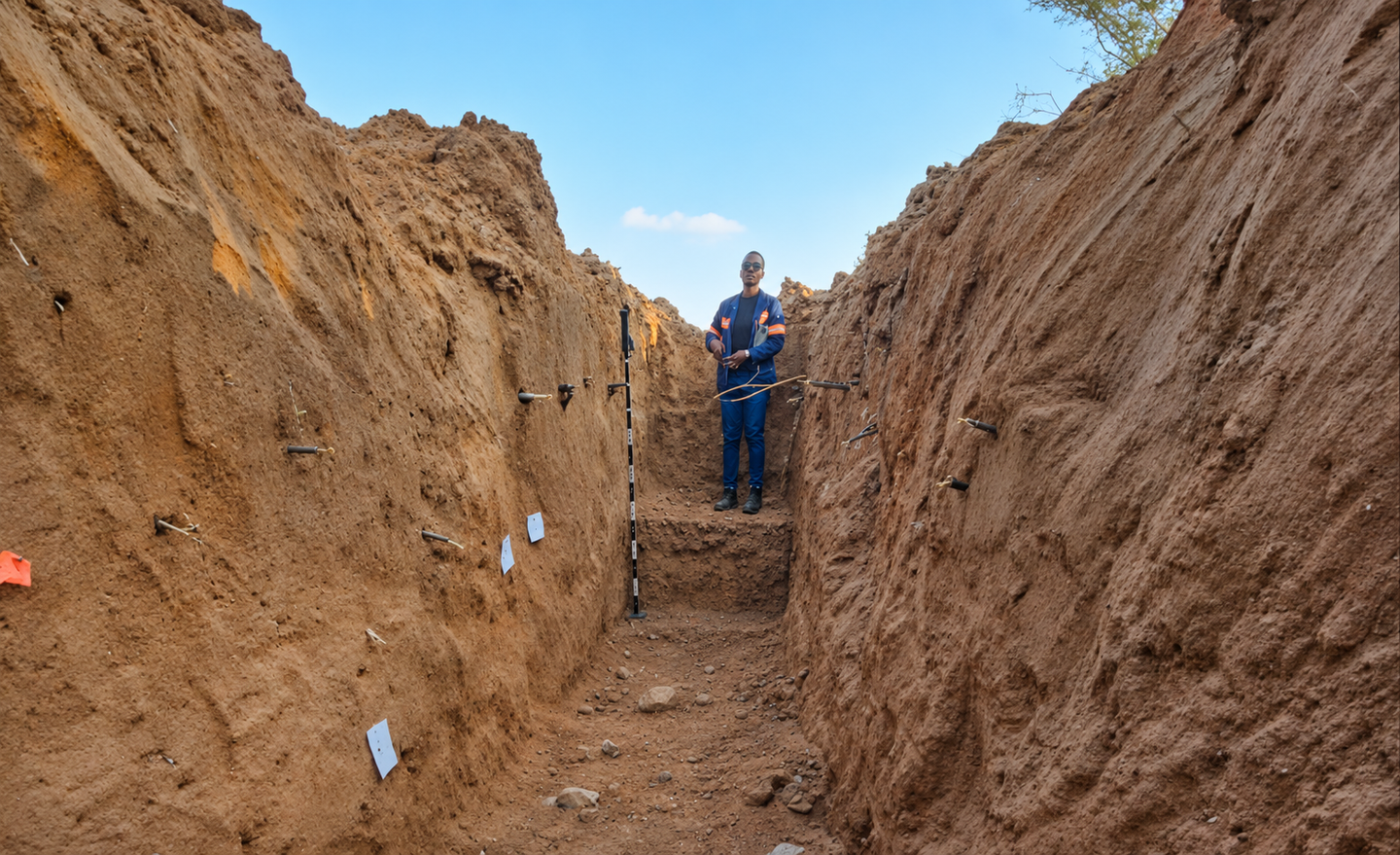
The Kalahari Craton rift is reusing an ancient fault system, with rock layers revealing past rifting and renewed deformation in Botswana. (CREDIT: Kgosidintsi et al.)
An ancient failed rift is showing renewed activity inside one of Africa's oldest continental cores. Researchers investigating the Kalahari Craton rift in eastern Botswana found evidence that present-day stretching is reusing a structure that first developed during a much older episode of continental extension.
Boniface Kgosidintsi of the Botswana International University of Science and Technology led the study, published in Tectonics. The team combined electrical imaging, borehole records and excavations to reconstruct the history of the Khurutshe Fault.
Co-author Folarin Kolawole, a structural geologist at the Lamont-Doherty Earth Observatory, helped investigate the inherited geological structures. The findings show how old weaknesses can influence a new period of deformation within otherwise resistant continental crust.
The work builds on evidence from a magnitude 6.5 earthquake that struck Botswana in April 2017. That event occurred on a different fault, roughly 80 kilometers north of Khurutshe. Together, the regional faults suggest that the East African Rift extends farther into the craton than previously recognized.
Unlike the more developed Turkana Rift, this southern system remains at an early stage. Its significance lies in where it is forming and what it has reused. A future ocean is a possible long-term outcome, rather than an established destination.
Reading a fault beneath the Kalahari landscape
The Khurutshe Fault forms an approximately 80-kilometer-long scarp, a step in the landscape created by displacement across a fault. Along its northern section, relief reaches roughly 120 meters. That height reflects a long geological history and cannot be assigned entirely to recent movement.
The researchers dug trenches across the scarp near Botswana's A1 highway. They also examined deeper excavations made for a government water pipeline. These openings exposed relationships between loose Kalahari sands, cemented sandstone and fractured rock that surface mapping alone could not resolve.
Studying surface rupture can reveal how a fault moves during an earthquake. At Khurutshe, the team instead reconstructed movements from preserved geological evidence. Polished, scored surfaces on excavated rocks indicated past sliding, while calcite veins recorded fluid movement through fractures.
The excavated blocks had lost their original orientations, so their polished surfaces could not establish the direction of ancient sliding. Other observations had to supply that context. The Kalahari Craton rift reconstruction therefore depends on combining rock textures with layer geometry and broader geological mapping.
Electrical resistivity tomography supplied a complementary subsurface view. Researchers passed electrical current through the ground and modeled differences in how strongly materials resist its flow. They compared those patterns with the rock types recorded in 20 groundwater boreholes.
As investigations of hidden faults demonstrate, underground geometry often requires multiple kinds of evidence. Here, the borehole logs helped constrain the interpretation of electrical layers. The deepest parts of the resistivity model remained less well resolved than the shallow sedimentary sequence.
The important pattern was sediment thickening toward the fault on its lowered side. Fault movement creates space where deposits can accumulate, producing wedge-shaped layers during basin growth. Finding that geometry in both old and young units supports repeated activity along the same structure.
The Kalahari Craton rift has two chapters
The older evidence comes from the Karoo succession, including Jurassic sandstone and volcanic rocks. These units record a much earlier period of regional stretching. Younger Kalahari deposits show renewed fault-related accumulation, pointing to reactivation rather than an entirely new rift starting from scratch.
Studies of Madagascar's ancient rifts likewise show how landscapes retain evidence from separate tectonic episodes. At Khurutshe, the researchers infer initial rifting during the broader Permian–Jurassic Karoo phase. The rift subsequently failed and entered a period of relative inactivity.
“We believe Khurutshe is one of the failed Mesozoic rifts within the craton and is reactivating,” Kgosidintsi said. The new history therefore contains an interruption, not uninterrupted stretching for hundreds of millions of years. Precisely when reactivation began remains uncertain.
Most deposition of the young Kalahari sands occurred during the Quaternary, the past approximately 2.6 million years. Their deformation helps establish recent geological activity. However, neither their broad age range nor the total scarp height provides an exact restart date or a count of individual earthquakes.
Research on rift-basin sediments shows why sedimentary layers can be valuable records of fault activity. Interpreting them still requires separating deposition, erosion and movement. Additional dating could refine when the Kalahari Craton rift resumed growing and how its activity changed.
Ancient seams weaken an otherwise resistant core
A craton is an old, relatively stable continental core with a thick, comparatively cool lithosphere, the crust and rigid upper mantle. The Kalahari Craton includes blocks with histories reaching back roughly 3.7 billion years. Such regions generally resist deformation more strongly than younger geological belts.
Resistance does not make them structurally uniform. The Kalahari's component blocks joined along ancient boundaries, leaving inherited fabrics and weaknesses. The researchers argue that this older framework helped guide later stretching and fault development.
“While cratons are regarded as strong old continental blocks, they do have inherent zones of weakness that can localize a new plate boundary,” Kolawole said. Studies of cratonic thinning elsewhere also challenge simple pictures of permanently unchanging continental interiors. The mechanisms and geological settings nevertheless differ.
The Khurutshe sequence suggests initial faulting preceded the Jurassic volcanic deposits. Magma therefore does not appear necessary to explain the earliest fault-controlled basin growth. That conclusion concerns the ordering of events, rather than excluding later magmatic contributions to extension.
Work on continental roots explores other interactions between stretching and deep Earth processes. In Botswana, the key observation is that an old structural weakness survived a failed rifting episode. Renewed regional extension could then exploit that weakness again.
Practical implications
The findings give geologists a framework for mapping deformation beyond the previously recognized southern rift boundary. They also challenge a proposed model treating the region south of Okavango as one stable microplate, called the San Plate. Active faults inside that proposed plate suggest its internal behavior needs closer examination.
The authors propose North San and South San plates as a possible revision. These names express a tectonic interpretation that requires further testing. They do not establish two newly separated landmasses or prove that a continuous new ocean-forming boundary already exists.
Broader studies of plate-stress models illustrate why regional geometry and forces must fit together. More observations of fault distribution, earthquakes and ground motion could test the proposed configuration. Better dates would also separate inherited relief from younger displacement.
Comparison with more advanced continental breakup elsewhere in Africa can help identify which stages this system has reached. Southern African extension is slow, and slowly developing rifts can stall. The Kalahari record itself demonstrates that failure is possible.
For now, the study offers an explanation for renewed stretching inside an ancient continental core. Its next value lies in testing where deformation continues and how quickly strain accumulates. Those measurements will help establish whether repeated reactivation establishes an emerging plate boundary or ends in another failed attempt.
Dig deeper into rifting and earthquakes in Botswana
These studies examine the region's faults, deeper structure and possible rift-initiation mechanisms.
Magnetotelluric investigation of the Southwestern terminus of the Cenozoic African rift system near the Okavango rift zone: A transition from deep melt-assisted to melt-deficient rift initiation mechanisms: This electrical-imaging study investigates contrasting deep structures and the possible roles of melt and mechanical weakening near Okavango. (Tectonophysics, 2026)
Rifting of the Kalahari Craton Through Botswana? New Seismic Evidence: This seismic study examines earthquakes and aftershock geometry as evidence for extension along inherited structures in Botswana. (Journal of Geophysical Research: Solid Earth, 2022)
Crustal and Upper Mantle Shear Wave Velocity Structure of Botswana: The 3 April 2017 Central Botswana Earthquake Linked to the East African Rift System: This analysis uses seismic velocities to investigate a possible deep connection between Botswana's earthquake region and the broader rift system. (Geophysical Research Letters, 2020)
The April 2017 Mw6.5 Botswana Earthquake: An Intraplate Event Triggered by Deep Fluids: This study evaluates evidence that elevated fluid pressure helped trigger the earthquake in the lower continental crust. (Geophysical Research Letters, 2018)
Aeromagnetic, gravity, and Differential Interferometric Synthetic Aperture Radar analyses reveal the causative fault of the 3 April 2017 Mw 6.5 Moiyabana, Botswana, earthquake: This investigation combines magnetic, gravity and satellite-radar observations to identify the previously poorly understood earthquake fault. (Geophysical Research Letters, 2017)
Research findings are available online in the journal Tectonics.
The original story "An ancient rift is reawakening inside Africa's Kalahari Craton in eastern Botswana" is published in The Brighter Side of News.
Related Stories
- Africa’s Turkana Rift has entered a critical stage of continental breakup
- Scientists discover a major geological rift tearing India in two
- Madagascar’s tilted past: How two ancient rifts sculpted a living island
Like these kind of feel good stories? Get The Brighter Side of News' newsletter.
Joseph Shavit
Writer, Editor-At-Large and Publisher
Joseph Shavit, based in Los Angeles, is a seasoned science journalist, editor and co-founder of The Brighter Side of News, where he transforms complex discoveries into clear, engaging stories for general readers. With vast experience at major media companies like The Los Angeles Times, Times Mirror and Tribune Publishing, he writes with both authority and curiosity. His writing focuses on space science, planetary science, quantum mechanics, geology. Known for linking breakthroughs to real-world markets, he highlights how research transitions into products and industries that shape daily life.