‘Groundshaking’ new study transforms our knowledge of remotely triggered earthquakes
Simulations suggest that passing seismic waves can raise fluid pressure in crushed fault material, leaving faults weakened after the shaking ends.
 HKU Writer: Philip KWONG

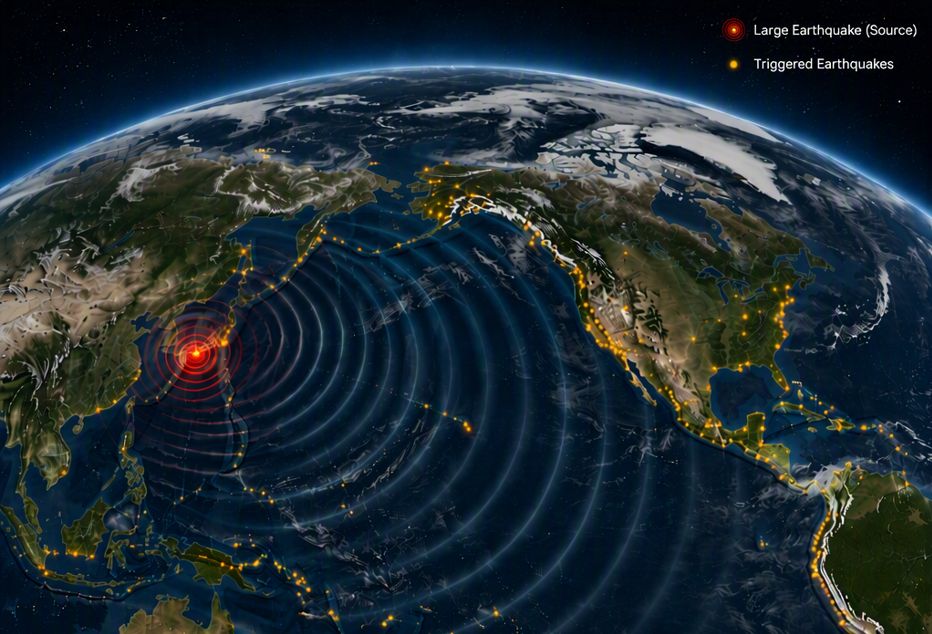
A fault-gouge model suggests trapped fluid pressure could explain remote earthquake triggering and weakening after seismic waves pass. (CREDIT: HKU)
An earthquake can disturb faults thousands of kilometers away, sometimes followed by local tremors long after its waves have passed. New modeling suggests that pressure trapped inside crushed fault material could help explain how a brief disturbance leaves a much longer mechanical aftereffect.
PhD student Chao Huang and Professor Jun Yang of The University of Hong Kong describe the mechanism in Science Advances. Their simulations connect the deformation of granular fault material with fluid-pressure changes during and after passing seismic waves.
Research on interacting faults asks how one earthquake might influence another. This study addresses a specific version of that problem: remote earthquake triggering caused by traveling waves, rather than rupture spreading continuously along adjoining faults.
Most remotely triggered events are small, according to the paper, commonly below magnitude 5. Like studies using tiny earthquakes to investigate hidden structures, this work treats them as clues to underground conditions. The aim is to understand fault sensitivity, rather than forecast a particular damaging earthquake.
The crushed material that controls fault strength
Repeated sliding grinds rock into fault gouge, a fine-grained material that can contain clay, silt-sized particles and fluid-filled pores. This layer differs mechanically from intact rock. Its grains can rearrange, changing the space available for fluid as stresses rise and fall.
Pressure inside those pores affects how strongly the solid grains press against one another. Scientists call the stress carried by the solid framework effective stress. Raising pore pressure can reduce that clamping force, making a fault easier to slide without requiring a comparable increase in shear stress.
The importance of fluid pressure also appears in research on injection-related seismicity. Here, however, the proposed pressure increase comes from wave-driven deformation within the gouge. The model does not require fluid to travel from the distant earthquake to the receiving fault.
Related investigations of water-rich fault zones show why rock structure and fluid movement matter together. In the HKU model, low permeability restricts drainage. Small irreversible contractions can therefore progressively squeeze the trapped pore fluid and raise its pressure.
To represent that behavior, Huang and Yang used a bounding surface model developed within critical-state soil mechanics. This framework allows small permanent deformations before the material reaches a conventional yielding threshold. Repeated loading can accumulate those changes even when each individual disturbance looks modest.
Gouge can also expand rather than contract, potentially lowering pore pressure and strengthening a fault. The authors discuss this as a possible reason some distant earthquakes suppress local seismic activity. Whether remote earthquake triggering occurs therefore depends partly on the material's initial condition and response.
How remote earthquake triggering unfolds in the simulation
The reference fault sits 4.25 kilometers deep, dips at 45 degrees and contains a one-meter-thick gouge layer. The researchers imposed a 200-second Rayleigh wave train containing ten cycles. Their simplified calculation follows conditions before rupture, rather than simulating a complete earthquake.
Models of earthquake cycles often explore how faults approach failure. Here, the modeled fault began close to that condition. Passing waves repeatedly altered its loading, allowing the researchers to track the evolution of pressure and strength.
The instantaneous oscillations were small: pore-pressure and effective-normal-stress amplitudes stayed below 0.2 megapascals, while shear-stress oscillations stayed below 0.03 megapascals. Yet excess pore pressure accumulated above 1.7 megapascals after ten cycles. Those numbers describe simulation outputs, not measurements collected from a natural fault.
A comparison with a conventional plasticity model highlighted the importance of accumulated deformation. That model largely returned to the same stress path each cycle and produced little progressive weakening. The bounding surface formulation instead moved the fault substantially closer to failure.
Time-dependent changes also matter in studies of dormant faults, although their loading conditions differ. In this simulation, the aftereffect involved drainage rather than continued shaking. Excess pressure at the fault's center fell from roughly 1.7 to 1.0 megapascals over three hours.
Pressure dissipation at that central location began only after approximately 30 minutes, as drainage effects spread inward from the gouge boundary. The fault therefore remained weakened well beyond the wave train. Its reference trajectory nevertheless stayed below the slip threshold and gradually moved away from failure afterward.
This distinction matters for interpreting delayed triggering. The model supplies a persistent weakened state in which additional loading or nearby events could promote later failure. It does not demonstrate that retained pressure alone inevitably causes a delayed earthquake.
Why the type of seismic wave matters
Love waves produce horizontal shearing, while Rayleigh waves combine shearing with motion that changes volume. Familiar records of Rayleigh waves illustrate their ability to carry disturbances over large distances. The HKU researchers examined which parts of that motion most effectively changed gouge pressure.
For certain fault orientations, Love waves can impose larger direct shear stresses than Rayleigh waves. Yet observations often associate remote triggering with Rayleigh-wave arrivals. That mismatch suggests the largest shear-stress pulse may not always identify the strongest trigger.
The researchers separated compressional and shear components of the modeled Rayleigh loading and compared similar stress amplitudes. Compression produced substantial cumulative pore-pressure growth, whereas the shear-only component contributed little net buildup. The contrast offers a possible explanation for Rayleigh waves' effectiveness.
As in other forms of seismic probing, interpreting a wave requires understanding the material it crosses. Here, pressure depends on the sequence of loading and unloading. Amplitude, duration and cycle count jointly affect the response, so peak shaking alone may miss important information.
The result does not establish that Rayleigh waves always dominate. The authors identify circumstances where stronger Love waves or poorly developed gouge could favor direct shear triggering. Their simplified material response also needs testing across different natural fault conditions.
Practical implications
The study gives seismologists specific mechanisms to test when investigating remote earthquake triggering. Laboratory experiments could repeatedly compress and shear natural gouge while recording pressure, deformation and drainage. Those measurements would test whether realistic materials retain the modeled mechanical aftereffect.
For field studies, the challenge includes reconstructing stresses at depth rather than relying only on surface shaking. Broader work on underground imaging shows how seismic measurements reveal otherwise hidden conditions. Testing this mechanism would require observations suited to much deeper fault zones.
The biggest uncertainty lies in the material parameters. Because the necessary cyclic-loading experiments on natural gouge remain scarce, the authors borrowed representative geotechnical values. Their formulation explores plausible behavior rather than providing a quantitatively calibrated description of a particular earthquake-producing fault.
Observations of actual rupture address another part of the process. This model uses a smooth, planar fault and prescribed wave stresses, omitting the complexity of branching structures and full rupture dynamics. Its three-hour calculation also does not reproduce the entire range of reported delays extending to months.
The proposed mechanism broadens what researchers should measure: grain-scale deformation, fluid confinement and the complete loading history. Establishing those links could improve understanding of fault sensitivity. Turning that understanding into reliable hazard forecasts remains a separate task requiring laboratory constraints, field observations and further modeling.
Dig deeper into remote earthquake triggering
These studies examine observed triggering, statistical uncertainty and the physical questions behind distant earthquake interactions.
False positives in the identification of dynamic earthquake triggering: This study shows how chance clustering can mimic triggering in earthquake catalogs and explains why statistical controls matter. (Journal of Geophysical Research: Solid Earth, 2025)
Ubiquitous Earthquake Dynamic Triggering in Southern California: This catalog analysis reports widespread apparent triggering, providing the observations later examined by the false-positive study above. (Journal of Geophysical Research: Solid Earth, 2023)
Characteristics of Frequent Dynamic Triggering of Microearthquakes in Southern California: This regional study investigates triggering frequency, wave characteristics and the difficulty of defining robust detection thresholds. (Journal of Geophysical Research: Solid Earth, 2021)
The Uses of Dynamic Earthquake Triggering: This review explains how passing seismic waves can serve as natural experiments for studying fault response. (Annual Review of Earth and Planetary Sciences, 2014)
Global ubiquity of dynamic earthquake triggering: This global seismic analysis documents increases in small-earthquake detections during passing surface waves across varied tectonic environments. (Nature Geoscience, 2008)
Research findings are available online in the journal Science Advances.
The original story "'Groundshaking' new study transforms our knowledge of remotely triggered earthquakes" is published in The Brighter Side of News.
Related Stories
- Scientists solve the 30-year mystery of 'clockwork' earthquakes
- Scientists create the first global map of rare, deep-mantle earthquakes
- Tiny earthquakes reveal hidden faults where San Andreas meets Cascadia
Like these kind of feel good stories? Get The Brighter Side of News' newsletter.
Joshua Shavit
Writer and Editor
Joshua Shavit is a NorCal-based science and technology writer with a passion for exploring the breakthroughs shaping the future. As a co-founder of The Brighter Side of News, he focuses on positive and transformative advancements in technology, physics, engineering, robotics, and astronomy. Having published articles on AOL.com, MSN, Yahoo News, and Ground News, Joshua's work highlights the innovators behind the ideas, bringing readers closer to the people driving progress.