Early galaxy collisions may explain why giant galaxies died young
Study links dusty star-forming galaxies to giant dead galaxies in the early Universe through violent cosmic mergers.

 Edited By: Joseph Shavit

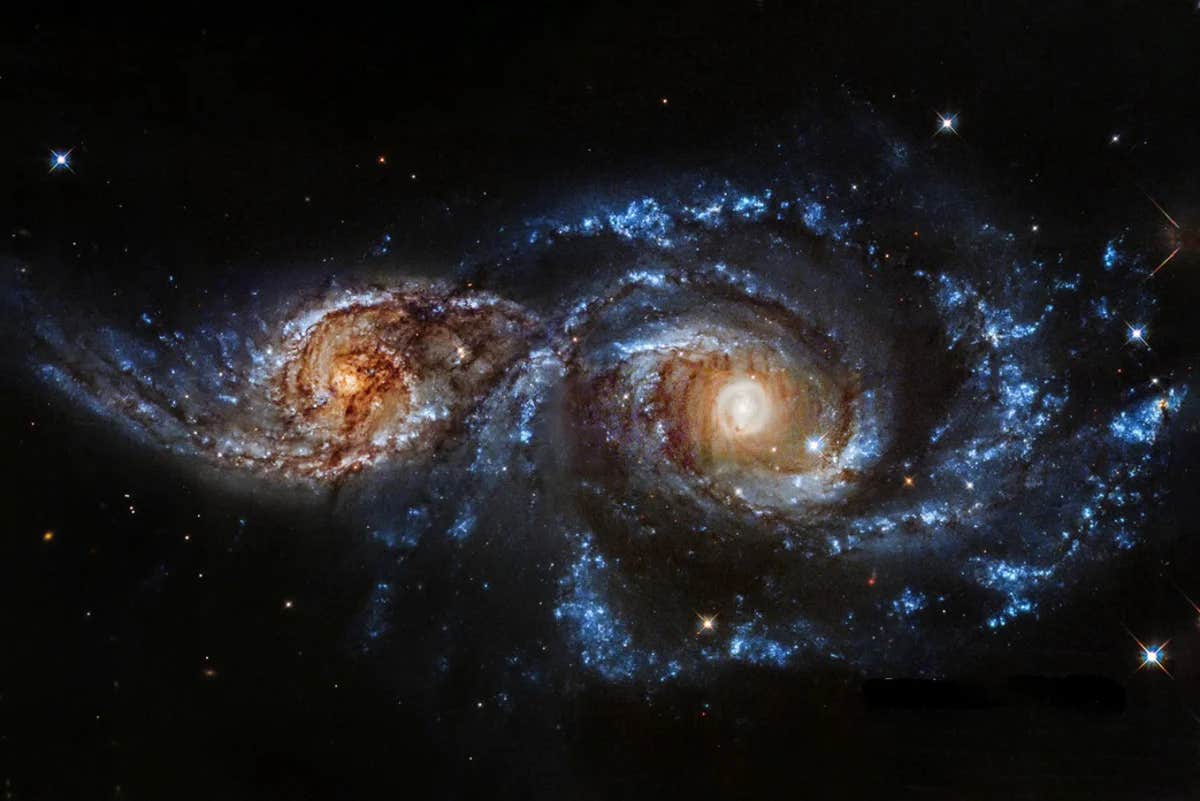
Astronomers have identified a likely evolutionary path linking dusty star-forming galaxies to massive quiescent galaxies that stopped producing stars surprisingly early in cosmic history. (CREDIT: NASA, ESA, and The Hubble Heritage Team (STScI))
A new study suggests that some of the Universe’s earliest giant galaxies may have lived dramatic lives. They began as dusty stellar factories, producing hundreds of stars each year, before suddenly shutting down and becoming cosmic graveyards. The research offers a possible explanation for one of astronomy’s most persistent puzzles: how massive galaxies formed so quickly after the Big Bang and then stopped making stars while the Universe was still young.
The study was conducted by researchers at the Institute of Astronomy, Geophysics, and Atmospheric Sciences at the University of São Paulo (IAG-USP) in Brazil and international collaborators. The work links two seemingly different classes of galaxies in the early Universe and proposes a common evolutionary path between them.
A Mystery From the Dawn of Cosmic History
Astronomers have long been puzzled by the existence of massive quiescent galaxies, often called MQs. These systems contain enormous numbers of stars yet show little or no ongoing star formation. Even more surprising, they appeared when the Universe was only 3 to 4 billion years old.
The timing creates a major challenge for galaxy formation theories. These galaxies had to build up vast stellar populations in a relatively short period and then somehow shut down star production almost completely.
Their behavior contrasts sharply with that of the Milky Way. Our galaxy formed early in cosmic history and still produces new stars today, roughly 13.5 billion years later. Although the Milky Way forms only about one solar mass worth of stars each year, it has never fully stopped.
Massive quiescent galaxies followed a very different path. They rapidly assembled their stellar mass and then became largely inactive.
Understanding how this happened has become one of the most important questions in studies of galaxy evolution.
Connecting Two Very Different Galaxy Populations
To investigate the mystery, researchers examined another class of galaxies known as dusty star-forming galaxies, or DSFGs.
“We focused on two seemingly distinct populations: dusty star-forming galaxies and massive quiescent galaxies,” said Laerte Sodré Júnior, a retired full professor at IAG-USP and doctoral advisor to lead author Pablo Araya-Araya.
DSFGs are among the most extreme star-producing systems in the Universe. Some generate up to 500 solar masses worth of stars every year. That rate is roughly 500 times higher than the Milky Way’s current production.
These galaxies are wrapped in thick clouds of dust that block visible light. As a result, they are difficult to observe with traditional optical telescopes. However, they shine brightly at submillimeter and infrared wavelengths.
Modern observatories have made it possible to study them in unprecedented detail. The Atacama Large Millimeter/Submillimeter Array, known as ALMA, has discovered thousands of these dusty galaxies. Meanwhile, the James Webb Space Telescope has begun revealing their structures and stellar populations through infrared observations.
The researchers wanted to determine whether these energetic star factories eventually evolved into the silent giants seen later in cosmic history.
Following Galaxies Through Time
The team used a semi-analytical galaxy formation model to reconstruct how galaxies evolved at redshifts between 2 and 4. These redshifts correspond to a period when the Universe was approximately 3 to 4 billion years old.
By tracing the histories of galaxies through simulations, the researchers could identify whether massive quiescent systems previously passed through a dusty, star-forming phase.
The answer was striking.
Between 86% and 96% of massive quiescent galaxies had previously existed as dusty star-forming galaxies. At redshift 2, about 86% of MQs showed evidence of an earlier DSFG phase. At redshift 3, the figure rose to 96%. At redshift 4, it remained above 90%.
In other words, nearly every massive quiescent galaxy appears to have lived a highly active and dusty youth.
However, the reverse was not true.
Many dusty star-forming galaxies never became massive quiescent galaxies. Instead, they continued producing stars for much longer periods before gradually slowing down.
This distinction pointed researchers toward a critical difference in their evolutionary histories.
The Violent Event That Changes Everything
According to the model, the future of a galaxy may depend on a single dramatic event: a major merger.
The researchers found that the ancestors of massive quiescent galaxies typically experienced an early collision with another galaxy of similar size.
These encounters were not gentle interactions. They were cosmic crashes involving enormous amounts of gas, dust and stars.
“The merger of the two galaxies concentrated large amounts of gas in the core, simultaneously triggering an extreme burst of star formation and intense feeding of the supermassive black hole,” Sodré explained.
The merger pushed huge quantities of cold gas toward the galaxy’s center. This fueled both explosive star formation and rapid growth of the central supermassive black hole.
For a brief period, the galaxy became extraordinarily active. Stars formed at exceptional rates while the black hole consumed matter at high speed.
Yet the same process that ignited this activity ultimately ended it.
How Galaxies Shut Themselves Down
As the central black hole grew, it released enormous amounts of energy into the surrounding environment.
This energy changed the galaxy’s future.
“In that process, the cold gas is rapidly consumed while the energy released by the active nucleus heats the surrounding halo gas and prevents it from cooling and being reincorporated into the galaxy, blocking the supply of raw material for new stars and halting star formation in less than one billion years,” Sodré said.
Without a fresh supply of cool gas, star formation could not continue.
The galaxy essentially exhausted its fuel and then prevented new fuel from arriving.
The simulations showed that galaxies following this path often quenched their star formation within less than one billion years after their peak dusty phase. The interval between maximum submillimeter brightness and quenching ranged from roughly 400 million to 900 million years, depending on the galaxy’s age and redshift.
Meanwhile, most dusty galaxies that avoided early major mergers followed a slower path. They continued growing through long-term star formation and experienced major mergers much later.
As a result, their star-forming activity faded more gradually.
New Telescopes Reveal More Questions
Recent observations from the James Webb Space Telescope have strengthened the importance of this research.
Webb has revealed larger numbers of massive quiescent galaxies in the early Universe than many models predicted. At the same time, it has provided new insights into dusty star-forming systems.
These discoveries suggest that astronomers may still be missing important pieces of the puzzle.
The new model helps explain how many dusty galaxies evolve into quiescent systems, but it does not fully resolve every discrepancy.
“We’re observing far more galaxies with submillimeter emissions than we predicted,” Sodré admitted.
This means existing models still underestimate the number of dusty star-forming galaxies observed in the real Universe.
Researchers will need more sophisticated simulations and better observations to close the gap.
Looking Toward the Next Generation of Astronomy
Future discoveries may come from one of the most powerful telescopes ever built.
The Giant Magellan Telescope, currently under construction at Las Campanas Observatory in Chile’s Atacama Desert, is expected to play a major role in studying early galaxies.
“With its 24.5-meter primary mirror, the GMT will be able to produce images three to four times more detailed than the James Webb,” Sodré emphasized.
Astronomers expect the telescope to begin operations during the next decade.
Its observations could reveal how galaxy mergers, starbursts and black hole growth shaped the first generations of massive galaxies.
Practical Implications of the Research
This research provides an important framework for understanding how galaxies grow, evolve and eventually stop forming stars. By identifying a likely connection between dusty star-forming galaxies and massive quiescent galaxies, scientists gain a clearer picture of how the largest galaxies in the Universe developed during its earliest epochs.
The findings also improve understanding of the role supermassive black holes play in regulating galaxy growth. Learning how black holes influence star formation can help researchers refine models of cosmic evolution and better interpret observations from powerful new telescopes.
As facilities such as the Giant Magellan Telescope come online, this work offers a roadmap for testing new theories against real observations. Ultimately, understanding how the first massive galaxies formed and evolved helps scientists reconstruct the broader history of the Universe and humanity’s place within it.
Research findings are available online in the journal Astronomy and Astrophysics.
The original story "Early galaxy collisions may explain why giant galaxies died young" is published in The Brighter Side of News.
Related Stories
- Astronomers discover the most chemically primitive galaxy in the universe
- A dead galaxy from the early universe is forcing astronomers to rethink galactic evolution
- ‘Space archaeologists’ use oxygen map to reconstruct a galaxy’s 12-billion-year past
Like these kind of feel good stories? Get The Brighter Side of News' newsletter.
Joshua Shavit
Writer and Editor
Joshua Shavit is a NorCal-based science and technology writer with a passion for exploring the breakthroughs shaping the future. As a co-founder of The Brighter Side of News, he focuses on positive and transformative advancements in technology, physics, engineering, robotics, and astronomy. Having published articles on AOL.com, MSN, Yahoo News, and Ground News, Joshua's work highlights the innovators behind the ideas, bringing readers closer to the people driving progress.