The universe is significantly older than previously thought, astronomers find
A new model says the universe may be 26.7 billion years old, giving early galaxies far more time to form than standard cosmology allows.

 Edited By: Joshua Shavit

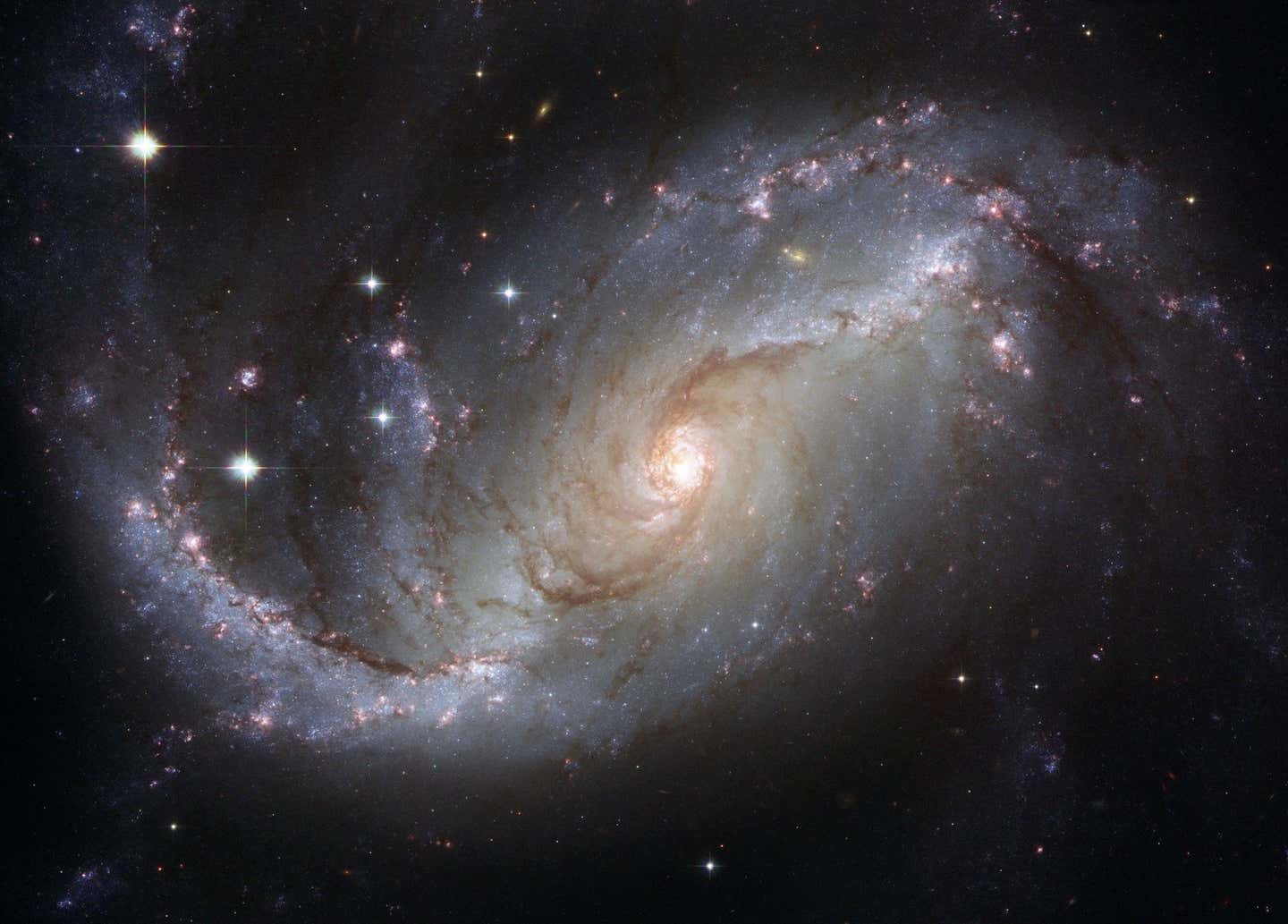
A new cosmology model suggests the universe may be 26.7 billion years old, reshaping how JWST’s earliest galaxies are understood. (CREDIT: Wikimedia / CC BY-SA 4.0)
Galaxies spotted by the James Webb Space Telescope have been causing trouble for the standard story of cosmic history. Some appear bright, massive, and oddly compact at a time when the universe, under the usual model, should have been only a few hundred million years old. That leaves very little time for such mature systems to form.
A study by University of Ottawa physicist Rajendra Gupta argues that the mismatch may not lie in the galaxies at all, but in the timeline used to interpret them. His model, which blends an expanding universe with a version of “tired light” and a framework in which fundamental constants change over time, stretches cosmic history far beyond the familiar estimate of about 13.7 billion years.
Under the version he favors, the universe would be 26.7 billion years old.
That is not a small adjustment. It is a direct challenge to the standard Lambda-CDM model, the long-dominant cosmological framework used to describe the universe’s expansion, dark energy, and the growth of large-scale structure.
The tension has grown sharper since JWST began peering deep into cosmic time. Observations have turned up galaxies less than 300 million years after the Big Bang that seem more developed than many astronomers expected. Other work has pointed to an excess of luminous galaxies at very high redshift, along with surprisingly early quasars and even a quiescent galaxy seen when the universe was only about 700 million years old.
Some of those objects also appear much smaller than expected.
Redshift may not tell a single story
Cosmologists usually treat redshift, the stretching of light toward longer wavelengths, as a sign of cosmic expansion. Gupta’s analysis asks whether that signal might instead be a hybrid, caused partly by expansion and partly by a gradual energy loss in photons as they travel huge distances. That second idea comes from Fritz Zwicky’s old tired light concept, a proposal that fell out of favor because it clashes with key observations when used on its own.
Gupta does not revive tired light as a replacement for expansion. He treats it as a partner.
In the study, he tests two hybrid models against Pantheon+, a major set of Type Ia supernova data often used to judge cosmological models. A plain tired light model fails badly. But two hybrids, one combining Lambda-CDM with tired light and another combining tired light with what Gupta calls a covarying coupling constants model, fit the supernova data nearly as well as the standard cosmology.
That second hybrid, called CCC + TL, is the one carrying the big implications.
The CCC part comes from an idea associated with Paul Dirac, who suggested long ago that fundamental constants might not stay fixed forever. Gupta’s model allows quantities tied to physics at the deepest level to evolve together over time. In his formulation, that changes the Friedmann equations that describe cosmic expansion and also changes how age, distance, and galaxy size are inferred from redshift.
The result is a much more generous early universe.
More time for the first giant galaxies
In the standard model, very distant galaxies seen at redshifts of 10 to 20 belong to a universe still in its infancy. Gupta’s preferred hybrid stretches those epochs dramatically. His paper reports that at redshift 10, the model gives the universe 5.8 billion years, and at redshift 15, 3.5 billion years, far more time than the standard picture allows for large galaxies to assemble.
That extended timeline is central to his argument. Rather than forcing stars, galaxies, and black holes to form at extreme speed, he suggests the clock itself has been read too narrowly.
The paper also focuses on angular size, another point of friction in JWST data. Under standard Lambda-CDM, the angular diameter distance reaches a maximum and then falls at higher redshift. That means a very small observed angular size can translate into a genuinely tiny galaxy. Gupta argues that in the CCC + TL model, the peak is much higher and shifted in a way that makes those same observations consistent with larger physical sizes.
His calculations suggest the difference becomes large at high redshift. Compared with Lambda-CDM, the inferred size multiplier for galaxies in the CCC + TL model reaches 5.6 at redshift 10, 9.5 at redshift 15, and 12.8 at redshift 20. If that framework were right, some galaxies now considered implausibly compact would no longer look so strange.
The study also tracks how much of the redshift in the hybrid model would come from tired light rather than expansion. That contribution stays modest, about 22 percent at redshift 1 and falling at higher redshift, but Gupta argues it still changes the picture because redshift effects combine multiplicatively.
A bold fix with major caveats
The paper is careful in places about what remains uncertain. Gupta notes that galaxy size evolution at very high redshift is not well measured. Observed angular sizes depend on how stellar populations are distributed, how faint outer regions are, and how galaxy light and mass profiles are interpreted. He also notes that some high-redshift candidates selected photometrically have later turned out to sit at much lower redshift when checked spectroscopically.
There are broader concerns too.
A model may help with early galaxies and still struggle elsewhere. Gupta openly says the next test would be whether CCC + TL can explain the cosmic microwave background, big-bang nucleosynthesis, and baryonic acoustic oscillations. Those are not side issues. They are among the main pillars any cosmological model has to satisfy.
The study also states that systematic uncertainties in the Pantheon+ data were not included, though Gupta argues those would likely affect the models in similar ways and would not change the comparison much.
Even so, the appeal of the proposal is clear. JWST has pushed astronomers into a tougher conversation about whether the earliest galaxies grew faster than expected, whether their masses and brightness have been overestimated, or whether the larger cosmological framework needs revision. Gupta’s paper lands squarely in the third camp.
He frames the James Webb telescope as a disruptive instrument, much as the Hubble Space Telescope was in the 1990s. Hubble helped cement the standard cosmological model. Webb, in his telling, is exposing its weak spots.
That does not mean the standard model is about to fall. It does mean the pressure on cosmology has risen.
Practical implications of the research
If Gupta’s model survives further testing, it would change more than one number in a textbook. It would alter how astronomers interpret redshift, estimate cosmic age, and infer the true sizes and maturity of the earliest galaxies. It could also ease the need for increasingly strained explanations of how massive galaxies and black holes appeared so quickly after the Big Bang.
At the same time, the proposal remains provisional. Its strongest value right now may be in forcing a sharper test of assumptions that have long seemed settled. JWST is delivering observations that do not fit neatly into the old timeline, and this research offers one way, though still a contested one, to explain why.
Key Characteristics of the Cosmic Dawn:
The cosmic dawn refers to the period in the early universe when the first stars and galaxies began to form and light up the cosmos. It marks a critical phase in the evolution of the universe, transitioning from the so-called Dark Ages—a time after the Big Bang when the universe was filled with a dense, opaque fog of neutral hydrogen and helium gas, and there were no sources of light.
Time Period:
- The cosmic dawn occurred roughly 100 million to 1 billion years after the Big Bang.
- It corresponds to redshifts of z ~ 20 to 10.
First Stars and Galaxies:
- The earliest stars, called Population III stars, were massive, short-lived, and composed almost entirely of hydrogen and helium.
- These stars began producing the first light (starlight) and elements heavier than helium through nucleosynthesis.
Reionization Era:
- Radiation from these early stars and galaxies began ionizing the surrounding neutral hydrogen, marking the onset of cosmic reionization.
- This process gradually cleared the fog of neutral gas, allowing ultraviolet light to travel freely and making the universe transparent to light.
Observation Techniques:
- 21-centimeter radio waves from neutral hydrogen during this era provide crucial information about the cosmic dawn.
- Advanced telescopes, like the James Webb Space Telescope (JWST) and LOFAR (Low-Frequency Array), aim to study this period by observing distant galaxies and the cosmic microwave background.
Significance:
- The cosmic dawn set the stage for the large-scale structure of the universe.
- Understanding this era helps scientists uncover how the first cosmic structures formed, including galaxies, black holes, and clusters.
Studying the cosmic dawn offers insight into the universe’s early history and the processes that shaped its evolution into the rich, complex cosmos we see today.
Research findings are available online in the journal Monthly Notices of the Royal Astronomical Society (MNRAS).
The original story "The universe is significantly older than previously thought, astronomers find" is published in The Brighter Side of News.
Related Stories
- Ancient Milky Way stars challenge the age of the universe and the Hubble tension
- Black hole GW190521 may be a wormhole from another universe
- Dense dark matter clumps link three strange objects across the universe
Like these kind of feel good stories? Get The Brighter Side of News' newsletter.
Joseph Shavit
Writer, Editor-At-Large and Publisher
Joseph Shavit, based in Los Angeles, is a seasoned science journalist, editor and co-founder of The Brighter Side of News, where he transforms complex discoveries into clear, engaging stories for general readers. With vast experience at major media companies like The Los Angeles Times, Times Mirror and Tribune Publishing, he writes with both authority and curiosity. His writing focuses on space science, planetary science, quantum mechanics, geology. Known for linking breakthroughs to real-world markets, he highlights how research transitions into products and industries that shape daily life.