Earth microbes could survive for days on the Moon, NASA finds
Cold, shadowed pockets near the lunar poles may protect Earth microbes from deadly UV radiation far longer than expected.
 University of Maryland Writer: Jennifer Holland

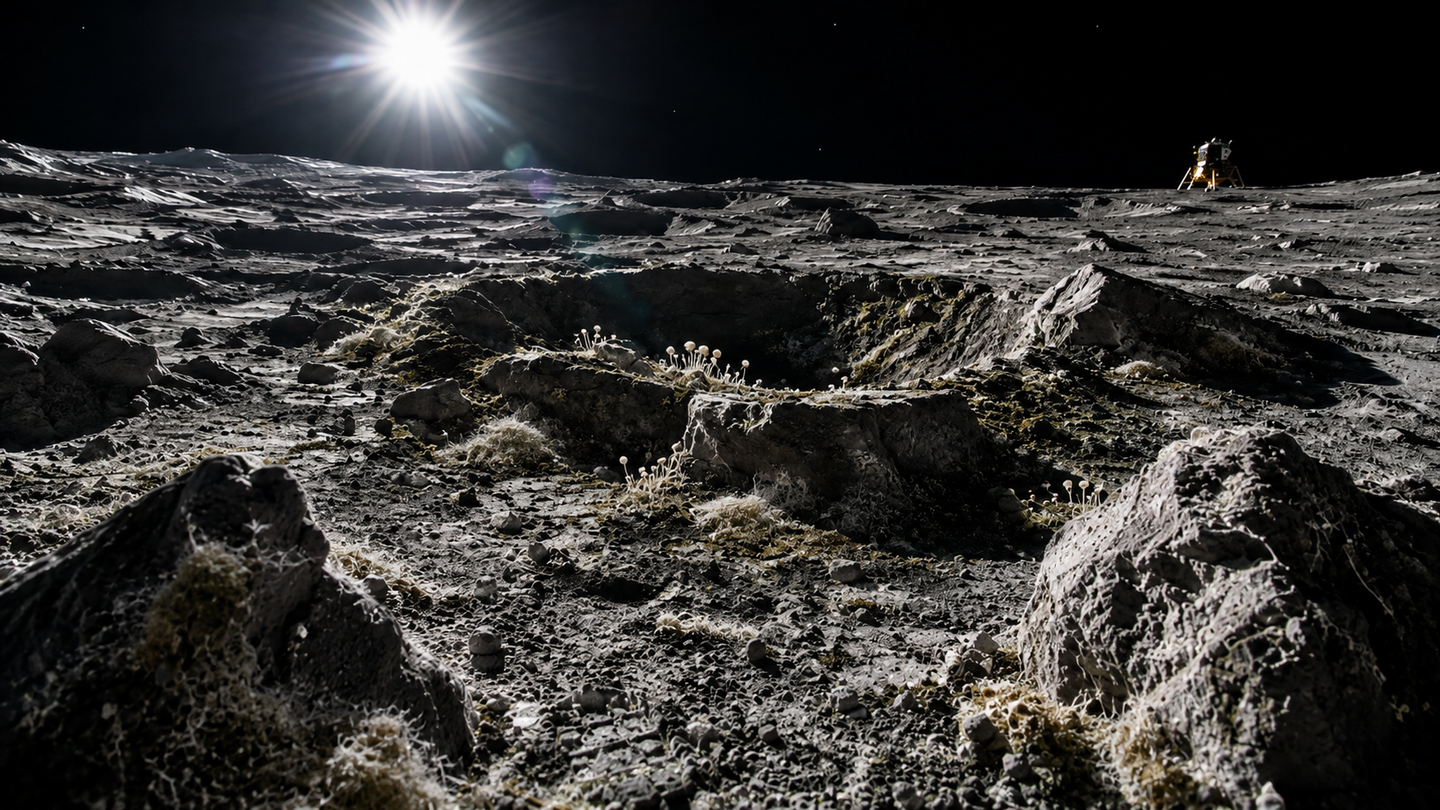
Microbes surviving on the moon could persist for a week in shaded polar niches, raising contamination concerns for Artemis missions. (CREDIT: Shutterstock)
- Shaded areas near the moon’s poles could allow some bacteria and fungi carried from Earth to survive for days, with the hardiest lasting at least a week.
- Craters, ridges and even small surface depressions can block ultraviolet radiation, which appears to be the main threat to microbes in these cold polar regions.
- The survival zones could complicate future moon and Mars science because astronauts may leave microbes behind in places where researchers want to search for ancient chemistry or signs of life.
The moon’s south pole can plunge into brutal cold and still offer something unexpected: shelter. In certain shaded pockets, microbes carried from Earth may endure the lunar surface far longer than scientists once assumed.
A NASA-led study mapped places where bacteria and fungi could survive for at least one Earth day. Some niches may protect the hardiest organisms for a week or more.
The result matters as NASA prepares for Artemis missions near the lunar south pole. Humans carry microbes wherever they go, and future astronauts could unintentionally leave biological traces in places scientists want to study for ancient chemistry and volatile compounds.
“When we created lunar maps with purple, red and blue representing different surviving microbe species, we were surprised at how colorfully they turned out,” said study co-author Stefano Bertone, an associate research scientist in the University of Maryland’s Department of Astronomy. “So much for ‘nothing can survive on the moon.’”
Shadows change the survival equation
The moon has only a small axial tilt, so the sun remains low on the horizon near the poles. Craters, ridges and even modest bumps can block direct sunlight.
That creates permanently shadowed regions, or PSRs, where temperatures remain low and direct ultraviolet radiation is absent. These conditions help preserve water ice and may also protect microbes from one of the moon’s most destructive forces.
Earlier work suggested microbes left on the lunar surface would have little chance of surviving. But those models focused mainly on equatorial areas and did not fully account for topography.
“Incorporating the bumps and craters was a key to this study,” Bertone said. “The question was, how well can the moon’s surface topography shield some areas from UV, and is it enough to keep any of our study organisms alive?”
The team examined five microbial groups: Bacillus, Deinococcus, Staphylococcus, Aspergillus and Fusarium. They include bacteria and fungi associated with humans, spacecraft environments and clean rooms, along with organisms known for unusual resistance to harsh conditions.
UV exposure becomes the main threat
Temperatures near the lunar poles rarely reached levels high enough to kill the selected microbes in the models. Ultraviolet radiation was far more important.
The organisms differed greatly in how much UV energy they could withstand. Aspergillus stood out as the most resilient. During lunar winter, it could potentially survive in 15% to 30% of mapped areas that receive some sunlight. During summer, that range dropped to about 2% to 9%.
All five microbes had potentially survivable areas in each of three Artemis III candidate regions examined at high resolution. About 3% of the mapped terrain in all three regions could support Aspergillus survival for at least seven days.
The researchers combined temperature measurements from NASA’s Lunar Reconnaissance Orbiter with elevation data from its Lunar Orbiter Laser Altimeter. They then used ray tracing, a method that follows the paths of light across uneven terrain.
“We can trace the path of light from the sun to the moon considering the sun’s position and every bump and boulder that causes a ray to bounce and pivot before reaching the surface,” Bertone explained. “Even what are called permanently shaded regions get light, and therefore UV, indirectly. It’s all extremely nuanced, and this method lets us account for small details.”
Scattered light mattered most inside permanently shadowed regions. In a modeled PSR near De Gerlache, reflected UV reduced the amount of survivable terrain, but did not eliminate it. All five microbes could still survive in some locations for more than a week.
Boot prints could create tiny shelters
Measurements from China’s Chang’e missions suggest that meter-scale and submeter craters near the poles can contain persistent shadows. Human activity could create similar niches. Boot prints, rover wheels, drill holes and scoops may leave depressions shielded from direct sunlight.
That possibility complicates planetary protection. Humans shed enormous numbers of microorganisms. A patch of skin about the size of a pinky nail can hold roughly a million bacteria, and crewed habitats add more potential pathways for contamination.
“There’s potential for a lot of human contamination of the lunar landscape and, inevitably, the science we do there,” Bertone said.
The concern is not that microbes will establish flourishing lunar ecosystems. Survival and growth are different biological states.
The modeled organisms would likely persist in a dormant, or cryptobiotic, condition. Growth would require a more habitable environment, including access to liquid water. The moon lacks the stable atmosphere and moderate surface conditions normally needed to maintain liquid water.
Still, a living microbe does not need to reproduce to cause scientific problems. Surviving cells, and even dead biological material, could complicate searches for organic compounds or evidence connected to prebiotic chemistry.
“We need to understand what was there before us, because when we go to Mars to search for signs of life beyond our planet, we will want to make sure it’s not stuff we brought,” said Prabal Saxena, a planetary scientist at NASA’s Goddard Space Flight Center who led the study.
Practical implications of the research
The findings give mission planners a reason to treat shaded lunar terrain as a contamination concern rather than assuming the surface quickly sterilizes everything humans leave behind.
The work could guide stricter contamination controls around scientifically sensitive sites, particularly permanently shadowed regions. The authors note that spacecraft headed for the lunar surface currently have no bioburden requirements, even though human activity will increase the quantity and diversity of microbes reaching the moon.
Next, the researchers plan to use higher-resolution terrain models, including shape-from-shading methods that reconstruct three-dimensional landscapes from photographs. They also want more detailed microbial experiments and better illumination models.
“In planning human operations to the moon or elsewhere, we need to know everything we can about what’s been left behind,” Bertone said.
Dig deeper into lunar microbes and planetary protection
These resources explore microbial survival in space, the unusual environment of lunar polar shadows, and the contamination challenges that come with sustained human exploration of the moon.
Researchers modeled microbial survival inside permanently shadowed regions at Shackleton and Faustini craters, concluding that these protected environments could preserve viable terrestrial microbes for decades. (Astrobiology, 2025)
This experiment found that Bacillus subtilis, the fungus Aureobasidium pullulans and the archaeon Methanosarcina mazei remained viable after two years of exposure outside the International Space Station, demonstrating how some organisms can persist under extreme space conditions. (Scientific Reports, 2024)
This analysis mapped faint radiation reaching lunar permanently shadowed regions and showed that scattered sunlight can deliver ultraviolet photons even where direct sunlight never reaches the surface, an important factor in estimating microbial survival. (Acta Astronautica, 2021)
This recent NASA resource examines how landed spacecraft can introduce organic contaminants to the lunar environment and describes modeling approaches for estimating contamination footprints around scientifically valuable sites. (NASA Technical Reports Server, 2026)
The current international planetary protection framework explains how missions manage biological and organic contamination, including enhanced documentation requirements for lunar polar regions and permanently shadowed regions. (Committee on Space Research, 2026)
Research findings are available online in the journal Science Advances.
The original story "Earth microbes could survive for days on the Moon, NASA finds" is published in The Brighter Side of News.
Related Stories
- Martian microbes can survive being blasted into space by a large asteroid strike
- Salty ice may hold the key to life on Jupiter’s moon Europa
- Recycled waste could make the moon or Mars suitable for growing food
Like these kind of feel good stories? Get The Brighter Side of News' newsletter.
Joseph Shavit
Writer, Editor-At-Large and Publisher
Joseph Shavit, based in Los Angeles, is a seasoned science journalist, editor and co-founder of The Brighter Side of News, where he transforms complex discoveries into clear, engaging stories for general readers. With vast experience at major media companies like The Los Angeles Times, Times Mirror and Tribune Publishing, he writes with both authority and curiosity. His writing focuses on space science, planetary science, quantum mechanics, geology. Known for linking breakthroughs to real-world markets, he highlights how research transitions into products and industries that shape daily life.