Physicists send a message through a brick wall using gravity
An elevator counterweight and a sensitive instrument in a bathroom carried the word “Gravity” through a brick wall. The experiment demonstrates a communication channel ordinary shielding cannot block, while highlighting major limits in speed and range.

 Editor: Joshua Shavit

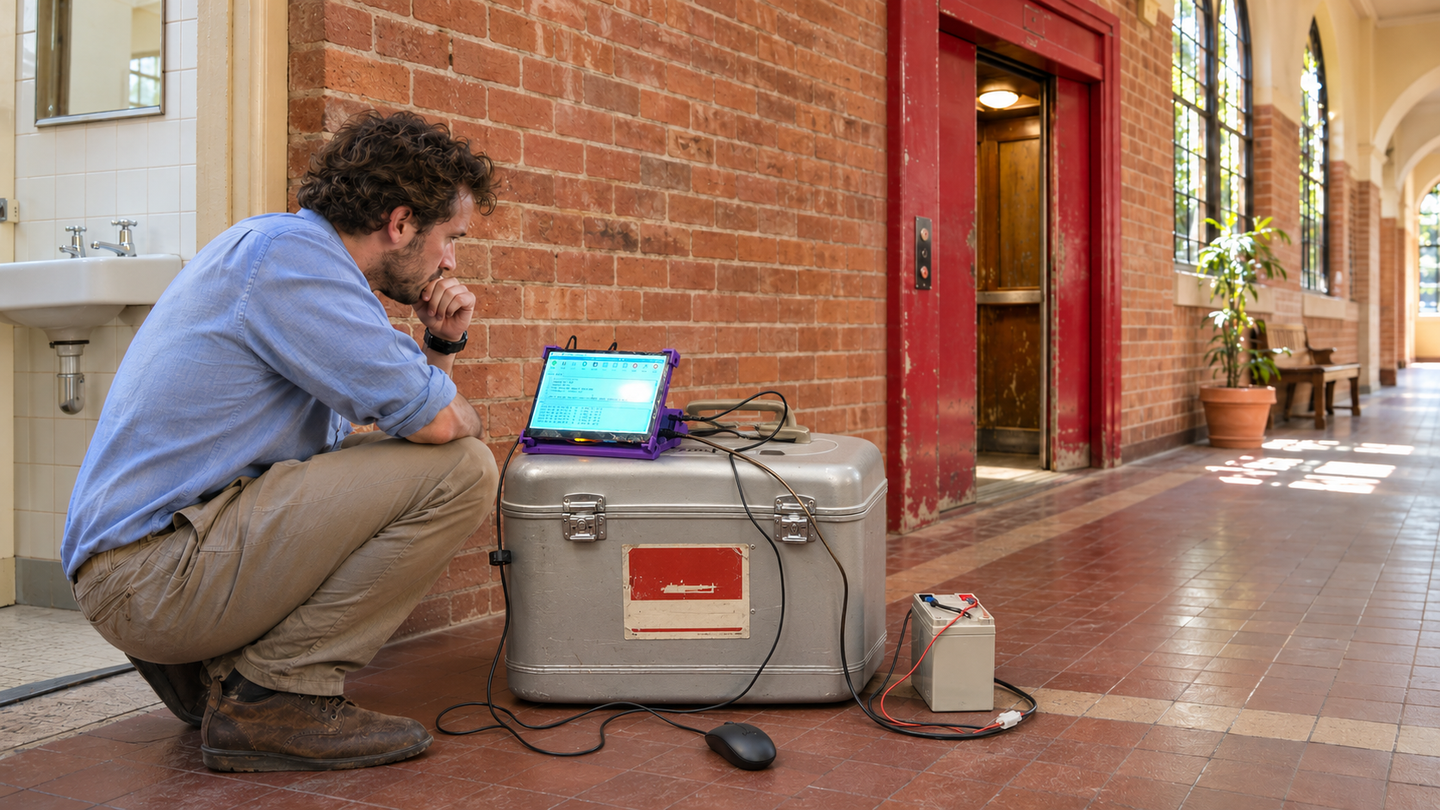
Artist’s reconstruction. A gravity communication experiment used an elevator counterweight to send a word through a brick wall at one bit per minute. (CREDIT: The Brighter Side of News)
An old elevator in a university physics building has delivered something more unusual than passengers: a message sent through gravity. On the other side of a brick wall, an instrument in a bathroom registered the changing pull of the lift’s counterweight. Its readings spelled out a single word, “Gravity.”
The University of Queensland team describes the experiment in Science Advances. Moving the roughly 1.8-tonne mass created two distinguishable gravitational states, which the researchers used as binary zeros and ones. The demonstration transmitted information across about 0.7 meters at one bit per minute.
That pace offers little competition for wireless communication. The attraction lies in a different property: ordinary material cannot screen out gravity the way it can block light or weaken radio signals. Advances in gravity sensing make that possibility worth testing, even while practical applications remain uncertain.
A weighing project becomes a communication experiment
The idea began with a contactless weighbridge. Andrew Groszek and his colleagues wanted to estimate the mass of trucks and other large vehicles by measuring their gravitational attraction. Every nearby object contributes to the local gravitational field, although the changes are usually far too small for a person to notice.
“Once we had shown that the idea worked, we realised the same physics could be used to encode and transmit information,” Groszek said. A mass that changes position also changes the pull experienced by a nearby detector. Repeat those movements in a planned sequence, and the detector can read a pattern.
This uses the familiar gravity described by Newton’s law, with a larger mass producing a stronger attraction and distance weakening it. Measuring such tiny forces connects with research on small-scale gravity. Here, however, the source was an ordinary piece of building machinery.
The elevator in UQ’s Parnell Building moved its counterweight between two positions as the lift traveled between levels. A nearby gravimeter measured the resulting change. Just as gravity measurements can reveal buried material, they could reveal where this known mass had moved.
Seven letters take about an hour
The researchers encoded “Gravity” using seven-bit ASCII, a scheme that assigns each character a sequence of zeros and ones. Seven letters therefore required 49 bits. They added seven alternating control bits before the word and another seven afterward, bringing the transmission sequence to 63 minutes.
Those extra patterns helped identify the message against the background and establish its timing. Each bit occupied a minute: roughly 25 seconds for counterweight movement, 10 seconds for settling and 25 seconds of measurement averaging. The slow rhythm gave the detector time to distinguish one state from the other. This transmission rate describes how quickly the machinery and receiver could handle information, rather than measuring how quickly a gravitational change propagates through space.
Sending data this way still involves familiar communication tasks: encoding a message, generating a physical signal and recovering it at the receiver. Research on transmitter design usually pursues faster or more efficient electromagnetic signals. This experiment changed the physical carrier instead.
The team also recorded background measurements before and after transmission to assess drift. After corrections, the recovered sequence matched the transmitted bits. As in other work on recovering signals, separating the intended pattern from unwanted variation was essential to reading the message.
The receiver measures a very small change
The instrument was a LaCoste and Romberg Model D gravimeter, a conventional device based on a mass and spring. It measured changes in the vertical component of gravity. The demonstration therefore used classical sensing, with no quantum detector required to receive the word. The counterweight’s contribution appeared as a small change against Earth’s much larger pull, which remained present throughout the entire message.
At its closest position, the counterweight’s center of mass was about 0.68 meters from the sensor. The researchers describe that as the communication range. It measures the separation between source and receiver, rather than the thickness of the brick wall alone.
The observed change was about 50 nanometers per second squared, a tiny difference in gravitational acceleration. Instruments used for precision measurements must distinguish such small effects from much larger surroundings. Averaging the readings helped make the two signal levels clearly separable.
The analysis corrected for sensor drift and Earth tides, and the team checked that counterweight movement produced negligible magnetic changes at the detector. Those checks supported the gravitational interpretation. Controlling background noise is part of establishing what a sensitive instrument has actually detected.
A wall cannot shield gravity, but reception can still fail
“Unlike the electromagnetic signals used in modern wireless communication, a gravitational signal cannot simply be screened out by placing ordinary material in its path,” Charles Woffinden said. A brick wall can obstruct a direct light beam, without providing an equivalent barrier to gravitational attraction. “While the present system is far from practical, it demonstrates the possibility of communicating using a method that ordinary physical barriers cannot block.”
This experiment measured changes in a local field, rather than receiving the kind of gravitational waves studied by observatories such as LIGO. Its operating principle follows the changing position of a nearby mass. That distinction helps explain why modest laboratory equipment could perform the demonstration.
The shielding advantage also differs from the engineering challenges facing optical communication. It does not guarantee a readable or secure message. Other moving masses could interfere with the pattern, and vibrations could disturb the gravimeter.
The paper discusses deliberate jamming and spoofing, along with possible improvements such as vibration isolation and measuring gravity in three directions. A signal that passes through shielding can still become difficult to interpret. Distance also makes detection harder as the changing gravitational signal weakens.
Better sensors would still need moving masses
Faster machinery and more sensitive instruments could improve performance, but each projection carries engineering assumptions. The paper estimates roughly 15 bits per minute for a modern lift and an improved conventional gravimeter. Even then, moving the source mass limits how quickly new signals can be produced. Making the detector more sensitive helps it resolve a weaker pull, but it does not remove the need to reposition a substantial mass for each change.
The projected range of about 500 meters requires a more ambitious combination: favorable geometry, a source mass around 75,000 kilograms, greater sensitivity and acceptance of a weaker signal relative to noise. Superconducting instruments or future quantum sensors could contribute to that sensitivity. The experiment did not demonstrate that distance or the projected faster rate.
Research using cold atoms offers routes toward precision sensing, but improved detection solves only part of the problem. A useful communication system would also need a workable moving source, stable reception and a setting where its shielding advantage justified the effort.
For now, the result establishes that a deliberately changing gravitational field can carry a recoverable message. The unlikely pairing of an elevator and a bathroom instrument made that principle tangible. Whether it becomes useful will depend on finding situations where a few slow bits can do something ordinary signals cannot.
Dig deeper into gravity sensing and unconventional communication
These studies explore sensitive detectors and other ways to carry information through difficult environments.
- A prototype differential atom interferometer for fundamental physics: Demonstrates noise rejection between atom interferometers, testing a principle relevant to proposed large-scale quantum detectors. (Nature, June 2026)
- Measuring gravity with milligram levitated masses: Measures gravitational coupling between a small levitated object and nearby source masses, extending laboratory techniques for detecting weak attraction. (Science Advances, February 2024)
- Quantum sensing for gravity cartography: Reports a quantum gravity gradiometer used to detect a buried tunnel, connecting precision sensing with practical underground mapping. (Nature, February 2022)
- Measurement of the Earth tides with a MEMS gravimeter: Demonstrates that a microelectromechanical instrument can resolve Earth tides, providing context for efforts to miniaturize gravity sensors. (Nature, March 2016)
- First message transmitted via neutrinos: Describes an accelerator-based experiment that sent a message through 240 meters of rock using neutrinos, illustrating another unconventional communication channel. (Department of Energy Pulse, April 2012)
Research findings are available online in the journal Science Advances.
The original story "Physicists send a message through a brick wall using gravity" is published in The Brighter Side of News.
Related Stories
- Sending short messages back in time may not break the laws of physics
- AI chatbots can hide secret messages invisible to surveillance
- First-ever laser-beamed message received from 10 million miles away
Like these kind of feel good stories? Get The Brighter Side of News' newsletter.
Joseph Shavit
Writer, Editor-At-Large and Publisher
Joseph Shavit, based in Los Angeles, is a seasoned science journalist, editor and co-founder of The Brighter Side of News, where he transforms complex discoveries into clear, engaging stories for general readers. With vast experience at major media companies like The Los Angeles Times, Times Mirror and Tribune Publishing, he writes with both authority and curiosity. His writing focuses on space science, planetary science, quantum mechanics, geology. Known for linking breakthroughs to real-world markets, he highlights how research transitions into products and industries that shape daily life.