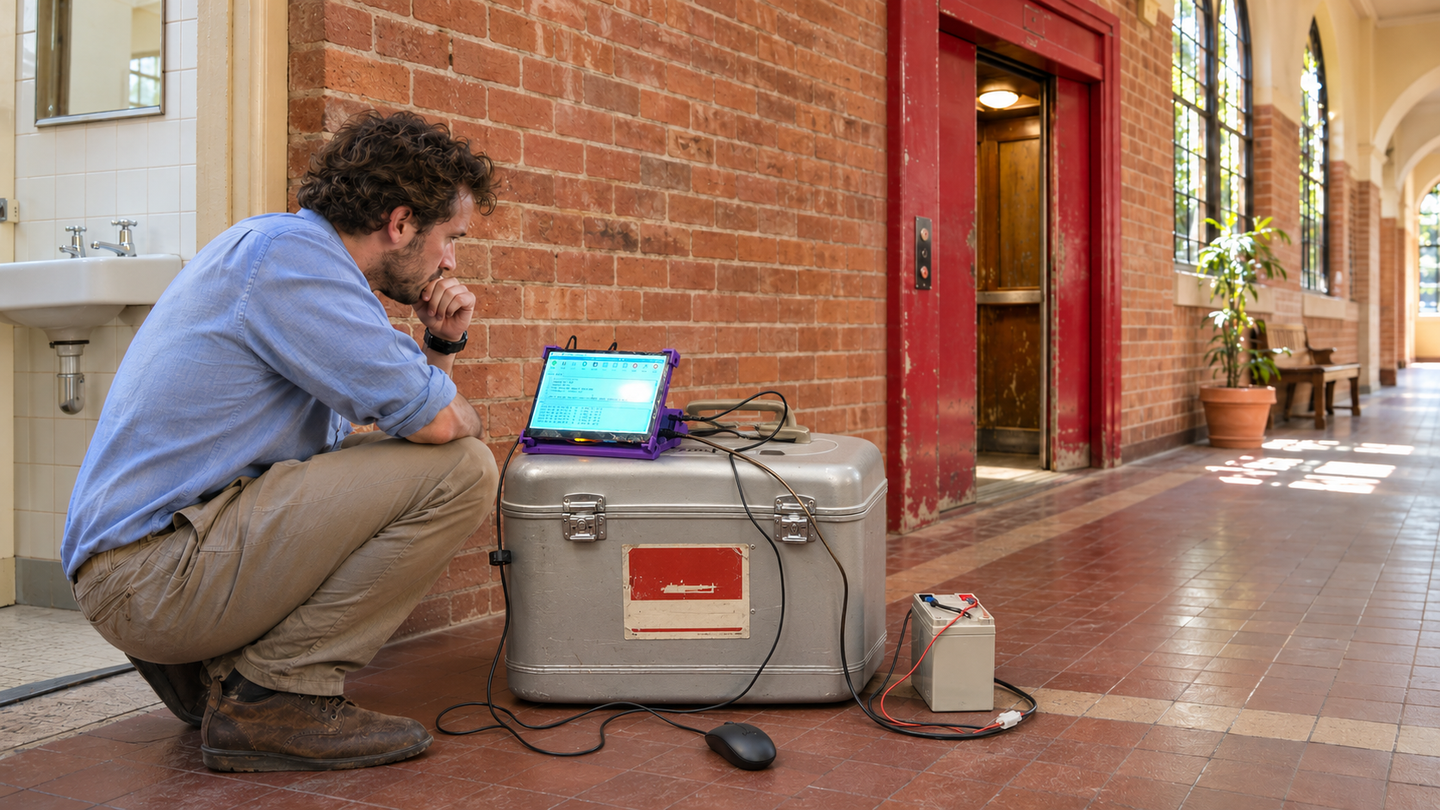
NIST scientists find quantum physics can verify a person’s location while keeping remote hackers out
A NIST experiment combines entangled light with timed challenges to verify access to a physical location. The result points toward a future security check that could tie sensitive commands to trusted buildings.
 NIST Writer: Ron Cowen

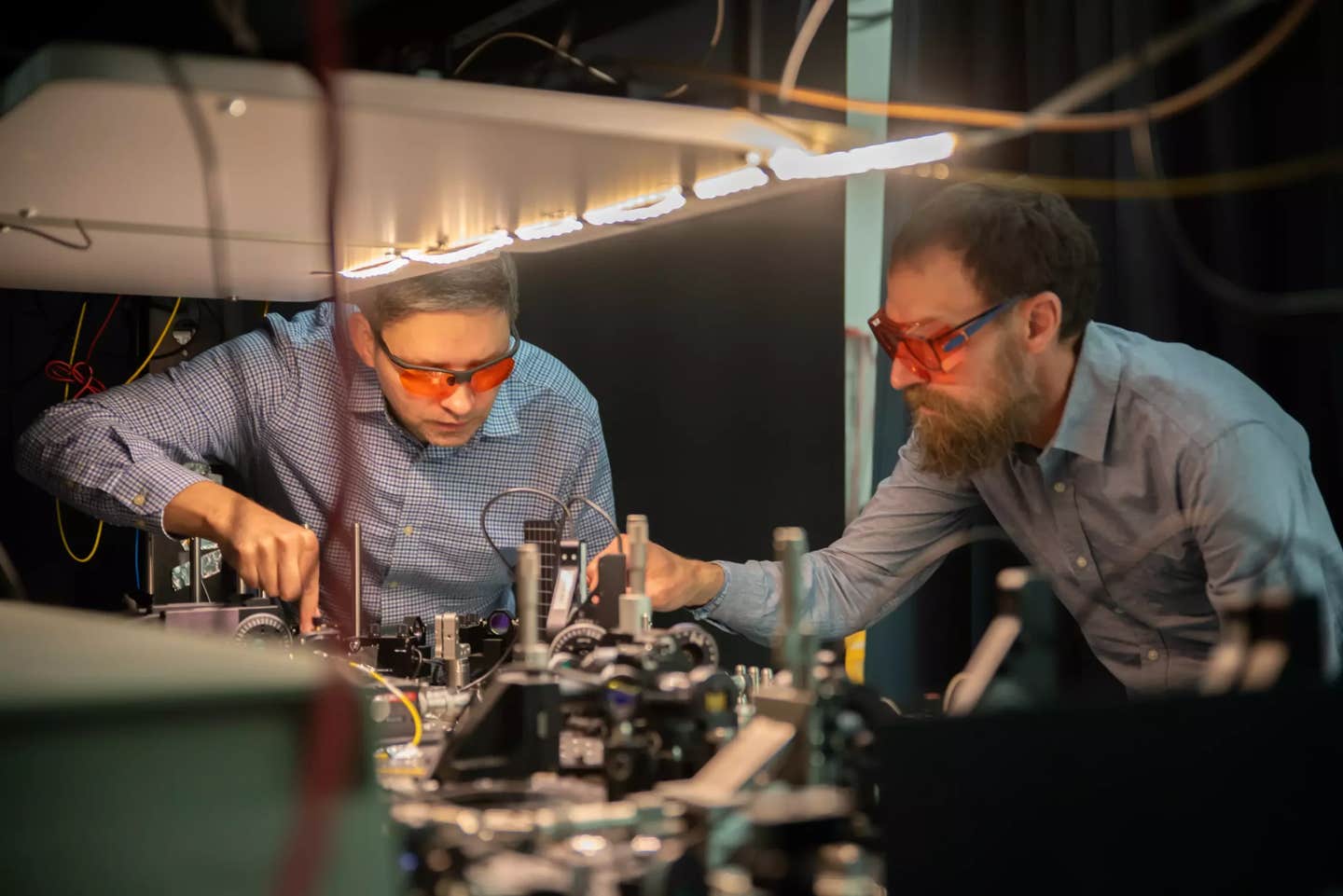
NIST researchers Krister Shalm (left) and Marty Stevens use optical equipment to direct entangled photons into an optical fiber as part of a new quantum security protocol. (CREDIT: Riley Wilson/NIST)
A company is about to send $50 million, and the instruction appears to come from its headquarters. A password can help establish who authorized the transfer. Proving that the instruction actually originated inside the building is a different problem, especially when attackers can coordinate from several locations.
Researchers at the National Institute of Standards and Technology, working with collaborators including the University of Colorado Boulder, have demonstrated a quantum approach to that problem. Their study, published in Nature, combines measurements of light with strict timing checks to verify access to a physical region.
“Our results show how digital security can instead be anchored to the physical world,” said NIST physicist Krister Shalm. The work adds a new possibility to quantum security, though using it beyond the laboratory will require more capable quantum networks. Its immediate achievement is an experimental demonstration, with practical services still some distance away.
Two stations ask a question that must be answered on time
The team built two trusted stations, called verifiers, about 195 meters apart on NIST’s Boulder campus. Optical fibers and electrical cables connected equipment through a research building. Between the stations sat the party whose location needed checking, known as the prover.
Each verifier sent random information timed to arrive at the claimed location together. The prover had to combine those instructions, perform a measurement and return the result promptly. Since information cannot travel faster than light, the response times helped define where that operation could have happened.
The difficulty is that timing alone leaves room for cooperation. Attackers stationed on different sides of a target could intercept challenges and coordinate answers, undermining a location claim. Quantum methods add a different kind of evidence, drawing on properties also being explored in remote quantum links.
That makes communication speed important in two ways. Signals must arrive quickly enough to provide useful location information, and the measurement must resist coordinated cheating. Whether a connection uses laboratory cables or a satellite uplink, its delays help determine how tightly a location can be constrained.
Entangled light supplies the second part of the evidence
For the quantum part, one verifier kept a photon from an entangled pair and sent its partner to the prover. Entanglement means the particles share a quantum state, producing measurement correlations that ordinary classical systems cannot reproduce. Maintaining those connections is a central challenge in work on entangled qubits.
The incoming random instructions told the prover how to measure the photon’s polarization. Polarization describes the orientation of light’s electric field. Choosing different measurement settings gives researchers a way to examine the pair’s quantum correlations across many trials, much as changing the question can reveal something a single answer cannot.
The randomness matters because an attacker cannot simply prepare the correct answer ahead of time. The prover must respond to instructions that become available only as the challenge arrives. That need for unpredictability connects this work with efforts to produce certifiable randomness.
Entanglement does not allow messages to travel faster than light. Instead, the verifiers compare the measurement records afterward, looking for a statistical pattern that passes a Bell test. Quantum information also cannot simply be copied perfectly and handed to several partners, although that rule alone is not enough to establish this protocol’s security. Combined with the timing information, the statistical evidence supports the location claim under the protocol’s security assumptions.
A reliable answer requires millions of trials
A Bell test examines whether correlations exceed what classical explanations allow under its assumptions. Here, the experiment closed important loopholes, including those associated with missed detections and communication between measurement stations. If too many photons disappear from the records, the remaining detections can give a misleading picture, so the experiment must account for those missing events. The strength of the evidence comes from the complete statistical test.
Capturing enough photons was therefore essential. The researchers used superconducting nanowire detectors and an efficient entangled-photon source, technologies developed at NIST. These tools address the wider difficulty of extracting quantum signals without losing the evidence needed to distinguish genuine correlations from misleading results.
The apparatus ran at 250,000 trials per second. One version of the analysis used 30 million trials collected over two minutes, allowing the researchers to build confidence through repeated measurements. Detection efficiencies exceeded 81% at both measurement stations.
The measurement events were also arranged so that a light-speed signal from one could not reach the other in time to influence it. Such separation is central to rigorous Bell experiments. It helps ensure that ordinary communication cannot explain the correlations being tested.
What the location claim does and does not establish
The approach is described as device-independent because its evidence does not require trusting a detailed account of the quantum hardware’s inner workings. The verifiers still need trustworthy timing, random choices and appropriate isolation. The test establishes access to a target region, rather than identifying the person operating the equipment.
That region has a finite size because processing and transmission take time. In this experiment, its volume was about 4.53 times smaller than the corresponding classical region with identical delays. Faster electronics and more direct signal paths could tighten the boundary further.
Security also depends on the resources available to coordinated attackers. The demonstrated version covers attackers with no previously shared entanglement, or only a tightly limited amount. More extensively entangled attackers could defeat that implementation, a relevant concern as distributed quantum computing advances.
The researchers propose more complex challenges to resist stronger quantum adversaries. Meanwhile, noise or equipment problems can make an honest participant fail the test, so failure alone does not establish fraud. These distinctions matter when turning laboratory advances in networked quantum information into useful security tools.
A future security check tied to a real building
Eventually, a network might require proof that a command came from inside a bank, hospital or infrastructure control room. Location could become an additional condition for retrieving records or authorizing a transaction, narrowing the circumstances in which access is granted. For the company moving $50 million, that could mean checking both authorization and physical access before releasing the funds. Existing identity checks would still have their own job to do.
Getting there requires dependable distribution of quantum information between distant users. Work on optical connections and fiber networks illustrates parts of that broader engineering effort. NIST physicist Scott Glancy estimates that real-world applications may be more than a decade away.
For now, the experiment gives researchers a concrete way to test that ambition. A future request for access could carry evidence that the necessary operation happened within an approved physical boundary. The next challenge is making that proof practical across a working network.
Dig deeper into quantum location checks and networks
These resources explain related position-verification research and the technology needed to connect quantum devices.
- Relativistic position verification with coherent states: Reports a different experimental approach using weak light pulses, with verifiers two kilometers apart and position verification accuracy better than 75 meters. (Nature Physics, September 2026)
- ‘Spooky’ Particles Transit DC Suburbs, a Step Toward a Quantum Network: Describes the distribution of entangled photons through 62 kilometers of commercial fiber, demonstrating that quantum connections can survive real-world network conditions. (NIST, August 2026)
- NIST Team Develops Technique to Stabilize the Phase of Weak Light Signals in Quantum Network: Explains why controlling the phase of faint light is important for preserving quantum information as it travels through optical fibers. (NIST, July 2025)
- NIST and Partners Use Quantum Mechanics to Make a Factory for Random Numbers: Introduces a public randomness service that uses entanglement and traceable records to make its output independently verifiable. (NIST, June 2025)
- Single-Qubit Loss-Tolerant Quantum Position Verification Protocol Secure against Entangled Attackers: Investigates how position-verification protocols can tolerate photon losses and errors while resisting attackers with bounded shared entanglement. (Physical Review Letters, October 2023)
Research findings are available online in the journal Nature.
The original story "NIST scientists find quantum physics can verify a person’s location while keeping remote hackers out" is published in The Brighter Side of News.
Related Stories
- Scientists may have found the key to one of quantum physics’ biggest mysteries: superconductivity
- From Schrödinger’s cat to LIGO: quantum physics turned strange ideas into useful technology
- The unprecedented link between quantum physics and artificial intelligence
Like these kind of feel good stories? Get The Brighter Side of News' newsletter.
Shy Cohen
Writer