Astronomers discover the unusual cause of the brightest gamma-ray burst ever recorded
A satellite designed to monitor charged particles helped recover the brightest moments of GRB 221009A. Its spectrum offers new clues to a jet powered largely by magnetic energy, with a possible hollow core.
 CAS Writer: Na Chen

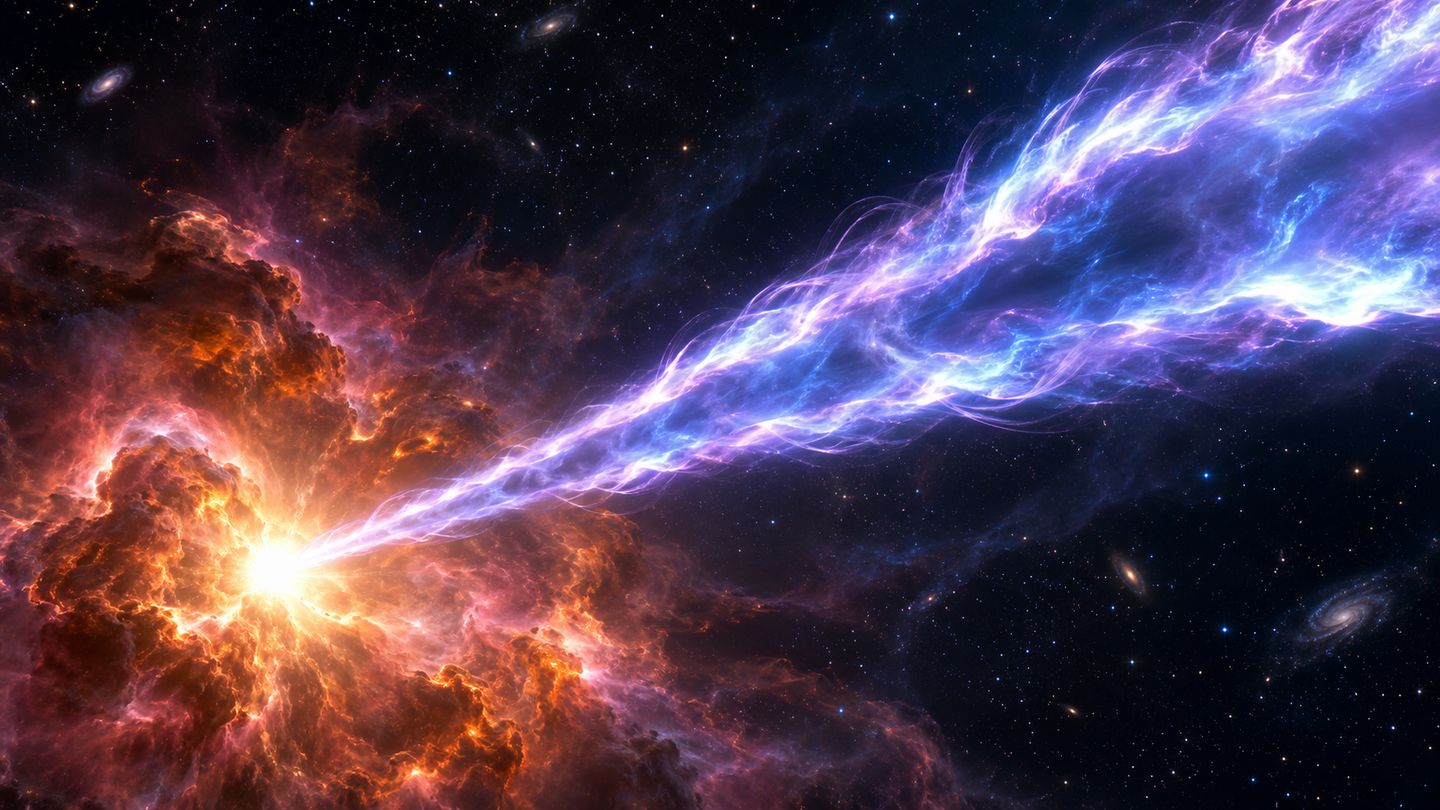
Artist’s visualization of the proposed jet structure in GRB 221009A. Spectral observations suggest a magnetically dominated outflow with weaker emission near its center, a possible explanation that researchers are still investigating. (CREDIT: The Brighter Side of News)
When the brightest gamma-ray burst ever recorded reached Earth, it gave astronomers an extraordinary opportunity and an awkward problem. So much radiation arrived that many detectors became overwhelmed just when researchers most wanted a clear view. Now, a satellite built to monitor charged particles has helped recover details from those difficult moments.
The event, GRB 221009A, arrived on October 9, 2022, from about 2.4 billion light-years away. Like other cosmic explosions, it carried information about an extreme environment far beyond our reach. Reading that information required measuring how its radiation changed from moment to moment.
A China–Italy team led by the Institute of High Energy Physics, part of the Chinese Academy of Sciences, reconstructed that changing spectrum. Their study, published in The Astrophysical Journal Letters, points toward a powerful magnetic jet whose center may have emitted more weakly than its surroundings.
A particle detector catches what others struggled to record
The unexpected contribution came from HEPP-H, the high-energy detector within the High Energy Particle Package aboard CSES-01, also called Zhangheng-1. Developed by IHEP, it normally monitors energetic charged particles. Its job puts it closer to instruments studying cosmic rays than to a conventional gamma-ray telescope.
Yet gamma rays can interact with material around the detector and produce secondary electrons, which HEPP-H can record. Its low efficiency for directly detecting gamma rays became an advantage during this exceptionally intense burst. Fewer direct detections helped it preserve usable observations while other instruments suffered saturation.
Turning those observations into a reliable spectrum still took substantial work. The researchers simulated how the instrument responded as radiation arrived, correcting for effects such as overlapping signals and brief periods when it could not register another event. They then checked the results against GECAM-C and Fermi observations.
Together, those steps recovered the spectrum across 2–255 MeV, an energy range that is particularly difficult to observe well. As with other space observatories, understanding the instrument’s behavior was essential to understanding the source. Here, that effort opened a window onto the burst’s brightest phase.
The brightest gamma-ray burst yields a spectral surprise
A spectrum shows how much radiation arrives at different energies. In this case, the familiar smooth description used for gamma-ray bursts, called the Band function, left something unexplained. Across all six time intervals studied during the main peak, the data contained an additional broad feature around 2 MeV. The unit describes the energy carried by individual photons, so this bump marks an excess of radiation in a particular energy range.
“HEPP-H let us study the burst when it was exceptionally bright and reveal an additional broad component at ~2 MeV that had not been observed in this phase,” said LI Xinqiao of IHEP, a corresponding author of the study.
The team explored whether this component came from heat released by an expanding fireball. Under that interpretation, it accounted for about 6% of the gamma-ray energy during the analyzed period. That leaves most of the emission requiring another energy source, which the researchers suggest was a much more powerful magnetic jet.
The thermal explanation remains a physical interpretation, since another mathematical component fitted comparably well. Still, it offers a way to connect a relatively weak hot fireball with the larger outflow. Understanding how jets form depends on untangling contributions like these, rather than assuming every part of the spectrum has the same origin.
Following a narrow line back through time
Alongside the broad bump, the researchers examined a much narrower feature, an emission line. Earlier Fermi work had identified it around 12 MeV. The new analysis followed its evolution farther back, finding it near 40 MeV before its energy declined toward the later measurements.
One possible source is the annihilation of electrons and positrons. A positron is an electron’s antimatter counterpart, and the two can release gamma rays when they annihilate. In a jet moving toward us at nearly light speed, that radiation can be shifted to much higher observed energies.
As time passed, the line energy decreased approximately in inverse proportion to elapsed time from the model’s reference point. Its width stayed consistent with roughly 10% of its central energy. Such a narrow feature gives researchers a more specific clue than the broad glow alone, helping them investigate the conditions surrounding particle interactions.
In two key intervals, the line reached statistical significances of about 4.0 sigma and above 4.5 sigma. The analysis extended its established evolution backward by roughly five seconds. An even earlier interval showed a weaker excess, so the most secure conclusions rest on the better-supported measurements.
Why the team proposes a hollow core
The line’s brightness added another piece to the puzzle. At the earlier stage, it was weaker than expected from simply extending the later fading trend backward. Taken together, the measurements suggest that its brightness rose before falling, even while its characteristic energy kept decreasing. These are two different changes: the energy tells researchers where the line sits in the spectrum, while its brightness describes how much radiation arrives in that feature. Explaining both requires a model that accounts for the evolving signal as a whole.
The researchers propose that the jet’s angular structure produced this pattern. Radiation from near its axis would reach us first, followed by radiation from regions farther off-axis. If the magnetic field and line emission were weaker near the center, the later-arriving light could initially make the line brighter.
That would give the magnetic structure a ring-like arrangement, motivating the description “hollow core.” The proposed hollow concerns a region of weaker magnetic field and emission near the axis. Astronomers inferred it from changing radiation, much as observations of other jet structures reveal conditions that telescopes cannot examine directly.
The line’s narrowness also suggests that electron–positron pairs cooled quickly before annihilating, potentially through radiation in a strong magnetic field. Along with the weak thermal component, this supports the magnetic interpretation. Establishing exactly how such energetic outflows behave will require further testing of the proposed geometry.
A fuller view comes from working together
CSES-01 is a Chinese–Italian mission supported by the China National Space Administration and Italian Space Agency. Its contribution illustrates why an instrument designed for one task can become valuable for another when an unusual event arrives.
Roberto Battiston, of the University of Trento and Trento Institute for Fundamental Physics and Applications, said agreement between CSES-01 and Fermi strengthens the case for an evolving emission process. Their different designs provide independent ways to check the same event, reducing reliance on any one detector’s response.
That cooperation is familiar in studies of long-lasting bursts and other high-energy transients. Each instrument records a different part of the event, and combining them can recover a more complete account of what happened.
For the brightest gamma-ray burst, the result is a clearer record of radiation that once seemed difficult to recover. It gives astronomers additional measurements to test their explanations of the jet, bringing its proposed magnetic structure within closer reach of observation.
Dig deeper into the brightest gamma-ray burst
These resources trace earlier discoveries that helped establish what made this burst so unusual.
- NASA’s Fermi Finds New Feature in Brightest Gamma-Ray Burst Yet Seen: Explains the earlier emission-line discovery and why electron–positron annihilation in a fast-moving jet could produce the observed radiation. (NASA, July 2024)
- Brightest gamma-ray burst of all time came from the collapse of a massive star: Describes Webb observations that revealed a supernova associated with GRB 221009A and examined its chemical signatures. (Northwestern University, April 2024)
- Evidence of an upper ionospheric electric field perturbation correlated with a gamma ray burst: Investigates the burst’s measurable effects on Earth’s upper ionosphere using satellite observations and modeling. (Nature Communications, November 2023)
- Brightest Cosmic Explosion Ever Detected Had Other Unique Features: Summarizes NuSTAR and other observations that prompted an earlier explanation of the burst’s unusual jet structure. (NASA, June 2023)
- NASA Missions Study What May Be a 1-In-10,000-Year Gamma-ray Burst: Reviews the initial multi-mission investigation, including detector saturation and the burst’s exceptional apparent brightness. (NASA, March 2023)
Research findings are available online in The Astrophysical Journal Letters.
The original story "Astronomers discover the unusual cause of the brightest gamma-ray burst ever recorded" is published in The Brighter Side of News.
Related Stories
- Rare x-ray flash reveals the first moments of a powerful supernova without a gamma-ray burst
- The seven-hour flash: Astronomers discover the longest gamma-ray burst on record
- Rare black hole-star merger creates the longest gamma-ray burst ever
Like these kind of feel good stories? Get The Brighter Side of News' newsletter.
Joseph Shavit
Writer, Editor-At-Large and Publisher
Joseph Shavit, based in Los Angeles, is a seasoned science journalist, editor and co-founder of The Brighter Side of News, where he transforms complex discoveries into clear, engaging stories for general readers. With vast experience at major media companies like The Los Angeles Times, Times Mirror and Tribune Publishing, he writes with both authority and curiosity. His writing focuses on space science, planetary science, quantum mechanics, geology. Known for linking breakthroughs to real-world markets, he highlights how research transitions into products and industries that shape daily life.