
Einstein was right: Darkness can travel faster than light without breaking relativity
Dark zeros in a wave field shift faster than light in a Technion experiment, revealing rapid pattern changes that preserve relativity.

 Edited By: Joshua Shavit

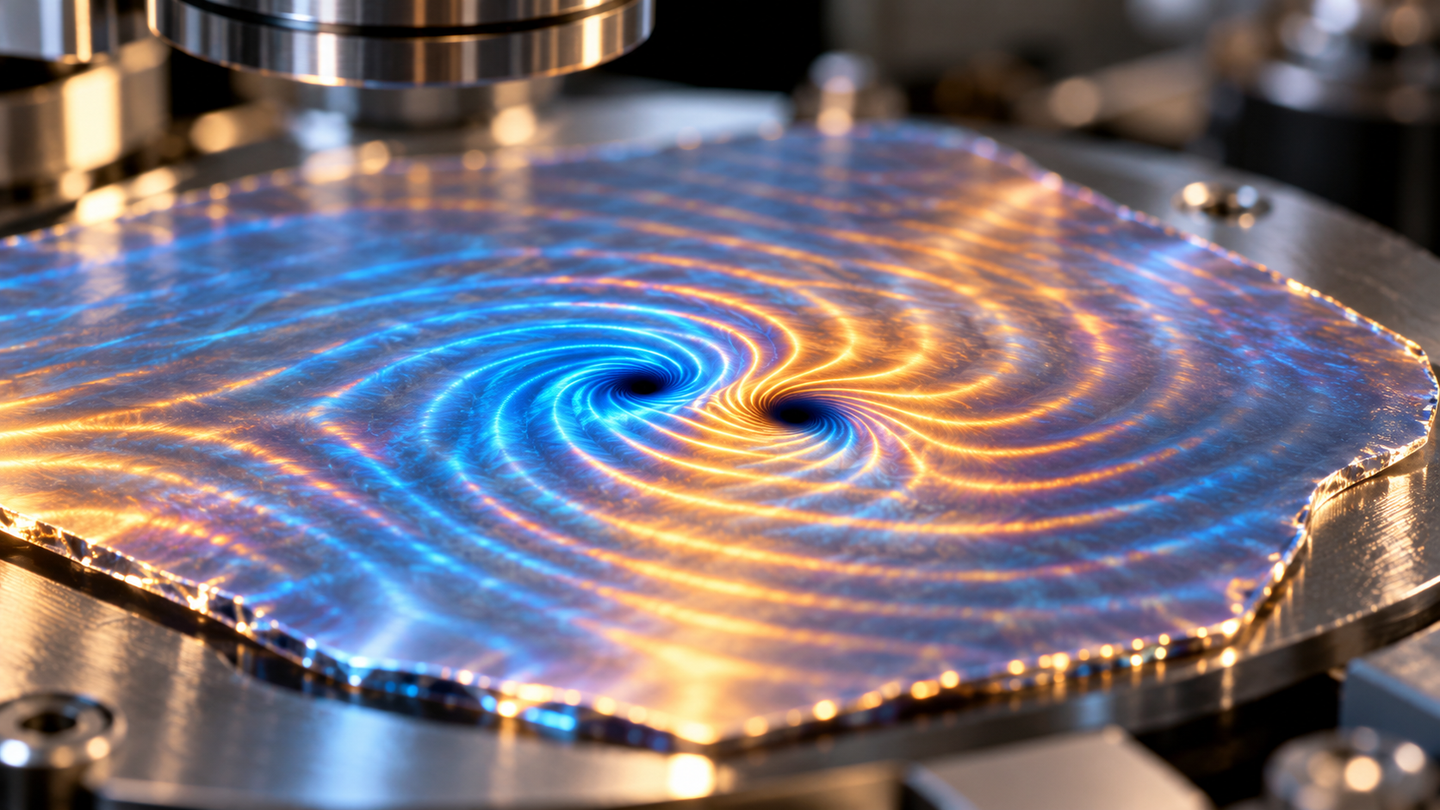
Electron microscopy tracks dark wave singularities moving faster than light, without carrying energy or information at that speed. (CREDIT: The Brighter Side of News)
- Electron microscopy tracked dark zeros in a wave field moving faster than light in vacuum, without transmitting energy or information at that speed.
- The experiment used hexagonal boron nitride and achieved approximately 20-nanometer spatial resolution and three-femtosecond temporal sampling.
- About 29% of tracked singularities exceeded light speed, supporting predictions about fast-moving wave patterns and their collective behavior.
Dark points within a changing wave pattern can shift faster than light, even while the waves carrying energy move far more slowly. An electron microscopy experiment has tracked that counterintuitive behavior in a thin material sample.
The moving features are locations where a measured wave field cancels to zero. Their motion describes an evolving pattern, so it does not provide a way to send information faster than light.
The study, published in Nature, was led by researchers at the Technion-Israel Institute of Technology. Tomer Bucher and Alexey Gorlach worked with Ido Kaminer’s team and an international collaboration to map these optical phase singularities.
The measurements captured their positions, speeds and relationships with neighboring singularities. That combination allowed the researchers to test longstanding predictions about how the features behave together.
A dark point is a feature of the surrounding waves
When waves overlap, their contributions can reinforce one another or cancel. At certain locations, cancellation drives the measured field amplitude to zero. These zeros are called phase singularities because the wave’s phase becomes undefined there. Around each point, however, the phase winds through a complete cycle.
The winding can run in either direction, giving the singularity a positive or negative topological charge. That label describes the field’s structure rather than an electrical charge. Oppositely charged singularities can meet and disappear, while new pairs can emerge as interference changes. Their identities therefore depend on the surrounding wave pattern.
The concept has roots in work on wave dislocations by John Nye and Michael Berry in 1974. Later theories examined how singularities move and how their positions and velocities are distributed. Some predicted extremely rapid motion near the creation or disappearance of pairs. Testing those predictions required resolving changes smaller than a wavelength and faster than a wave cycle.
Slow waves made the fast patterns easier to observe
The experiment used hexagonal boron nitride, known as hBN, in flakes approximately 40–50 nanometers thick. Within this material, electromagnetic fields couple with vibrations of the crystal lattice. The resulting hybrid waves are called phonon polaritons. Their properties make hBN useful for concentrating light into very small regions.
Mid-infrared laser pulses with an average wavelength of seven micrometers excited the sample. The polariton wavelength shrank to roughly 630 nanometers, and their group velocity could be more than 100 times slower than light in vacuum. Group velocity describes the motion of the wavepacket’s envelope. The dark interference points followed a different kind of motion.
Rough sample edges launched waves in different directions and phases. Scattering from other boundaries added further interference, producing a complicated pattern containing many singularities. The material’s unusual relationship between phase and group velocities increased the prevalence of very fast pattern changes. Slowing the wavepacket therefore helped expose the singularities’ apparently superluminal motion.
Electrons reconstructed changes within a wave cycle
The team combined a laser system with an ultrafast transmission electron microscope. Probe electrons interacted first with a reference light field and then with the field near the sample. An energy filter selected electrons carrying information from those interactions. Changing the relative timing and optical phase allowed the researchers to reconstruct the sample field’s amplitude and phase.
The technique, called free-electron Ramsey imaging, achieved spatial resolution of approximately 20 nanometers. That is roughly one-thirtieth of the polariton wavelength. Temporal sampling reached three femtoseconds, with one femtosecond equal to a millionth of a billionth of a second. The exciting light’s cycle lasted about 23 femtoseconds, so the measurements resolved changes within a single cycle.
These maps were assembled from measurements at controlled delays and computational reconstruction. The researchers corrected drift before identifying singularities and linking their positions across frames. Those tracks revealed creation and annihilation events, alongside motion between them. The microscope measured the field component along the electron trajectory, providing a detailed but specific view of the wave dynamics.
Phase information was essential to identifying each singularity’s winding direction. A brightness map alone would show dark regions without establishing their topological charge. Recovering both amplitude and phase allowed the researchers to distinguish the two charge types and follow their interactions through time.
The fastest changes appeared near disappearing pairs
Opposite-charge singularities accelerated as they approached annihilation. Their paths joined into a continuous curve in space and time, with sharply changing positions just before they disappeared. Mathematical descriptions predict formally unbounded speed close to that meeting point. The experiment measured finite speeds above the vacuum light-speed limit, rather than an infinite velocity.
Across the measured distribution, about 29% of singularities exceeded light speed. The reported average was approximately 1.04 times that speed, close to the limit overall. The distribution nevertheless had a pronounced “heavy tail,” meaning it included unusually fast events. Those extremes distinguish singularities from material particles, whose motion follows different constraints.
The team also examined how singularity separation relates to relative velocity. Oppositely charged pairs were more common at close distances and showed a wider range of speeds. Measurements agreed with calculations based on interfering random waves. Together, the results connected individual disappearance events with the statistical behavior of an entire ensemble.
The slow polariton platform made these events comparatively common. For the same laser parameters in free space, the researchers calculated that only about 0.4% of singularities would exceed light speed. That figure is a theoretical comparison, not a second experiment. It helps explain why the chosen material made the phenomenon easier to detect.
Relativity remains intact, while microscopy gains a tool
A moving zero is not a parcel of matter traveling between locations. It marks where waves cancel at a particular moment, and that location can shift rapidly as the field changes. The singularity itself does not transport energy or information along its apparent path. Consequently, its speed does not violate relativistic causality or enable faster-than-light communication.
The broader achievement is the ability to map delicate wave structures with unusually fine spatial and temporal detail. Similar singularities occur across optical systems, superfluids and other physical settings, although their underlying dynamics differ. The researchers propose extending the approach to additional two-dimensional materials and more complex optical structures. Such studies could test how material properties change singularity statistics.
Important limits remain, including finite resolution and scarce observations of some closely spaced pairs. Some extreme speeds also fell outside the technique’s detection range. Mapping full three-dimensional fields would require additional reconstruction methods. The work establishes a powerful measurement approach and confirms fast pattern motion, while its proposed applications remain directions for future research.
Dig deeper into optical vortices and ultrafast imaging
These resources trace the theory of wave singularities and the imaging methods used to investigate them.
Coherently amplified ultrafast imaging using a free-electron interferometer: Describes the electron-interference approach that supports phase-sensitive imaging. (Nature Photonics, 2024)
Attosecond electron microscopy of sub-cycle optical dynamics: Demonstrates methods for resolving optical behavior within an excitation cycle. (Nature, 2023)
Photonics with hexagonal boron nitride: Reviews the material’s optical properties and its role in nanoscale photonics. (Nature Reviews Materials, 2019)
Phase singularities in isotropic random waves: Develops statistical predictions for singularity positions and motion in random wave fields. (Proceedings of the Royal Society A, 2000)
Dislocations in wave trains: Introduces the wave-dislocation framework underlying modern studies of phase singularities. (Proceedings of the Royal Society A, 1974)
Research findings are available online in the journal Nature.
The original story "Einstein was right: Darkness can travel faster than light without breaking relativity" is published in The Brighter Side of News.
Related Stories
- Cosmic gamma rays test the limits of Einstein’s speed of light rule
- Inside the strange physics of why time stops at the speed of light
- New discovery rewrites what we know about the speed of light
Like these kind of feel good stories? Get The Brighter Side of News' newsletter.
Joseph Shavit
Writer, Editor-At-Large and Publisher
Joseph Shavit, based in Los Angeles, is a seasoned science journalist, editor and co-founder of The Brighter Side of News, where he transforms complex discoveries into clear, engaging stories for general readers. With vast experience at major media companies like The Los Angeles Times, Times Mirror and Tribune Publishing, he writes with both authority and curiosity. His writing focuses on space science, planetary science, quantum mechanics, geology. Known for linking breakthroughs to real-world markets, he highlights how research transitions into products and industries that shape daily life.