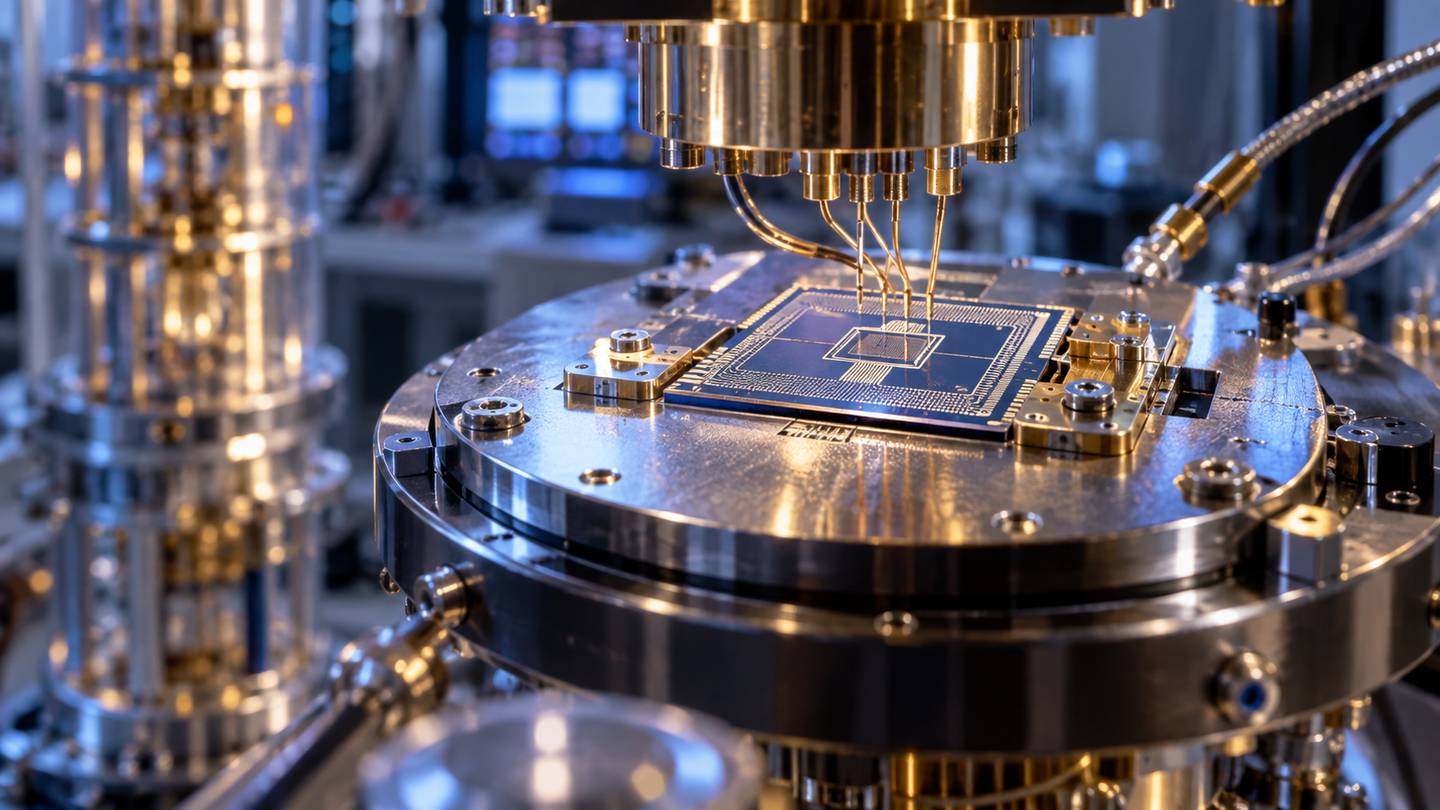
Physicists convert microwaves to light helping quantum computers communicate over optical networks
Magnons and excitons inside CrSBr coherently transfer microwave information onto reflected light across a 300 MHz bandwidth.
 CCNY Writer: Jay Mwamba

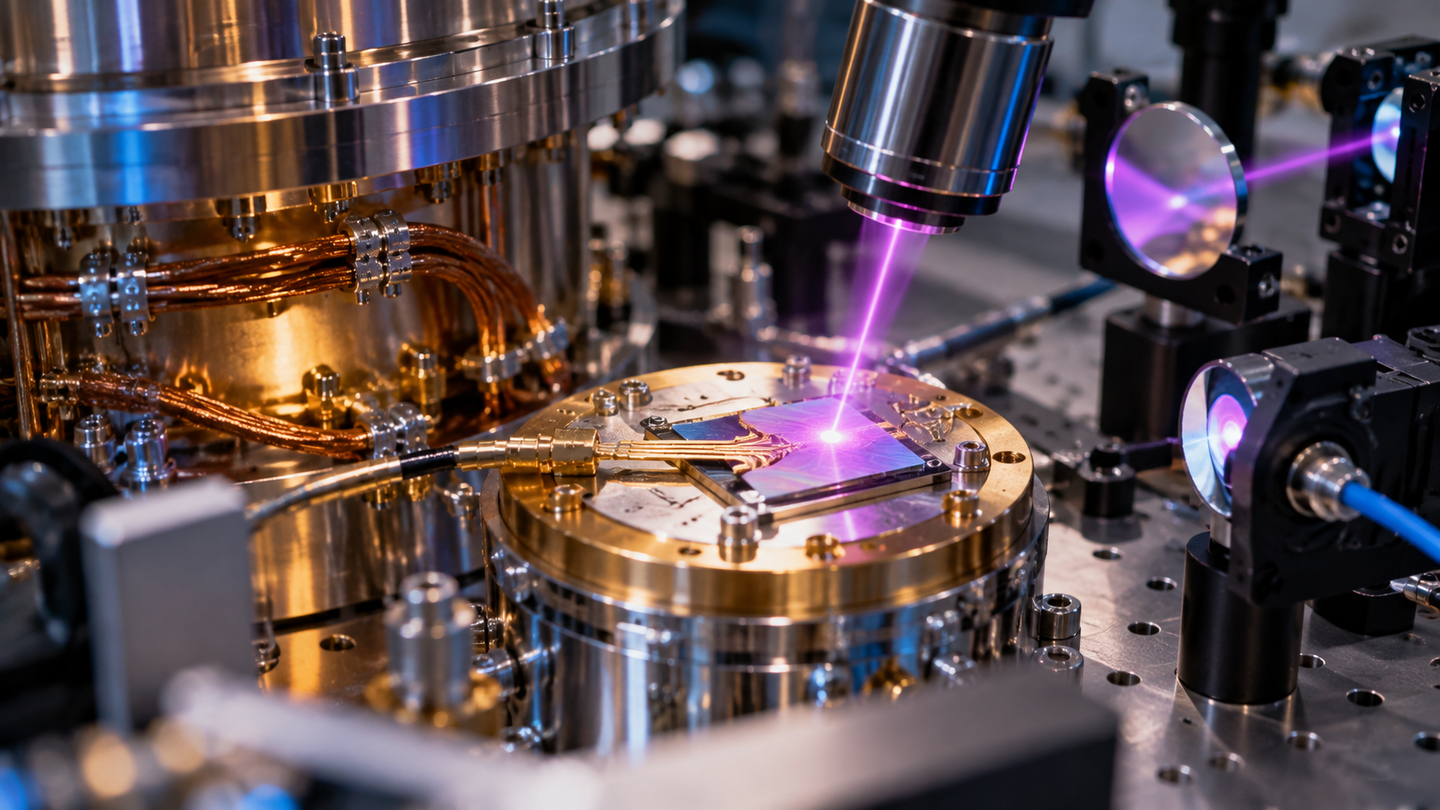
A layered magnetic crystal converts microwave signals into light, offering a new path toward future quantum network interfaces. (CREDIT: Shutterstock)
- A layered magnetic semiconductor called CrSBr converted microwave-driven magnetic excitations into coherent optical signals across a bandwidth of about 300 megahertz.
- The experiment used coupling between magnons and excitons, allowing microwave information to modulate reflected laser light without optical or microwave cavity enhancement.
- The present efficiency remains far below what quantum networking requires, but thinner crystals, resonators and polariton engineering could substantially strengthen the conversion.
Quantum computers and optical networks communicate using very different parts of the electromagnetic spectrum. Many leading quantum processors operate with microwave signals, while light is far better suited to carrying information over long distances through optical fibers.
Physicists at The City College of New York have now demonstrated a new way to bridge those regimes using a layered magnetic semiconductor. Their approach converts microwave-driven magnetic motion into a coherent optical signal inside a crystal of chromium sulfide bromide, or CrSBr.
The research, published in Nature Materials, was led by the Laboratory for Nano and Micro Photonics at CCNY. Physics professor Vinod M. Menon heads the laboratory, while postdoctoral researcher Pratap Chandra Adak led the study.
The experiment does not yet transfer individual quantum states between microwaves and light. Instead, it establishes a new physical mechanism that could eventually become part of an interface linking microwave quantum processors with optical communication networks.
Magnetic waves provide the bridge
The underlying problem is enormous in frequency terms. Superconducting quantum bits generally operate at microwave frequencies measured in gigahertz, while optical photons used in fiber networks occupy frequencies roughly five orders of magnitude higher.
A useful quantum transducer must connect those regimes while preserving fragile quantum information. It also needs high conversion efficiency, low added noise and enough bandwidth to work with practical quantum hardware.
The CCNY team approached that challenge through magnetic excitations called magnons. A magnon represents a coordinated wave of atomic magnetic moments rather than the motion of one individual spin.
CrSBr is particularly suited to this approach because it is both magnetic and semiconducting. Below about 132 kelvin, neighboring layers become antiferromagnetically ordered, while relatively weak coupling between those layers allows magnetic modes to appear at gigahertz frequencies.
The material also hosts excitons, which are bound pairs of electrons and holes that interact strongly with light. Putting magnons and excitons in the same crystal creates a pathway through which microwave-driven magnetism can influence an optical signal.
Microwaves change the reflected laser light
The conversion happens through two linked processes. First, a microwave signal travels through a coplanar waveguide beneath the CrSBr crystal and excites a magnon when the microwave frequency matches a magnetic resonance.
The resulting collective spin motion changes the relative magnetic alignment between neighboring layers. Because the exciton energies depend strongly on that magnetic arrangement, the spin motion shifts the optical properties of the material.
A laser reflected from the crystal therefore acquires an optical modulation at the microwave-driven magnon frequency. In frequency terms, the process creates optical sidebands offset from the original laser by the microwave frequency.
Researchers verified that this was coherent conversion using homodyne detection, a sensitive method that mixes the reflected signal with a reference laser. A clear optical response appeared only when the microwave drive matched a magnon resonance and the optical probe was positioned near an exciton resonance.
That combination strongly supported the proposed magnon-exciton mechanism. It also distinguished the process from older magneto-optical methods that rely primarily on weak off-resonant effects such as Faraday rotation.
The signal spans about 300 megahertz
One striking feature of the system is its bandwidth. The researchers measured coherent microwave-to-optical conversion across approximately 300 megahertz, broadly matching the width of the underlying magnon resonances.
The operating frequency could also be adjusted using an external magnetic field. In one set of measurements, the relevant microwave resonance occurred near 23.2 gigahertz with no static magnetic field and shifted to about 22.5 gigahertz at 0.5 tesla.
CrSBr can support gigahertz magnon modes even without an external field because of its strong magnetic anisotropy. That property could eventually simplify certain device designs by reducing dependence on large bias magnets.
The experiments were performed at cryogenic temperatures, with the crystal mounted in a system operating near 2 kelvin. The researchers could still detect the relevant optical response at temperatures approaching 20 kelvin, although the signal weakened.
Strong interaction does not yet mean efficient conversion
The experiment achieved its result without using a high-quality optical cavity or microwave resonator to amplify the interaction. That makes the basic conversion mechanism particularly clear, but it also helps explain the device's extremely low efficiency.
The researchers estimated a lower bound on microwave-to-optical transduction efficiency of roughly 3.3 × 10^-12. That is many orders of magnitude below what would be required to faithfully convert individual quantum states.
A practical quantum transducer would ideally approach unity efficiency while adding less than roughly one photon of noise. The current system should therefore be viewed as a materials and mechanism demonstration rather than a usable quantum-network component.
Even so, the fundamental interaction is strong. The researchers estimated a single-magnon coupling rate of about 6.2 kilohertz for the high-energy exciton in the bulk crystal, around three orders of magnitude stronger than coupling typical of some Faraday-based magneto-optical systems.
The reason is that the new method operates near an exciton resonance, where the optical response to the magnetic state becomes particularly large.
Making the crystal thinner could transform performance
CrSBr's layered structure may provide one of the clearest paths toward much stronger conversion. The bulk crystal used in the experiment was about 300 micrometers thick, 0.5 millimeters wide and 2 millimeters long.
Microwaves therefore excited magnons across a much larger magnetic volume than the tiny region sampled by the laser. Much of the driven magnetic motion contributed little to the measured optical signal.
Reducing CrSBr to a thin flake could bring the magnetic mode volume much closer to the optical interaction volume. The researchers' calculations indicate that this confinement could dramatically increase the single-magnon coupling strength.
“A particular advantage of CrSBr is its layered structure, which gives us considerable freedom in device design and integration,” Adak said. “These materials can be thinned down to just a few layers while retaining their key magnetic and optical properties.”
Microwave resonators could further enhance the magnetic drive, while engineered optical cavities could increase interaction with light. Combining those approaches could improve cooperativity and push conversion efficiency toward levels relevant to quantum devices.
Polaritons offer another route forward
The team also investigated exciton-polaritons, hybrid states formed when excitons strongly mix with photons. A naturally thin terrace on the CrSBr crystal produced several polariton resonances that remained sensitive to magnons and supported the same basic microwave-to-optical conversion.
That result could become important because polaritons combine the strong material interaction of an exciton with some of the lower-loss characteristics of light. Carefully designed cavities may therefore reduce optical dissipation while retaining strong coupling to magnetic motion.
“What excites me is the potential to build on these results,” Menon said. “CrSBr brings strong optical interactions and microwave-frequency magnetism together in the same crystal.”
Major engineering challenges remain before this platform could connect quantum computers over fiber. Efficiency must improve enormously, noise must be carefully measured and controlled, and the process ultimately must preserve individual quantum states.
Still, the experiment establishes an unusual bridge between two otherwise distant technologies. Magnetic waves inside a layered crystal can now carry microwave information into light, giving researchers another possible route toward the interconnects future quantum networks will require.
Dig deeper into microwave-to-optical quantum transduction
These resources examine competing transduction technologies and the physics behind magnon, exciton and optical interfaces.
Perspectives on quantum transduction: This review outlines the efficiency, bandwidth and noise requirements practical quantum transducers must satisfy. (Quantum Science and Technology, 2020)
Microwave-optical quantum frequency conversion: A broad review compares electro-optic, optomechanical, magneto-optic and other approaches for connecting microwave and optical quantum systems. (Optica, 2021)
Superconducting qubit to optical photon transduction: Researchers demonstrated conversion involving a superconducting qubit and optical photons through an optomechanical intermediary. (Nature, 2020)
Exciton-coupled coherent magnons in a 2D semiconductor: This study established strong coupling between excitons and coherent magnons in CrSBr, providing important groundwork for the new conversion approach. (Nature, 2022)
Magneto-optics in a van der Waals magnet tuned by self-hybridized polaritons: Researchers showed that CrSBr can form strongly coupled exciton-polariton states with tunable magnetic properties. (Nature, 2023)
Research findings are available online in the journal Nature Materials.
The original story "Physicists convert microwaves to light helping quantum computers communicate over optical networks" is published in The Brighter Side of News.
Related Stories
- Global first: Physicists use light to reveal quantum vibrations in a superconducting material
- NIST scientists invent a quantum crystal detector to hunt for dark matter
- MIT device creates linked microwave signals at room temperature without extreme cooling
Like these kind of feel good stories? Get The Brighter Side of News' newsletter.
Joshua Shavit
Writer and Editor
Joshua Shavit is a NorCal-based science and technology writer with a passion for exploring the breakthroughs shaping the future. As a co-founder of The Brighter Side of News, he focuses on positive and transformative advancements in technology, physics, engineering, robotics, and astronomy. Having published articles on AOL.com, MSN, Yahoo News, and Ground News, Joshua's work highlights the innovators behind the ideas, bringing readers closer to the people driving progress.