Faint manganese signals could reveal how the universe built its elements
Hundreds of predicted manganese signals could reveal conditions in stellar debris and help reconstruct billions of years of cosmic chemistry.
 OSU Writer: Tatyana Woodall

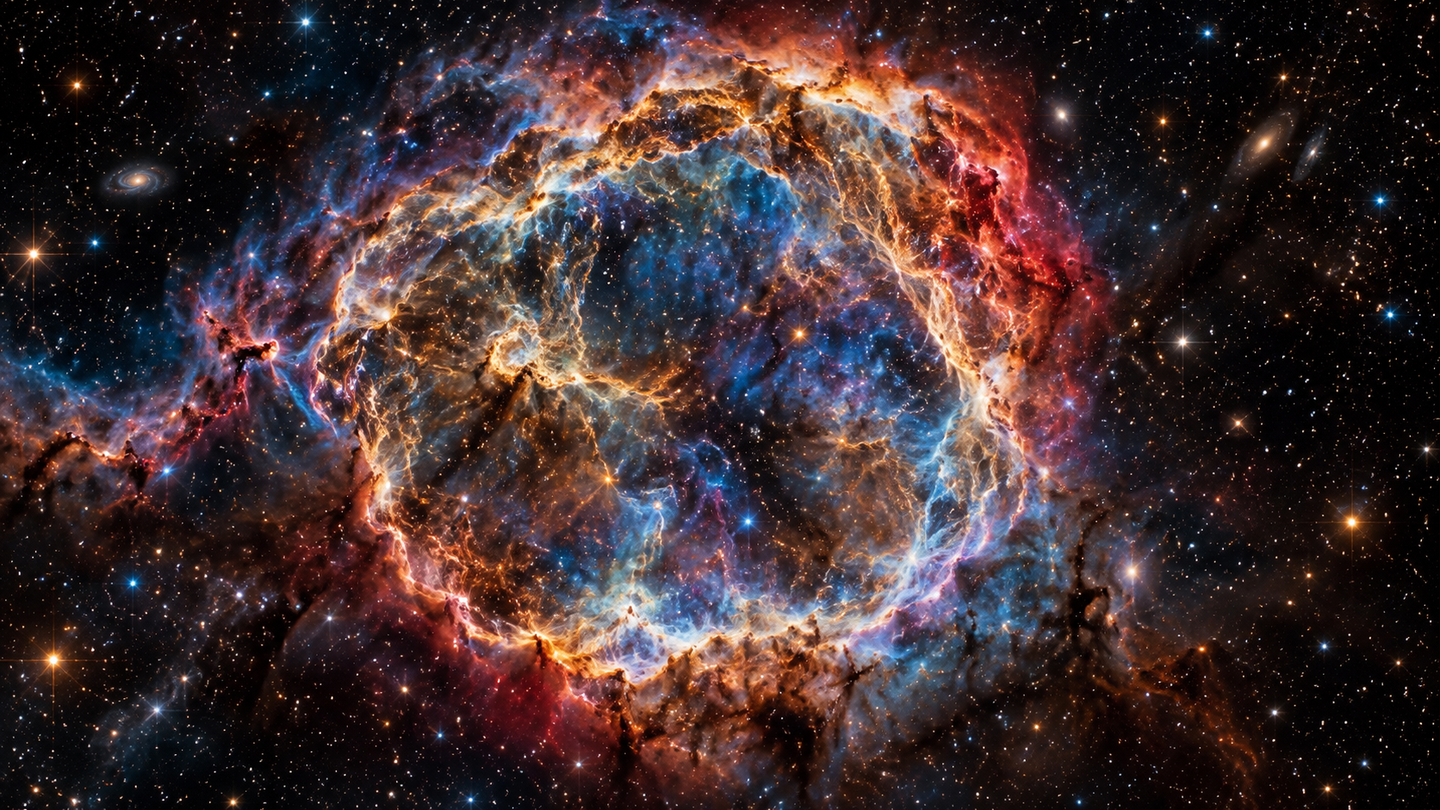
New manganese emission-line calculations could help astronomers trace supernova chemistry and the chemical evolution of galaxies. (CREDIT: Shutterstock)
- Astronomers calculated 703 forbidden emission transitions from doubly ionized manganese, identifying line ratios that could reveal the temperature and density of supernova remnants and other nebular environments.
- Manganese is especially valuable because its abundance relative to iron changes as galaxies evolve, potentially allowing astronomers to trace the timing of stellar explosions and chemical enrichment across cosmic history.
- The work remains theoretical, but several predicted ultraviolet, optical and infrared manganese signatures could eventually be tested with the James Webb Space Telescope and ground-based observatories.
A faint signal from manganese atoms scattered through exploded stars could give astronomers a new way to reconstruct billions of years of cosmic chemical evolution. The element is difficult to observe, but its abundance changes in a way that may preserve a record of how different generations of stars enriched their galaxies.
Researchers have now calculated hundreds of emission lines from doubly ionized manganese, known as Mn III, and identified combinations that could reveal the physical conditions inside supernova remnants, H II regions and other nebulae. The work, recently published in Monthly Notices of the Royal Astronomical Society, combines astrophysics, atomic physics and plasma modeling to predict which manganese signals astronomers should search for.
“If we understand the chemical composition of galaxies, we can learn more about the chemistry of stars and their elements,” said Anil Pradhan, a co-author and professor of astronomy at The Ohio State University. “That will eventually lead to understanding the evolution of the universe and the composition of everything within it.”
Manganese records different generations of supernovae
Heavy elements are built and redistributed through stellar evolution, with supernova explosions playing a particularly important role. Manganese and iron can both emerge from core-collapse Type II supernovae and Type Ia supernovae, but the two explosion types operate on very different timescales.
Massive stars can live for only millions of years before undergoing core collapse. Type Ia supernovae involve white dwarfs produced from lower-mass stars and generally enter a galaxy’s chemical history much later, on timescales that can reach billions of years.
That timing makes manganese especially interesting. Type Ia supernovae can produce manganese efficiently in neutron-rich conditions, so the amount of manganese relative to iron tends to increase as a galaxy ages and Type Ia explosions contribute more material.
Astronomers can therefore treat the Mn/Fe ratio as a potential chronometer of stellar nucleosynthesis and galactic evolution. Rather than providing a literal age for a galaxy, it could help reveal how its enrichment history changed as different stellar populations lived and died.
“Space and time are related, so measuring manganese abundances can grant us insight into the ever-expanding nature of the universe,” Pradhan said. Combining manganese measurements with elements such as iron, oxygen and sulfur could eventually provide a more complete picture of how cosmic chemistry evolved.
A useful signal that is extremely hard to detect
Chemical abundances are often measured through spectral lines, narrow wavelengths created when atoms or ions absorb or emit energy. Each element produces a characteristic collection of these signatures, allowing astronomers to identify substances in objects far beyond the reach of spacecraft.
Manganese presents an observational challenge because it is much less abundant than iron. Its weak spectral signatures can therefore demand highly sensitive instruments and long observing times.
Neutral manganese absorption lines are already useful for studying stellar atmospheres. Emission from ionized manganese, however, has received far less attention, even though highly ionized manganese has been observed at X-ray wavelengths in supernova remnants.
The researchers focused on Mn III, manganese that has lost two electrons. They argue that this ionization state could exist during later nebular phases of stellar remnants, producing ultraviolet, optical and infrared emission that may encode information about the surrounding plasma.
Computers calculated more than 700 possible signals
To identify the most promising lines, the team first calculated 1,421 fine-structure energy levels of Mn III. They then selected the lowest 38 levels for detailed electron-ion scattering calculations because those states were most relevant to the forbidden transitions likely to appear in astrophysical plasmas.
The calculations produced collision strengths for 703 transitions. These values describe how effectively electrons moving through hot gas can collide with manganese ions, excite them and eventually cause them to release photons at particular wavelengths.
The researchers modeled temperatures ranging from 2,500 to 40,000 kelvins, covering conditions expected in ionized nebular environments. They then used a collisional-radiative model to calculate how the intensities of different manganese lines should change as electron temperature and density vary.
That approach revealed two useful classes of emission-line ratios. Some were highly sensitive to electron density while remaining almost unaffected by temperature, while others responded strongly to both properties.
Those differences could make manganese more than a simple chemical marker. If the predicted lines can be detected, their relative strengths could help astronomers diagnose the physical state of the gas producing them.
Different wavelengths could reveal different properties
One promising ultraviolet line ratio involves transitions at nearly identical wavelengths. Because the two lines are so close together, effects such as interstellar reddening and uncertainties in flux calibration should influence them similarly, making their ratio a comparatively clean measure of electron density.
The calculations also identified a mid-infrared ratio that remained nearly independent of temperature between 2,500 and 40,000 kelvins while changing with density. Its wavelength makes it particularly relevant to observations with the James Webb Space Telescope.
Other ratios carried different information. A separate mid-infrared combination showed strong sensitivity to temperature, especially at lower densities, while a near-infrared ratio involving lines around 8,213.52 and 8,081.28 angstroms changed with both temperature and density.
Using several ratios together could help astronomers separate those effects. A density-sensitive measurement could constrain one property while a temperature-sensitive measurement helps determine the other, reducing ambiguities that can complicate plasma diagnostics.
A possible new window on early galaxy chemistry
The broader goal is to use these atomic signatures to measure manganese abundance and compare it with iron in environments spanning different stages of cosmic history. Because the Mn/Fe ratio changes as various supernova populations contribute material, those observations could reveal how rapidly galaxies enriched themselves.
“By combining this emission line data with other known facts on important elements like oxygen and sulfur, we may be able to view some of the earliest observable epochs in the history of the universe,” Pradhan said.
Redshift may actually help with some manganese observations. Ultraviolet light emitted by very distant galaxies is stretched toward longer wavelengths as the universe expands, potentially moving otherwise difficult lines into wavelength ranges accessible to JWST.
Important uncertainties remain. The work is theoretical, and converting a measured Mn III line into a total manganese abundance also requires knowing what fraction of the manganese exists in that ionization state under the conditions being observed.
The researchers also examined a previously suggested Mn III line near 6,821 angstroms but could neither confirm nor rule out the identification. Their calculations predict nearby candidate transitions to be extremely weak, illustrating the practical difficulty of turning atomic theory into astronomical detections.
The team plans to compare its predictions with observations from JWST and ground-based observatories while making the new atomic data available to other researchers. “We’re getting better and better at capturing energy that reveals the shape of the universe,” Pradhan said. “This work joins astrophysics, atomic physics and plasma physics together, and we’re on the cusp of discovering many brand new processes.”
Dig deeper into manganese and cosmic chemical evolution
These resources explore how manganese, supernovae and elemental abundance measurements help astronomers reconstruct the chemical history of galaxies.
Constraining SN Ia progenitors from the observed Fe-peak elemental abundances in the Milky Way dwarf galaxy satellites: Uses iron-peak abundance patterns in dwarf galaxies to test how different Type Ia supernova progenitors contribute elements such as manganese. (Monthly Notices of the Royal Astronomical Society, 2025)
Observational constraints on the origin of the elements. IX. 3D NLTE abundances of metals in the context of Galactic Chemical Evolution models and 4MOST: Reassesses manganese and other metal abundances using improved stellar-atmosphere modeling and compares the results with Galactic chemical-evolution predictions. (Monthly Notices of the Royal Astronomical Society, 2025)
Chemical evolution models: the role of type Ia supernovae in the α-elements over iron relative abundances and their variations in time and space: Examines how Type Ia supernova delay times and elemental yields shape the evolving chemical composition of the Milky Way. (Monthly Notices of the Royal Astronomical Society, 2024)
Assessing stellar yields in Galaxy chemical evolution: Observational stellar abundance patterns: Tests theoretical stellar yields against observed elemental abundances, including the changing contribution of manganese from core-collapse and Type Ia supernovae. (Monthly Notices of the Royal Astronomical Society, 2023)
Chemical separation of stellar populations: analytic solutions for chemical evolution models with metallicity-dependent yields: Develops chemical-evolution models that account for metallicity-dependent element production, including manganese yields from Type Ia supernovae. (Monthly Notices of the Royal Astronomical Society, 2025)
Research findings are available online in the journal Monthly Notices of the Royal Astronomical Society.
The original story "Faint manganese signals could reveal how the universe built its elements" is published in The Brighter Side of News.
Related Stories
- A dead galaxy from the early universe is forcing astronomers to rethink galactic evolution
- Astronomers discover interstellar processes that drive galactic evolution
- Scientists crack the mystery of galactic filaments and magnetic fields at the heart of the Milky Way
Like these kind of feel good stories? Get The Brighter Side of News' newsletter.
Joseph Shavit
Writer, Editor-At-Large and Publisher
Joseph Shavit, based in Los Angeles, is a seasoned science journalist, editor and co-founder of The Brighter Side of News, where he transforms complex discoveries into clear, engaging stories for general readers. With vast experience at major media companies like The Los Angeles Times, Times Mirror and Tribune Publishing, he writes with both authority and curiosity. His writing focuses on space science, planetary science, quantum mechanics, geology. Known for linking breakthroughs to real-world markets, he highlights how research transitions into products and industries that shape daily life.