Galaxy-killing wind may explain why giant galaxies died so early
CRISTAL-02 may show how starburst winds rapidly shut down massive galaxies in the early universe.

 Edited By: Joshua Shavit

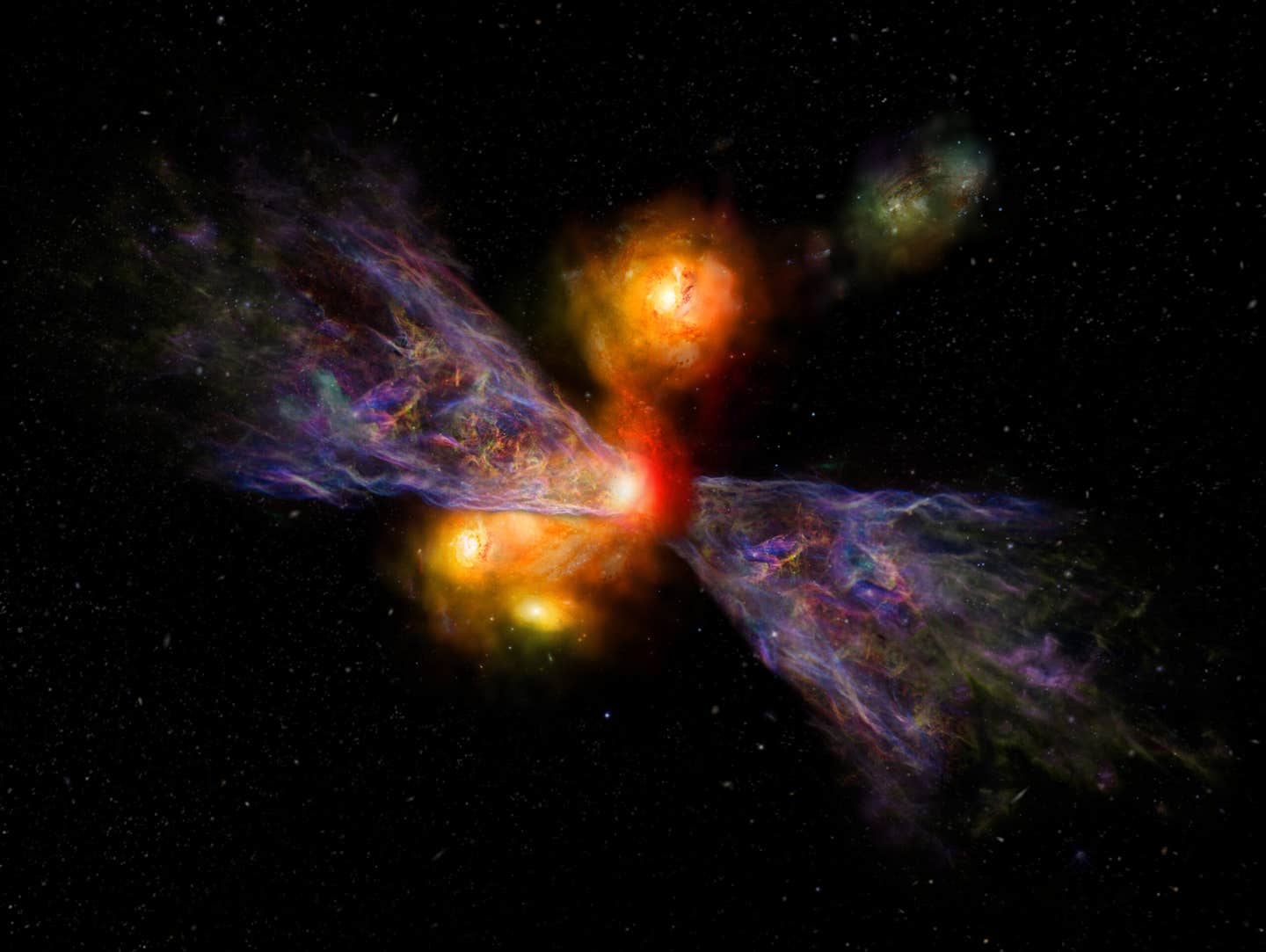
An artist’s impression of the galaxy CRISTAL-02, with a huge plume of cold gas extending away from it. This plume is almost as long as the galaxy itself, which is a telltale sign that gas is being driven out of the galaxy. (CREDIT: Joshua Worth via Creative Commons CC-BY license)
A massive galaxy in the early universe seems to be growing itself toward ruin. While it churns out new stars at a furious pace, it is also blasting away the cold gas that makes those stars possible. This is a self-defeating process that may help explain why so many big galaxies died young.
The system, called CRISTAL-02, appears just 1 billion years after the Big Bang. This is a time when astronomers did not expect to find large numbers of massive, quiescent galaxies. Those are galaxies that had already stopped forming stars. Yet the James Webb Space Telescope has revealed many of them. Their existence has become one of the biggest puzzles in modern astrophysics.
Now a team led by Dr Rebecca Davies of Swinburne University of Technology in Melbourne says CRISTAL-02 offers a simpler answer than some of the more exotic ideas proposed in recent years. Rather than needing changes to dark energy or some other revision to cosmic history, the evidence points to a violent but familiar process. In this process galaxies collide, star formation surges, massive stars explode, and powerful winds sweep the galaxy clean.
“Dense regions of the universe are like very active cities,” Davies said. “Galaxies collide and undergo frenzied bursts of star-formation. But when the biggest stars burn out, they explode as supernovae, launching powerful winds that blast away the very gas galaxies need to keep forming stars.”
A galaxy caught in the act
Using JWST and the Atacama Large Millimeter/submillimeter Array, or ALMA, the researchers examined CRISTAL-02 in unusual detail. The system has a stellar mass of about 10^10.2 solar masses and forms stars at 260 plus or minus 30 solar masses per year. This is roughly three times the average for galaxies of similar mass and era.
JWST resolved the system on scales of about 400 parsecs and showed that it is made up of several large star-forming clumps. The structure does not look like a settled, single galaxy. Instead, the evidence suggests an early-stage merger, with several components moving together. At least one faint companion is nearby.
ALMA revealed a striking plume of cold gas extending 7 kiloparsecs to the northeast. That plume is blueshifted, broad, and nearly as long as the galaxy itself. Its geometry matters as much as its size. The gas appears in a quasi-biconical structure that sits almost perpendicular to the galaxy’s main kinematic axis. This is a classic sign of a starburst-driven outflow rather than an ordinary tidal feature.
The team found matching clues in the optical emission lines measured by JWST. The ionized gas shows enhanced velocity dispersion in the same broad bicone, and line ratios indicate shock excitation, another hallmark of outflowing material. Both the cold gas traced by [C ii] emission and the ionized gas traced by Hα appear to follow the same motion.
An outflow, the authors argue, is the most natural explanation.
Fast enough to empty a galaxy
The numbers are severe. The broad [C ii] component implies an outflow velocity of 640 kilometers per second. After correcting for likely viewing angle, the true speed could be 740 to 1,280 kilometers per second. The estimated escape velocity of CRISTAL-02 is about 600 kilometers per second. This means some of this gas may not fall back at all.
The outflowing neutral gas mass is estimated at 1.5 times 10^9 solar masses. From that, the team calculated a total outflow rate of 521 solar masses per year. In other words, the galaxy is ejecting gas about twice as fast as it is turning gas into stars.
“The galaxy has a powerful wind that is ejecting material twice as fast as the galaxy forms stars,” Davies said.
That matters because CRISTAL-02 still appears to hold a large molecular gas reservoir, with a molecular-to-baryonic mass fraction of about 0.5 to 0.67. This is typical for galaxies at this redshift. But if the current pace continues and the galaxy does not pull in fresh cold gas from its surroundings, that reservoir could be exhausted in less than 100 million years. The paper says the entire supply could be gone in under 50 million years if both the star formation and outflow persist at their current rates.
“If this rapid blowout continues, the galaxy could be dead in less than 50 million years: explaining the origin of the mysterious massive dead galaxies in the early universe,” Davies said.
Not a black hole, at least not obviously
One of the more important parts of the analysis is what does not seem to be driving the wind. CRISTAL-02 shows no detection in X-ray or radio continuum. Its multiwavelength photometry is consistent with pure star formation. Its Balmer lines do not show the broadening expected from a Type 1 active galactic nucleus. The observed emission line ratios also fit ionization by young stars rather than an energetically important AGN.
That leaves stellar feedback, especially supernova explosions, as the leading explanation. The team found that the estimated energy injection from supernovae is comparable to the kinetic power of the outflow. The mass-loading factor, about 2.0 plus or minus 0.4, also fits predictions for starburst-driven winds.
The researchers then compared CRISTAL-02 with 99 star-formation-driven outflows reported across roughly 12 billion years of cosmic time. On that broader test, CRISTAL-02 did not look wildly exotic. Its outflow mass loading and velocity were broadly similar to lower-redshift starbursts when matched by local conditions at the launch point. This suggests the basic physics of stellar feedback may not have changed much over cosmic history.
Why mergers may matter so much
CRISTAL-02 is not just forming stars quickly, it is doing so in the middle of a cosmic collision. The merger likely funneled gas toward the center, intensified star formation, and set up the blowout now being observed. That combination, the authors argue, could make merger-driven winds an important route to creating early dead galaxies.
The idea gains weight because CRISTAL-02 may not be unusual. The paper notes that almost half of massive galaxies at this redshift are experiencing major mergers. If many of those systems go through the same sequence, rapid growth followed by violent gas loss, then the abundance of massive quiescent galaxies in the early universe becomes less surprising.
“Almost half of early massive galaxies are interacting with other nearby galaxies, suggesting this isn’t a quirk but a widespread cosmic phenomenon,” Davies said. “If many early galaxies collide and experience rapid growth, then it may not be surprising that we see so many dead galaxies in the early universe.
“CRISTAL-02 offers a natural solution to the mystery of why these massive galaxies live fast and die young.”
Practical implications of the research
This work gives astronomers a concrete mechanism for shutting down star formation in some of the universe’s earliest massive galaxies without immediately needing more speculative explanations. It also raises the importance of catching galaxies in the brief transition between starburst and quiescence.
The study suggests that deep, spatially resolved observations in both optical emission lines and neutral gas will be essential for telling true outflows apart from tidal debris in distant mergers.
More examples like CRISTAL-02 could help determine whether stellar feedback alone can produce early dead galaxies. Alternatively, faded black hole activity could still have to be part of the story.
Research findings are available online in the journal Monthly Notices of the Royal Astronomical Society.
The original story "Galaxy-killing wind may explain why giant galaxies died so early" is published in The Brighter Side of News.
Related Stories
- Early galaxy collisions may explain why giant galaxies died young
- Milky Way’s central black hole wind finally detected ending 50-year search
- A dead galaxy from the early universe is forcing astronomers to rethink galactic evolution
Like these kind of feel good stories? Get The Brighter Side of News' newsletter.
Joseph Shavit
Writer, Editor-At-Large and Publisher
Joseph Shavit, based in Los Angeles, is a seasoned science journalist, editor and co-founder of The Brighter Side of News, where he transforms complex discoveries into clear, engaging stories for general readers. With vast experience at major media companies like The Los Angeles Times, Times Mirror and Tribune Publishing, he writes with both authority and curiosity. His writing focuses on space science, planetary science, quantum mechanics, geology. Known for linking breakthroughs to real-world markets, he highlights how research transitions into products and industries that shape daily life.