Former NASA engineer creates electrostatic space drive — no propellant needed
Charles Buhler says electric fields created thrust without propellant, reviving debate over how spacecraft might one day move.

 Edited By: Joshua Shavit

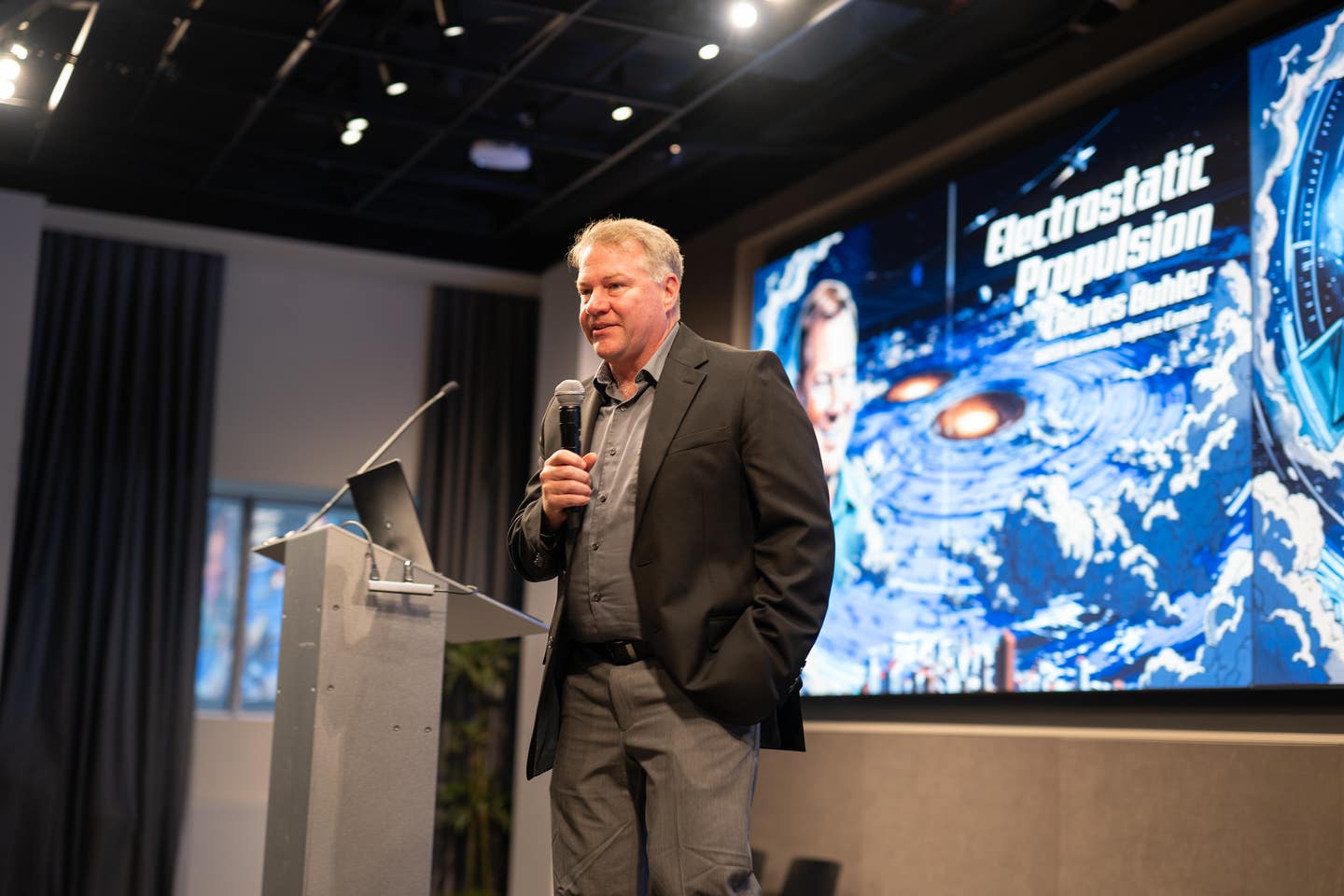
NASA veteran says vacuum tests reveal a strange thrust force with no fuel. (CREDIT: Exodus Technologies)
For as long as rockets have existed, motion in space has come with a brutal tradeoff. To move forward, you throw mass backward, and that means carrying huge amounts of fuel.
Charles Buhler says that tradeoff may not be permanent.
The longtime lead NASA engineer, now co-leading Exodus Propulsion Technologies, says his team has built a propulsion system that produces thrust without expelling propellant. Instead of relying on combustion or ion streams, the device uses electric fields. In repeated vacuum-chamber tests, Buhler says, it generated enough upward force to counter Earth’s gravity on the test article itself.
“The most important message to convey to the public is that a major discovery occurred,” Buhler said.
That is an enormous claim, and one that lands in a field with a long history of bold announcements that failed to survive careful scrutiny. Yet Buhler is not an obvious fringe figure. He spent decades working on NASA programs including the Space Shuttle, the Hubble Space Telescope, and the International Space Station, and he served as a subject matter expert in electrostatics.
A push without exhaust
Exodus’ device is built around electrostatic forces, the same class of forces behind static cling and the small shocks that jump from a fingertip to a metal doorknob. Buhler says his team found a way to create an asymmetry in electrostatic pressure that produces directional thrust.
If that effect holds up, it would challenge one of the most basic assumptions of spaceflight. Traditional rockets must burn through propellant. Even electric thrusters still eject mass. A truly propellantless system could change the economics of satellites, long-duration missions, and deep-space travel.
The work did not unfold in one dramatic leap. Buhler and his colleagues spent more than two decades exploring the idea. Between 2016 and 2020, he said, their best devices produced only a tiny effect, roughly one hundred-thousandth of Earth’s gravity. That was measurable, but nowhere near enough to matter in practice.
Then came what the team calls “unity,” the point at which the device can produce force equal to one Earth gravity on the object being tested. Buhler says they crossed that threshold in 2023 during vacuum-chamber experiments.
“This discovery of a New Force is fundamental in that electric fields alone can generate a sustainable force onto an object and allow center-of-mass translation of said object without expelling mass,” he said.
Why this claim gets attention
Alternative propulsion ideas are not new. Systems such as the EmDrive and IVO Ltd.’s Quantum Drive drew interest by promising thrust without fuel, but neither has achieved broad acceptance as a working technology.
That history explains why many physicists and engineers will withhold judgment until Exodus shows the effect in orbit, where air currents, vibration, thermal distortions, and other ground-based artifacts are less likely to muddy the picture.
Buhler says his group has spent years trying to rule those out. The company built its own vacuum chamber and is now developing a larger walk-in version. According to Buhler, the team has run about 2,000 experiments across many different configurations, using pendulums, scales, spinners, force plates, polarity reversals, Faraday cages, sealed setups, and low-pressure tests.
At the Alternative Propulsion Energy Conference, he described a long process of eliminating ion wind, magnetic effects, and equipment errors. “Through iterative refinement and rigorous testing, we achieved thrust measurements exceeding previous limits,” he said.
One reason the work has drawn a closer look is Buhler’s standing in the field. Another is the reported consistency. He says the force changes direction when the device is flipped, appears in multiple designs, and can show up in sealed conditions where escaping air should not be able to provide a push.
Still, consistency inside one group’s lab is not the same as independent confirmation.
The strangest result may be the hardest to explain
Among the team’s most curious observations is what Buhler describes as a lingering force. In some tests, he says, thrust continues after power is cut off.
That detail is one reason the claim has become so provocative. A device that keeps producing force after disconnection does not fit neatly into ordinary engineering intuition, and Buhler has acknowledged that the theory lags behind the experiments.
“Science’s role is to dissect what this means,” he said.
He has tried to connect the effect to quantum electrodynamics, or QED, the theory that describes how light and matter interact. But even sympathetic outside reviewers have not settled the question. David Chester, who examined Buhler’s ideas, raised concerns about parts of the theoretical explanation while saying he could not offer a simple conventional reason for the full body of experimental results as described.
That leaves the work in an awkward but familiar scientific position. The measurements may be interesting, even important, but they are not yet a settled discovery. For now, the reported effect stands as an experimental claim waiting for wider testing.
What happens if the measurements survive
Buhler does not say the current system is ready to launch vehicles from Earth. The reported force is still small, in the millinewton range. But he argues it could already matter in space, where satellites and spacecraft need relatively modest thrust for station-keeping, orbital adjustments, and long-duration corrections.
That possibility is why the next step matters so much. Exodus is seeking funding and partnerships for an in-orbit demonstration, the kind of test that could either sharply strengthen the case or bring it back to Earth.
“It will be this force that we will use to propel objects for the next 1,000 years… until the next thing comes,” Buhler said.
That forecast may prove visionary, or premature.
For now, the safer conclusion is narrower. A veteran electrostatics specialist says he and his colleagues have measured a repeatable thrust effect in vacuum without propellant, and they believe it cannot be explained by ion wind or standard electrical artifacts. If independent groups reproduce that result and a spacecraft test confirms it, propulsion physics would face a remarkable new chapter.
If not, the episode will join a long list of seductive ideas that taught researchers how easy it is to fool themselves at the edge of measurement.
Either way, the debate has returned to a basic scientific question worth asking: have we really exhausted the ways a machine can move through space?
Practical implications of the research
If Exodus’ measurements are confirmed, the first practical use would likely be modest, not cinematic. Satellites could use a propellantless system for station-keeping, reducing the fuel now reserved for orbit maintenance and extending mission life.
Over time, that could lower spacecraft mass, simplify design, and reduce launch costs. Longer missions would become easier to plan because engineers would not need to budget propellant so tightly for corrections and repositioning.
The larger dream is much farther off. A stronger version of the effect, paired with a durable power source, could reshape interplanetary travel. But that remains speculative until outside teams reproduce the force and a spaceflight test shows it works beyond the lab.
The original story "Former NASA engineer creates electrostatic space drive — no propellant needed" is published in The Brighter Side of News.
Related Stories
- Physicists believe that warp drive could exist in the next 100 years
- Pulsar Fusion’s Sunbird fusion rocket could get us to Mars in half the time
- Cutting-edge rocket engine could accelerate to 99% the speed of light
Like these kind of feel good stories? Get The Brighter Side of News' newsletter.
Joseph Shavit
Writer, Editor-At-Large and Publisher
Joseph Shavit, based in Los Angeles, is a seasoned science journalist, editor and co-founder of The Brighter Side of News, where he transforms complex discoveries into clear, engaging stories for general readers. With vast experience at major media companies like The Los Angeles Times, Times Mirror and Tribune Publishing, he writes with both authority and curiosity. His writing focuses on space science, planetary science, quantum mechanics, geology. Known for linking breakthroughs to real-world markets, he highlights how research transitions into products and industries that shape daily life.