Germany’s U-Shift II reimagines the vehicle as a swappable platform
U-Shift II separates the vehicle from its function, letting one autonomous platform handle many different jobs.

 Edited By: Joseph Shavit

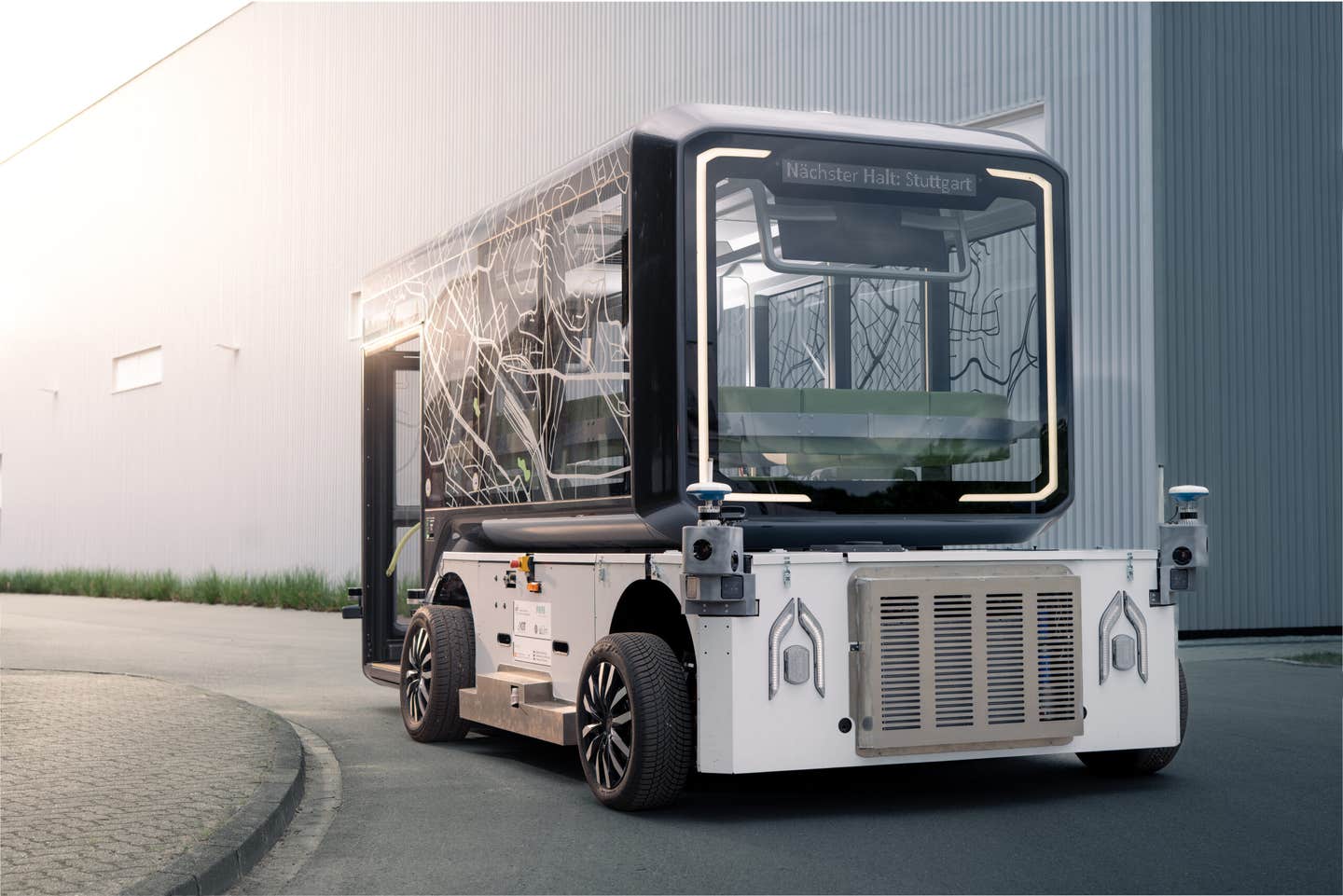
The U-Shift system combines a mobile platform (“drive board”) with replaceable capsules for different applications. (CREDIT: Amadeus Bramsiepe, KIT)
Some vehicles are built for one job and stay that way for life. The U-Shift II concept takes the opposite view, treating the vehicle more like a platform that can change roles as needed, from public transport to deliveries to mobile services.
At the center of the idea is a strict split between the vehicle itself and the task it performs. Instead of building separate vehicles for each use, the same autonomous base can move under a capsule designed for a specific purpose, lift it, lock it in place, and head off without human help.
That flexibility is what gives the concept its appeal.
The system was developed at the Institute of Vehicle Concepts of the German Aerospace Center, or DLR, and has been pursued across several DLR projects over a number of years. In U-Shift II, researchers and partners focused on moving the idea closer to practical use while supporting technology transfer for small and medium-sized companies in Baden-Württemberg.
“Innovation is the key driver for tomorrow’s value creation in the automobile sector. This makes the U-Shift II project so important for SMEs. With its focus on technology transfer and the targeted involvement of medium-sized partners, this research and development project systematically strengthens the long-term competitiveness of Baden-Württemberg’s automobile industry when it comes to autonomous and networked driving,” said Dr. Nicole Hoffmeister-Kraut, Minister of Economic Affairs, Skilled Trades and Tourism.
A vehicle that changes its job
Professor Kora Kristof, Vice President for Digitalization and Sustainability at KIT, framed the idea in practical terms. “We want to make vehicles that suit more than one single purpose,” she said. “A vehicle that adapts flexibly to different tasks saves resources. It’s a building block of sustainable mobility, and creates innovative options for Baden-Württemberg as a mobility hub.”
The heart of that concept is a flat drive board. It carries the main technical systems, including four hub motors, batteries, the steering system, and central functions for control, monitoring, and energy supply. Those components were developed at the Research Institute for Automotive Engineering and Power Systems Stuttgart, or FKFS.
When the system is ready to work, the drive board moves autonomously beneath the capsule needed for the task at hand. It lifts the capsule and secures it in place. No one needs to step in during that process.
Dr. Michael Frey of KIT’s Institute of Vehicle Systems Technology, known as FAST, compared the idea to a swap container. “Instead of designing dedicated vehicles for each task, the vehicle remains the same, only the superstructure changes,” he said.
FAST was responsible for the chassis design, including the integrated lifting system that lets the vehicle pick up and drop off capsules without extra infrastructure. According to Frey, putting the concept into operation basically requires only a free space for the capsule and the vehicle.
A digital link between platform and capsule
That physical simplicity depends on a more complex digital setup. Before the vehicle picks up a capsule, it establishes a digital connection with it. Once linked, the system can adjust the vehicle’s technical functions to match the job.
“Thanks to the flexible technical architecture, the vehicle can adopt different functions depending on its task,” said Professor Eric Sax, who heads KIT’s Institute for Information Processing Technology, where the electronic and software-based control center was developed.
That control center connects and coordinates the vehicle functions and the technologies inside the capsule. The result is a platform that can switch behavior depending on whether it is meant to carry passengers, transport goods, or support another application.
The concept also allows new software to be installed wirelessly, much like a smartphone update. That means functions do not have to stay fixed once the vehicle is built. The architecture is designed to change with new tasks.
In the material describing the project, the range of possible uses is broad: on-demand public transportation, delivery services, mobile medical services, and even temporary accommodation. The common thread is not the service itself, but the reusable autonomous base underneath it.
Precision matters most when the vehicle docks
To move safely, the vehicle relies on cameras, radar, and lidar to read its surroundings. The sensor concept, along with data processing and motion planning, was developed at Ulm University.
Those systems become especially important during docking, where the platform has to position itself with extreme accuracy under the capsule. The project says the interaction between those systems and the motion systems developed at FKFS allows maneuvering and docking with centimeter precision.
That level of control is not just a technical flourish. If the entire concept depends on a vehicle repeatedly approaching, lifting, and carrying different capsules, the handoff has to work smoothly and reliably each time.
Once the capsule is in place, a locking system developed at DLR keeps it secured during travel. That closes the loop on the platform idea: approach, identify, connect, dock, lift, lock, and move on to the next task.
Professor Meike Jipp, Director of DLR’s Energy and Transport division, said the work will help move automated vehicle concepts and their related technologies forward. “With this research, we’re supporting Baden-Württemberg as an automotive hub, establishing important baselines for taking these innovative mobility ideas to practical application, and preparing their transfer to the road,” she said.
Other vehicle projects chasing similar flexibility
U-Shift II is not the only attempt to rethink what a vehicle can be. Around the world, other companies have been testing modular, purpose-built, or service-based vehicle concepts that move away from the old model of one machine, one fixed role.
Toyota’s e-Palette
Toyota’s e-Palette is one of the clearest examples. First unveiled in 2018, the battery-electric vehicle was designed as a multi-use platform for services including local transport and mobile retail.
The automotive advantage is straightforward: one underlying vehicle can support several business models instead of being locked into a single purpose.
Toyota says it began sales of the e-Palette on September 15, 2025, with deployment planned around Toyota Arena Tokyo and Woven City, making it one of the few projects in this space to reach the market.
Einride
Einride has pushed the idea in freight. Its autonomous electric pod, built without a conventional driver cab, is meant for goods movement rather than passenger service.
That design can improve automotive efficiency by tailoring the vehicle to logistics, reducing emissions, and rethinking how freight vehicles are packaged. Einride says it became the first company to operate an autonomous, electric freight vehicle on a public road in 2019, and it has continued public-road and commercial operations since then.
In that sense, its technology is beyond the concept stage, though still limited to specific deployments rather than a broad consumer market.
Zoox
Zoox, by contrast, has focused on urban ride-hailing. Its purpose-built robotaxi was publicly introduced in 2020 and was designed from the start for riders rather than drivers.
That changes not only the cabin layout, but also the logic of the whole vehicle, from safety systems to passenger experience.
As of July 1, 2026, Zoox says it is live in Las Vegas and San Francisco and is welcoming public riders, which puts it further along than many autonomous vehicle programs that remain stuck in testing.
REE Automotive
REE Automotive has taken yet another path, focusing on a flat, by-wire platform that can support different commercial vehicle bodies.
That kind of architecture can improve automotive design by freeing up packaging space, simplifying the base vehicle, and supporting a wider range of end uses on the same platform. REE said customer deliveries began in 2024, including to Penske, U-Haul, and Airbus.
At the same time, the company later shifted toward a software-led model, so while the platform reached customers, it has not yet become a broad in-market vehicle system on the scale once envisioned.
Taken together, these efforts point to a larger shift in the industry. The traditional vehicle, built once for one clear role, is being challenged by platforms that can be updated, repurposed, or designed around a service from the start. U-Shift II fits squarely into that movement, but with an especially sharp version of the idea: keep the driving platform, swap the function.
The original story "Germany’s U-Shift II reimagines the vehicle as a swappable platform" is published in The Brighter Side of News.
Related Stories
- Electric vehicles get major boost from new ultra-powerful lightweight battery
- Electric vehicles now match gas and diesel counterparts for longevity
- Volkswagen's newest vehicles to feature ChatGPT for enhanced communication
Like these kind of feel good stories? Get The Brighter Side of News' newsletter.