Nearby exoplanet just got more Earth-like and promising for life
GJ 3378b now appears smaller and rockier, making it a stronger nearby target in the search for habitable worlds.

 Edited By: Joshua Shavit

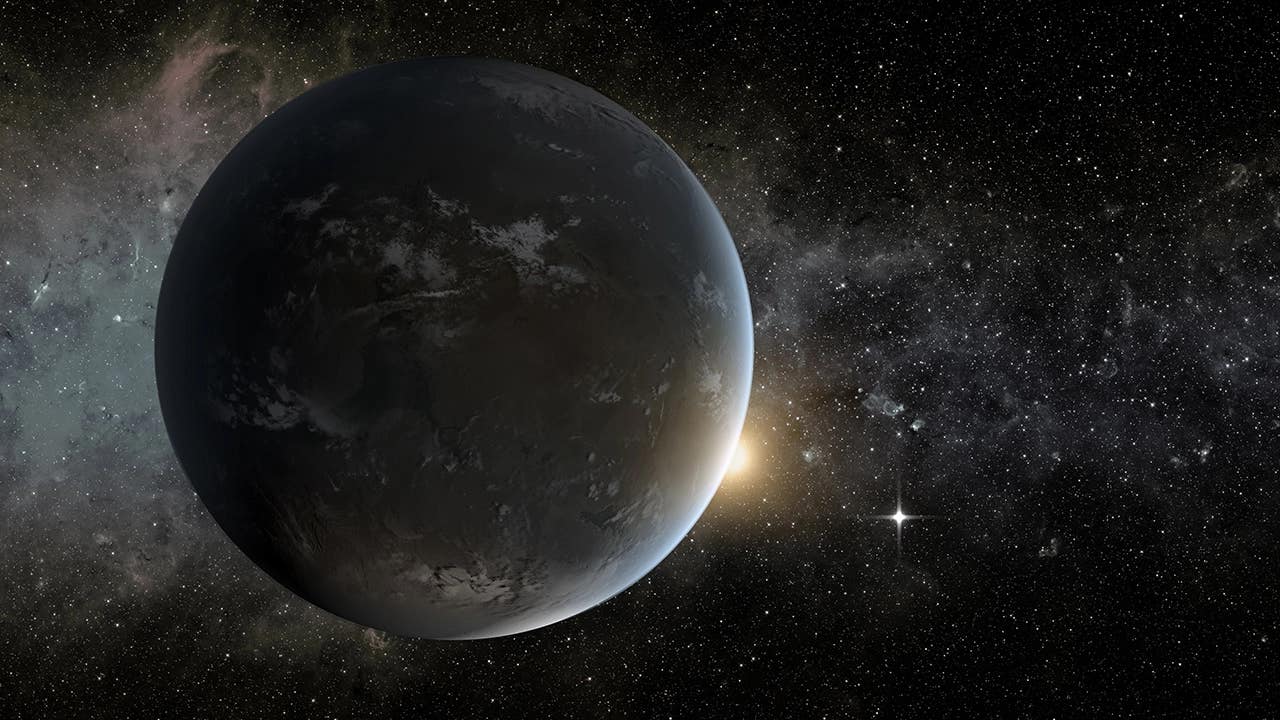
GJ 3378 b is a super Earth exoplanet that orbits a M-type star. Its mass is 2.3 Earths, it takes 21.5 days to complete one orbit of its star, and is 0.09673 AU from its star. (CREDIT: NASA)
GJ 3378b has moved closer to the kind of world astronomers most want to find: small, rocky, temperate, and near enough for future telescopes to inspect in far greater detail.
The planet circles a red dwarf star about 25 light-years from Earth, in the northern constellation Camelopardalis. It sits in the star’s habitable zone, the range where temperatures could allow liquid water. And after a fresh look with the Hobby-Eberly Telescope at McDonald Observatory, researchers say the planet appears significantly lighter than earlier estimates suggested.
That matters because mass helps determine what kind of world a planet is. A heavier planet is more likely to hold a thick envelope of gas. A lighter one, especially in this range, has better odds of being rocky.
“Our mantra is ‘follow the water,’” said Paul Robertson, an astronomer at the University of California, Irvine, and lead author of the study published in The Astrophysical Journal. “It’s the one thing every known living thing on Earth needs, so that’s the first thing we look for when trying to find environments that could sustain life.”
A nearby world comes into sharper focus
GJ 3378b orbits a small, cool red dwarf, the most common kind of star in the Milky Way. Because red dwarfs are faint and low in mass, their habitable zones sit much closer in than Earth’s does around the Sun. That makes their planets easier to detect through tiny gravitational pulls on the host star, but still difficult enough that the work demands very precise instruments.
“About 70% of stars in our galaxy are red dwarfs, so they represent the standard,” said Michael Endl, an astronomer at UT Austin, a member of its Center for Planetary Systems Habitability, and a co-author on the paper. “It’s really important that we understand the planet population around these stars.”
To study the system, the team used the Habitable-zone Planet Finder on the 10-meter Hobby-Eberly Telescope. The instrument watches for a subtle wobble in the star, caused by the pull of an orbiting planet. That wobble reveals the planet’s orbital period and a minimum estimate of its mass.
“The Habitable-zone Planet Finder is optimized to use infrared light,” Robertson said. “As stars get smaller, they get cooler, and most of their energy comes out in infrared wavelengths. So, we put an infrared spectrometer on a 10-meter telescope, and that gives us more raw light-collecting power to observe these faint stars.”
The team combined 137 new radial velocity measurements from that instrument with additional observations from the NEID spectrometer at Kitt Peak National Observatory, plus archival data from CARMENES, SPIRou, TESS, and Gaia.
Smaller than first thought
When GJ 3378b was reported in 2024, it was thought to have a period of about 24.7 days and a minimum mass near five Earth masses. The new analysis points to a different picture.
The team found that the signal is better explained by a circular orbit lasting 21.45 days. More strikingly, the planet’s minimum mass drops to 2.3 Earth masses, with a Doppler signal of just 1.3 meters per second.
That shift puts the planet more comfortably in the range where terrestrial compositions remain plausible. The paper says the revised mass is “potentially consistent with a terrestrial composition,” and places the world among the more Earth-like known exoplanets within 10 parsecs of the solar system.
The host star itself is small, about 0.262 times the Sun’s mass and 0.275 times its radius, with a luminosity of just 0.0085 times solar. Because it is so dim, a planet can orbit very close and still receive temperate levels of starlight. The study estimates GJ 3378b gets about 91% of the radiation Earth receives from the Sun, with an equilibrium temperature of 272 kelvin, assuming zero albedo.
That is not the same as proving the planet is habitable. The classic habitable zone assumes an Earth-like atmosphere, and no atmosphere has been detected here. Around red dwarfs, that uncertainty looms large.
A temperate orbit, with an important warning
Planets around red dwarfs live close to their stars, and that can come at a cost. Young M dwarfs can be magnetically active and bright in high-energy radiation, which may strip atmospheres away over time.
The researchers examined that issue using an atmosphere retention metric based on the planet’s likely exposure to X-ray and ultraviolet radiation and its estimated escape velocity. Their result put GJ 3378b near the dividing line between planets that are expected to lose atmospheres and those that may keep them.
In other words, the planet’s atmosphere cannot be assumed, but it also cannot be ruled out by simple scaling arguments.
That ambiguity is part of what makes the world interesting. It is not simply a habitable-zone planet, but one that sits near a scientifically useful boundary: close enough to its star to raise real doubts, yet not so extreme that the case is closed.
The researchers also checked whether the 21.45-day signal could instead be caused by stellar activity. Red dwarfs can produce false alarms when starspots and magnetic changes mimic a planet’s tug. But the team found no significant activity signal near the candidate planet’s period, and no strong evidence that the signal was being driven by the star itself.
They also searched TESS data for transits, which would have let astronomers measure the planet’s size directly. None were found.
Built for the telescopes coming next
Even without a transit, GJ 3378b stands out because of its distance. At 7.7 parsecs, or about 25 light-years, it lies in the solar neighborhood, the same small patch of space where astronomers hope to find the best future targets for atmospheric studies and, eventually, biosignature searches.
“The name of the game is precision,” Endl said. “In order to find those low mass planets, you’re always looking for tiny signals. If your instruments aren’t precise enough, you won’t find them. You can’t find them.”
The study argues that nearby habitable-zone planets around red dwarfs are especially important because the next generation of giant observatories will be able to examine some of them directly. GJ 3378b may prove challenging to image because of how close it lies to its star, but the system still matters as part of the local census of potentially temperate planets.
“The ultimate goal is biosignatures. We really want to know, ‘Are we alone in the universe?’” Endl said. “We are still in the reconnaissance phase of our solar neighborhood, trying to find the planets around the nearest stars because those will be the easiest ones to detect a biosignature on. This planet brings us one step closer to knowing all of our neighbors and, ultimately, which might be hospitable for life.”
The Habitable-zone Planet Finder, built by Penn State with participation from UT Austin, has been operating since 2018. For now, its role is still detective work: find the small worlds, sort the promising from the doubtful, and give future telescopes a shortlist worth chasing.
GJ 3378b now looks more deserving of a place on that list.
Practical implications of the research
The revision of GJ 3378b’s mass and orbit makes the planet a stronger candidate for future follow-up work aimed at identifying rocky, temperate worlds around nearby red dwarfs.
It sharpens the target list for next-generation observatories such as the Giant Magellan Telescope, the Extremely Large Telescope, and the planned Habitable Worlds Observatory. Just as important, it shows why combining data from multiple high-precision instruments can change the picture of a planet in meaningful ways.
In this case, a world once viewed as heavier and less Earth-like now looks like a more plausible terrestrial planet in the habitable zone, though questions about its atmosphere remain unresolved.
Research findings are available online in the journal The Astrophysical Journal.
The original story "Nearby exoplanet just got more Earth-like and promising for life" is published in The Brighter Side of News.
Related Stories
- Astronomers observe six red dwarf stars 'eating' Earth-like planets
- Astronomers map the climate of Earth-like exoplanets for the first time
- Scientists find Earth-like exoplanets to be common in the universe
Like these kind of feel good stories? Get The Brighter Side of News' newsletter.
Joseph Shavit
Writer, Editor-At-Large and Publisher
Joseph Shavit, based in Los Angeles, is a seasoned science journalist, editor and co-founder of The Brighter Side of News, where he transforms complex discoveries into clear, engaging stories for general readers. With vast experience at major media companies like The Los Angeles Times, Times Mirror and Tribune Publishing, he writes with both authority and curiosity. His writing focuses on space science, planetary science, quantum mechanics, geology. Known for linking breakthroughs to real-world markets, he highlights how research transitions into products and industries that shape daily life.