How animal feces became an evolutionary force 540 million years ago
Ancient coprolites reveal how growing animals and more complex guts may have reshaped ocean nutrient cycles 540 million years ago.
 Flinders University Writer: Tania Bawden

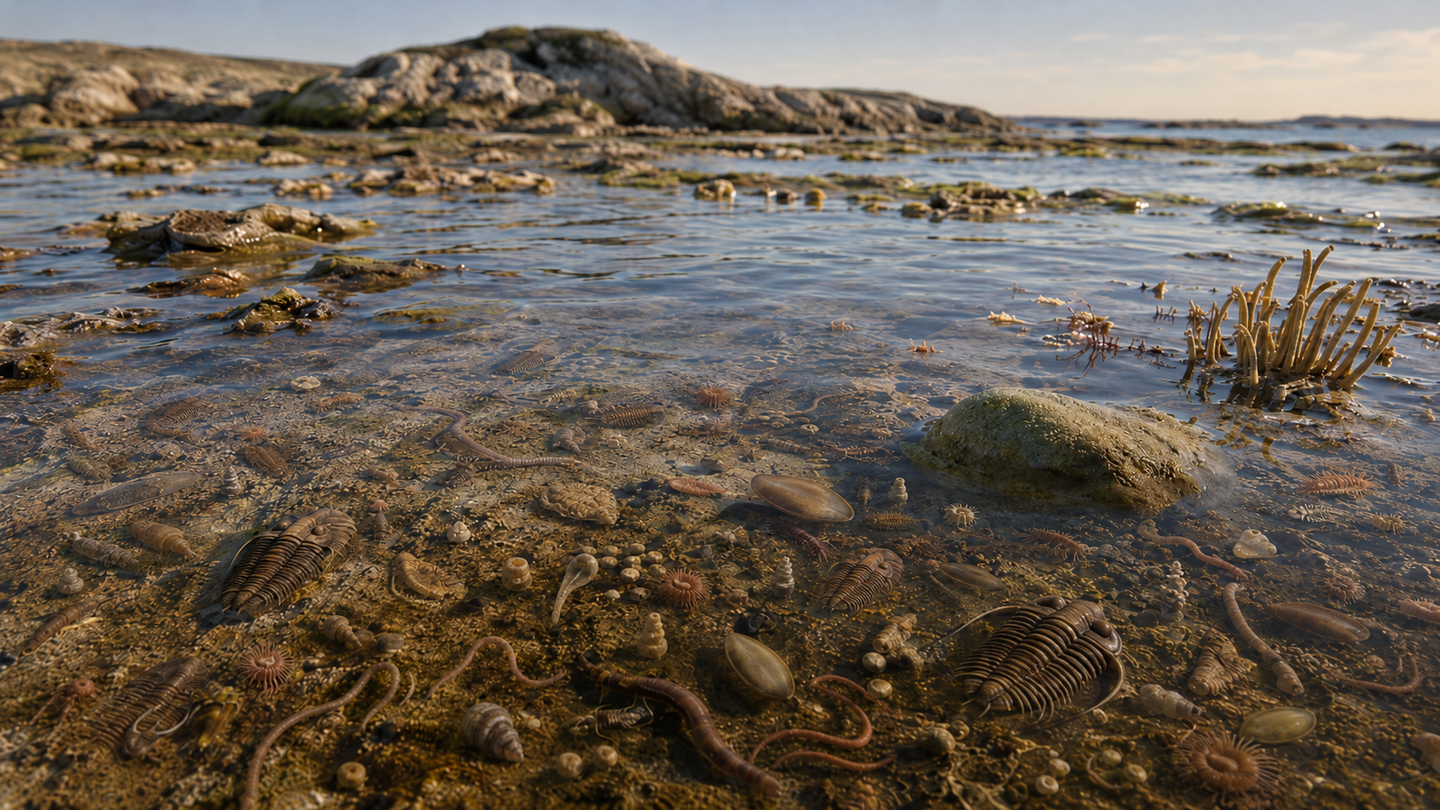
Cambrian Explosion fossilized feces may have moved nutrients through ancient oceans, helping complex marine ecosystems expand. (CREDIT: Wikimedia / AI-Generated / CC BY-SA 4.0)
- Fossilized feces may have helped fuel the Cambrian Explosion by moving nutrients and organic matter through ancient oceans as animal life became larger and more diverse.
- More complex digestive systems produced larger and more varied waste, creating new food sources and helping carry carbon, nitrogen, phosphorus and iron into deeper water.
- The idea adds feces to rising oxygen and changing food webs as a possible force in early animal diversification, although some effects on ancient ocean productivity remain uncertain.
Fossilized feces may have helped transform Earth’s early oceans, feeding a cycle of nutrients, larger animals and more complex ecosystems during one of evolution’s most dramatic bursts of diversification.
An international team led by Flinders University argues that animal waste deserves a larger place in explanations for the Cambrian Explosion, the interval beginning about 540 million years ago when most major animal groups started appearing.
Writing in Trends in Ecology & Evolution, the researchers describe a “faecal revolution” in which increasingly abundant fecal pellets and coprolites, or fossilized excrement, helped move organic matter and nutrients through ancient seas.
“Next to rising oxygen levels and other contributing factors, the importance of faeces in ancient ecosystems is often overlooked,” said Dr Russell Bicknell, an Australian Research Council DECRA fellow at Flinders University’s College of Science and Engineering.
Waste becomes part of the ecosystem
Animals had appeared by roughly 600 million years ago during the Ediacaran Period, but few known Ediacaran animals preserve evidence of guts. No coprolites are currently known from Proterozoic deposits.
That picture changes in the Cambrian. The researchers identified coprolites from 36 deposits, ranging from about 538.8 million to at least 494.2 million years ago.
The fossils vary dramatically. Some are microscopic pellets. Others reach several centimeters and contain shells, animal fragments or organic material.
“We have considered these ancient diets, increasingly sophisticated digestive systems and trophic interactions as part of a much bigger picture to help explain how more organic matter and nutrients poured into the ancient oceans to accelerate ecosystem development at the end of the Ediacaran and early Cambrian periods,” Bicknell said.
As the Cambrian progressed, digestive systems also became more elaborate. Some early arthropods developed specialized foreguts and digestive glands that increased food-processing efficiency.
“The faecal matter includes microscopic pellets through to centimetre-scale coprolites containing shells and other animal fragments,” Bicknell said.
Guts, predators and a changing food web
Fossilized gut contents trace that transition. About 558-million-year-old gut contents have been identified in the tube worm-like Calyptrina and mollusk-like Kimberella. A confirmed Ediacaran through-gut in cloudinomorphs was simple, connecting a mouth to an anus.
Early Cambrian fossils show greater variety. Hyoliths from southern France preserve three-dimensional digestive tracts. By Cambrian Series 2, fossils from Australia, China and Greenland preserve more advanced guts.
“With this shift, we see increasingly complex digestive systems, particularly in early arthropods which evolve specialised foreguts and digestive glands capable of processing a wider variety of food,” Bicknell said.
Coprolite contents also reveal complicated feeding relationships. Many contain remains of bottom-dwelling animals, including trilobites, hyoliths, worms, sponges and other arthropods.
Some large coprolites from South Australia’s Emu Bay Shale may have been produced by the trilobite Redlichia rex. Its legs carried stout feeding spines, and biomechanical modeling suggests it could crush shells. Modern horseshoe crabs fed small bivalves produce shelly feces with similar angular fragments.
Still, most Cambrian coprolites cannot be tied confidently to a specific animal. Preservation is uneven, and the scarcity of very early fossils may partly reflect where paleontologists have looked.
Fecal pellets move nutrients deeper
The broader argument goes beyond identifying who ate whom. Feces can transport carbon and nutrients through marine ecosystems.
In modern oceans, animal feces contribute to particulate organic carbon, the sinking material that helps carry carbon from sunlit surface waters into deeper zones. Fecal matter also contains nitrogen, phosphorus and iron.
Modern zooplankton fecal pellets can account for up to 100 percent of particulate organic carbon in some conditions, though their contribution usually remains below 40 percent.
The researchers argue that a similar process strengthened during the Cambrian as more animals developed guts and total biomass increased. Larger bodies could produce larger fecal masses, while growing populations generated more organic material.
The team says the growing supply of fecal matter likely increased the organic carbon reaching sediments and deeper water. That would have added to nutrient availability on marine shelves as oxygen levels also rose.
“It becomes clear in the fossil record that the evolution of feeding strategies aligns with the production and distribution of organic carbon and nutrients to start creating conditions we see in modern oceans and later on land where fertiliser today is used to produce our food,” Bicknell said.
A feedback loop in Cambrian seas
By Cambrian Stage 3, marine food webs had developed a general structure broadly similar to modern ecosystems. The team proposes that fecal production became part of a positive feedback loop.
More and larger animals produced more waste. That waste redistributed nutrients and organic matter. Those resources could support detritus feeders, burrowing animals and other organisms entering new environments.
The fossil record shows greater colonization of distant marine settings during Cambrian Stages 2 through 4, about 529 million to 507 million years ago. Deeper burrowing opened new ecological niches.
Some animals may even have fed directly on feces or microbes growing on them. Rare fossils from Canada’s Ravens Throat River Lagerstätte preserve trilobites, agnostids and hyoliths on coprolites, interpreted as possible feeding on the waste or its microbiota.
Important questions remain. Fecal matter in carbonate environments is poorly understood, and some pellet-like structures may have other origins. The effect of fecal nutrients on Cambrian primary productivity also remains hypothetical.
Practical implications of the research
The work expands how paleontologists can use coprolites. Rather than treating fossilized feces mainly as evidence of predator-prey interactions, the researchers argue they can also reveal how nutrients moved through early ecosystems and how digestive evolution reshaped marine environments.
A stronger fossil record from the Ediacaran and earliest Cambrian could help identify when animals first began producing fecal pellets and how quickly that process altered nutrient cycling.
The researchers also call for combining fossil morphology, trace fossils and biogeochemical evidence. That approach could clarify how rising oxygen, changing diets, larger bodies and increasing waste worked together during the Cambrian Radiation.
Once animals began eating more, digesting more efficiently and producing more waste, feces became part of the machinery of ecosystem change.
Research findings are available online in the journal Trends in Ecology & Evolution.
The original story "How animal feces became an evolutionary force 540 million years ago" is published in The Brighter Side of News.
Related Stories
- Climate change could alter feeding patterns throughout freshwater ecosystems
- Pink 'living rocks' reveal hidden ecosystem beneath Japan’s coast
- Ancient squirrel droppings reveal 700,000 years of lost ecosystems
Like these kind of feel good stories? Get The Brighter Side of News' newsletter.
Joseph Shavit
Writer, Editor-At-Large and Publisher
Joseph Shavit, based in Los Angeles, is a seasoned science journalist, editor and co-founder of The Brighter Side of News, where he transforms complex discoveries into clear, engaging stories for general readers. With vast experience at major media companies like The Los Angeles Times, Times Mirror and Tribune Publishing, he writes with both authority and curiosity. His writing focuses on space science, planetary science, quantum mechanics, geology. Known for linking breakthroughs to real-world markets, he highlights how research transitions into products and industries that shape daily life.