Humanity could start an 80,000-year journey to Alpha Centauri in 2029
A nonprofit wants to begin humanity’s first deliberate voyage toward another star using solar power, electric thrust and patience.

 Edited By: Joshua Shavit

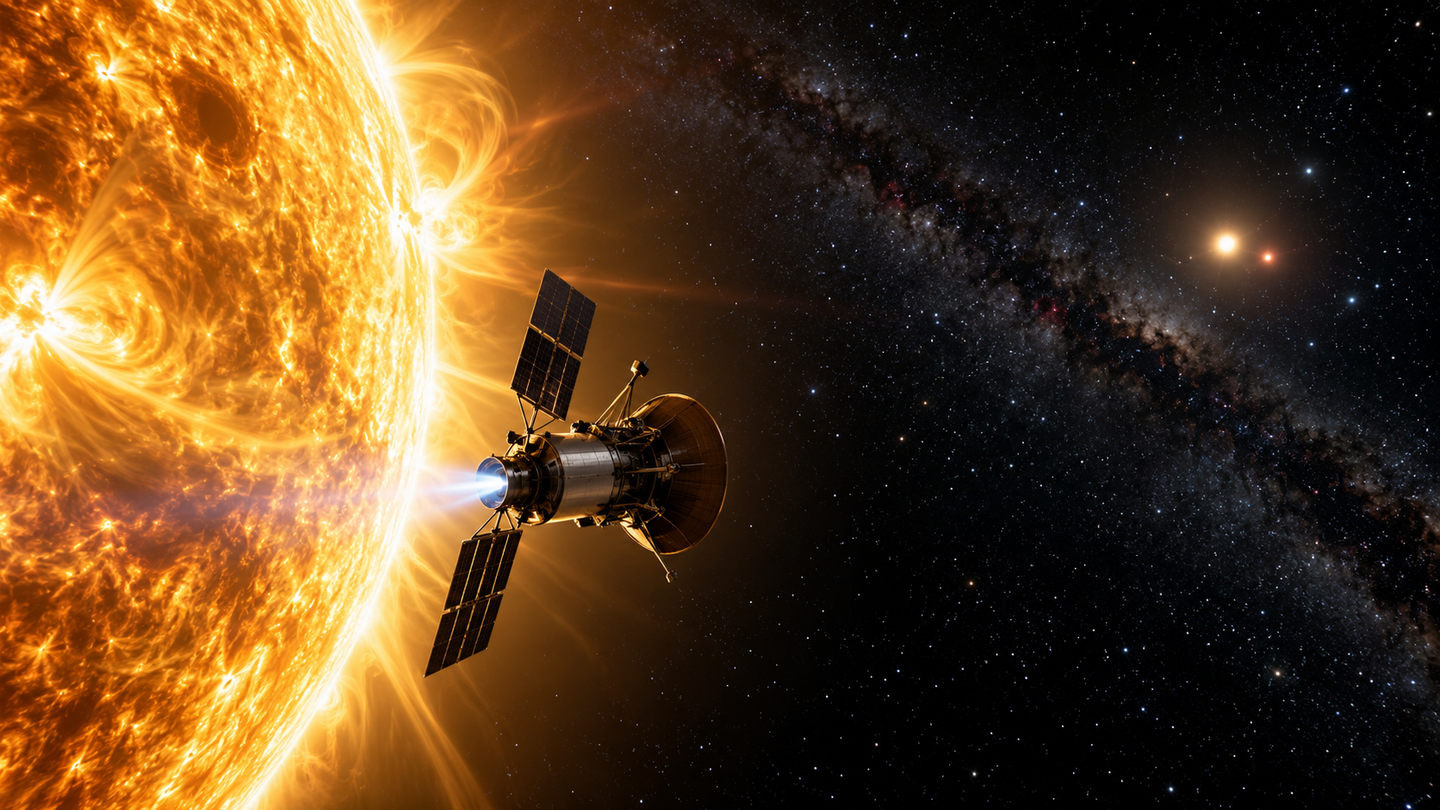
An AI-assisted mission plan could send a solar-electric spacecraft toward Alpha Centauri by 2029 on an 80,000-year journey. (CREDIT: Shutterstock)
- A nonprofit called the Fermi Explorer Mission plans to launch a spacecraft toward Alpha Centauri by the end of 2029 using a solar-electric trajectory developed through an AI-assisted physics research system.
- Physical Superintelligence’s technical assessment found that repeated close approaches to the Sun could let a lightweight spacecraft build enough speed for an interstellar trajectory, although the trip would still take roughly 73,000 to 80,000 years.
- The concept uses existing classes of propulsion technology rather than speculative lasers or nuclear power, but the 2029 schedule, spacecraft mass, long-duration operations and projected cost remain significant engineering challenges.
Humanity's first spacecraft deliberately aimed at another star may not need exotic engines, giant lasers or anything approaching the speed of light. It may simply need an extraordinary amount of patience.
The nonprofit Fermi Explorer Mission announced plans Sept. 1 to launch a small spacecraft toward Alpha Centauri before the end of 2029. The organization expects the vehicle to pass through the neighboring star system's outer reaches tens of thousands of years after everyone involved in its construction is gone.
The proposed route emerged from an analysis by Physical Superintelligence, or PSI, a newly launched AI physics laboratory backed by $58 million in seed funding led by Breakthrough Energy Ventures. Its July technical report describes a solar-electric spacecraft repeatedly diving toward the Sun to build speed before beginning an almost entirely unpowered interstellar coast.
The destination is moving
Alpha Centauri lies about 4.365 light-years away, but simply pointing a spacecraft at its current location would miss.
The stellar system is moving through space. PSI's calculations therefore asked where Alpha Centauri's A and B stars will be tens of thousands of years from now and when reaching that future position requires the least departure energy.
The report identifies an optimum near 73,012 years after launch, requiring a heliocentric cruise speed of about 23.64 kilometers per second after escaping the Sun. A broad range between roughly 67,000 and 80,000 years costs almost the same amount of energy.
Fermi Explorer publicly describes its mission as an approximately 80,000-year journey passing within 2,600 astronomical units of the Alpha Centauri AB barycenter. That is not a close planetary flyby. It is roughly an attempt to reach the system's distant cometary neighborhood.
The AI found a way around the solar-power problem
Electric propulsion is extremely efficient with propellant but produces weak thrust. Solar panels create another problem because available sunlight falls rapidly as a spacecraft travels away from the Sun.
A conventional outward spiral eventually runs out of useful power before the vehicle reaches the speed required by the mission.
PSI's solution was multi-revolution perihelion pumping. The spacecraft would first use thrust in ways that lower its orbit toward the Sun, eventually bringing perihelion to about 0.42 astronomical units. Near those close approaches, its solar panels could receive several times the sunlight available at Earth's distance.
The craft would then fire its electric thruster strategically around perihelion. Because it is already moving quickly when it adds velocity, the maneuver provides a particularly useful increase in orbital energy.
The report's best 12-year trajectory at its design thrust level required about 23.98 kilometers per second of heliocentric electric-propulsion delta-v. More than 98% of the overall interstellar journey would then consist of passive coasting.
The physics itself is not new. The novelty lies in combining established orbital mechanics, solar-electric propulsion and repeated close-Sun maneuvers into a mission architecture that the Fermi team had not previously considered.
Getting off Earth remains difficult
The report also exposes how narrow the engineering margins are.
Its original requirement envisioned a roughly 100-kilogram spacecraft launched as a rideshare into low Earth orbit. Under every trajectory PSI found, that configuration failed to close its mass budget.
Starting from a geostationary transfer orbit changes the calculation considerably. The required Earth-escape delta-v falls from about 7.6 to 4.24 kilometers per second, allowing a 100-kilogram spacecraft to close with the modeled margins. PSI recommends a roughly 100- to 110-kilogram vehicle and a GTO rideshare.
That spacecraft would carry at least one kilogram of payload. Fermi Explorer says it plans scientific and artistic material, messages from Earth and a copy inspired by the Golden Record carried aboard Voyager 1 and Voyager 2.
It is the opposite of Breakthrough Starshot
The strategy contrasts sharply with Breakthrough Starshot, announced in 2016.
Starshot proposes using enormous Earth-based laser arrays to accelerate gram-scale lightsails to about 20% of light speed. Such probes could potentially reach Alpha Centauri in just over 20 years. The $100 million initiative remains a research and engineering program aimed at demonstrating the underlying technologies.
Fermi Explorer accepts an almost unimaginable travel time in exchange for avoiding that technological leap.
Voyager 1 illustrates the scale of the challenge. NASA's most distant spacecraft travels roughly 17 kilometers per second relative to the Sun and, after nearly five decades, has journeyed only a tiny fraction of one light-year.
Launching by 2029 is far from guaranteed
Even PSI's own assessment does not present the mission as ready to fly.
The technical report says its results underwent staged internal and independent computational checks but did not receive comprehensive human peer review. It also labels a 2029 launch schedule as conditional on propulsion and thermal qualification work that has not yet been completed.
Cost is another uncertainty. Fermi Explorer now publicly targets less than $15 million, while PSI's earlier assessment tested a $10 million requirement and estimated conventional program costs at roughly $15.7 million to $16.6 million.
If the spacecraft does launch, its builders do not expect it to be the first human technology to arrive at Alpha Centauri. Faster spacecraft developed centuries or millennia from now could easily overtake it.
That may be beside the point. The significance of Fermi Explorer would lie in placing something on a deliberate trajectory toward another star using technology available near the beginning of the space age.
The spacecraft might spend almost its entire existence alone in interstellar darkness. Yet its launch would mark the moment humanity stopped merely calculating routes to other stars and actually started down one.
Dig deeper into interstellar flight and electric propulsion
These resources explore Alpha Centauri, electric propulsion and other serious approaches to pushing spacecraft beyond the solar system.
Close stellar conjunctions of α Centauri A and B until 2050: Provides precise astrometric measurements of the Alpha Centauri system, including its distance and motion, information essential for planning extremely long-term interstellar trajectories. (Astronomy & Astrophysics, 2016)
Launch of Breakthrough Starshot: Describes the alternative laser-driven lightsail concept intended to make an Alpha Centauri mission possible on a human timescale. (Breakthrough Initiatives, 2016)
Solar Electric Propulsion: Explains NASA's development of solar-powered electric thrusters, the same broad propulsion class underlying the Fermi Explorer concept. (NASA, 2025)
Voyager 1: Details the journey and present status of the most distant human-made object, providing a real-world benchmark for the speeds achieved by current interstellar-bound spacecraft. (NASA, 2026)
Voyager Program Frequently Asked Questions: Summarizes the speeds and interstellar trajectories of Voyager 1, Voyager 2 and other spacecraft now escaping the solar system. (NASA, 2026)
Research findings are available online in the journal Physical Superintelligence PBC.
The original story "Humanity could start an 80,000-year journey to Alpha Centauri in 2029" is published in The Brighter Side of News.
Related Stories
- JWST detects giant exoplanet in the Alpha Centauri star system - just 4 light-years away
- Relativistic electron beams: A new frontier in interstellar travel
- Physicists believe that warp drive could exist in the next 100 years
Like these kind of feel good stories? Get The Brighter Side of News' newsletter.
Joseph Shavit
Writer, Editor-At-Large and Publisher
Joseph Shavit, based in Los Angeles, is a seasoned science journalist, editor and co-founder of The Brighter Side of News, where he transforms complex discoveries into clear, engaging stories for general readers. With vast experience at major media companies like The Los Angeles Times, Times Mirror and Tribune Publishing, he writes with both authority and curiosity. His writing focuses on space science, planetary science, quantum mechanics, geology. Known for linking breakthroughs to real-world markets, he highlights how research transitions into products and industries that shape daily life.