Tidal forces may have doomed an ancient moon around Venus
Venus has no moon today, but tidal models suggest an ancient satellite could have spiraled back and been destroyed.

 Edited By: Joseph Shavit

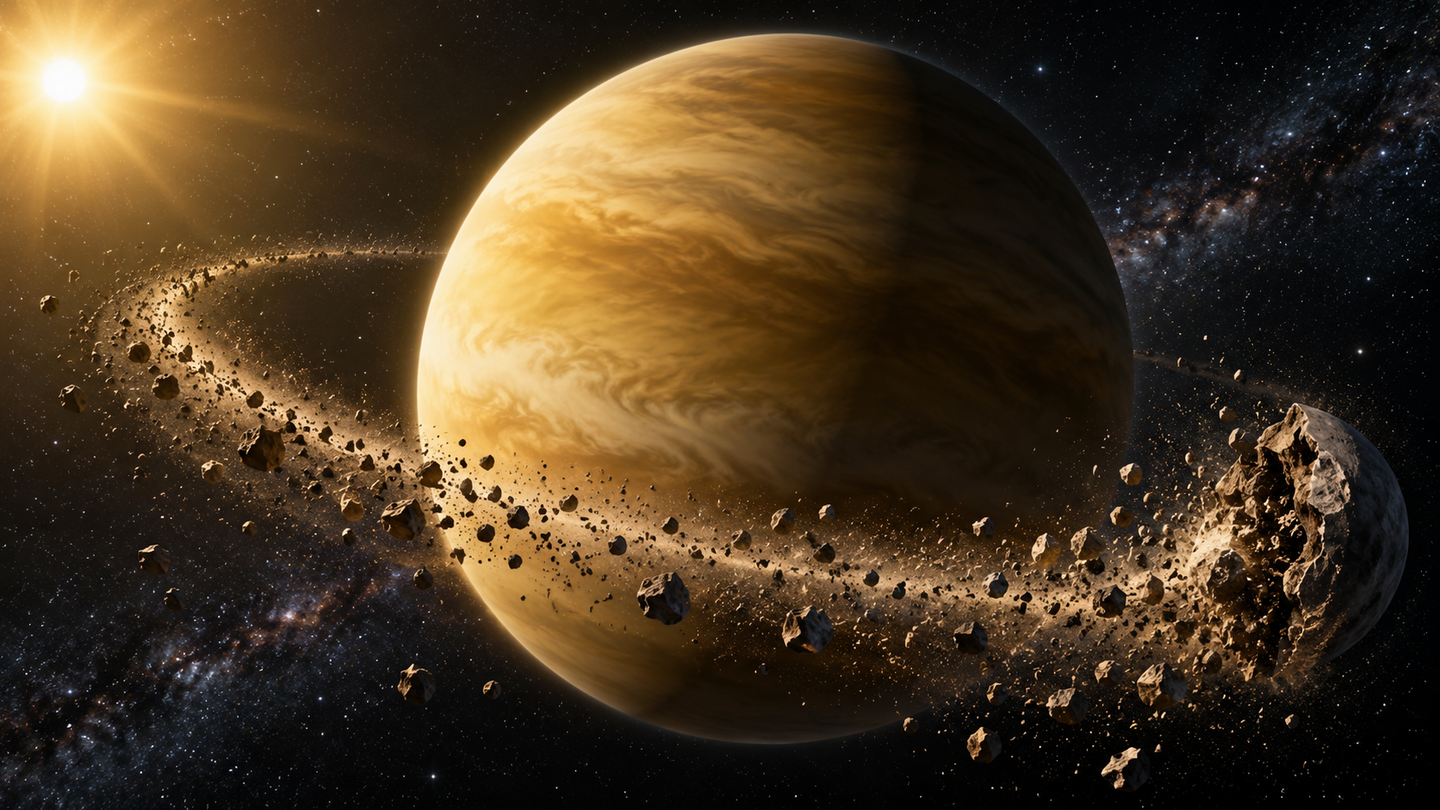
Models show a hypothetical ancient Venusian moon could reverse its orbit, break apart and disappear through tidal evolution. (CREDIT: Shutterstock)
- A hypothetical moon around early Venus could initially have migrated outward, only for tidal evolution to reverse its path and send it crashing back toward the planet.
- The moon’s fate depends strongly on Venus’s original spin, the satellite’s mass, orbital eccentricity and how the planet’s rocky interior dissipated tidal energy.
- The models do not show that Venus ever possessed a moon, but they demonstrate that its absence today does not rule out an ancient satellite that was destroyed billions of years ago.
Venus has no moon today, but that emptiness may not tell the whole story of the planet's violent youth.
A new theoretical study finds that a substantial satellite created by an ancient impact could have spent millions or even billions of years orbiting Venus before tides reversed its migration. The moon could then have spiraled inward, crossed the planet's Roche limit, broken apart into a temporary ring and eventually rained much of its material onto Venus.
The work, led by University of California, Riverside astronomer Stephen Kane with Franck Selsis, Jeremy Leconte and Sean Raymond, is accepted for publication in arXiv. Their paper does not claim that such a satellite actually existed. Instead, it asks whether a moon created during Venus's formation could plausibly disappear through ordinary orbital evolution.
Venus could have suffered its own giant impact
The idea begins with the chaotic early solar system, when growing planets frequently collided.
Earth's Moon is widely thought to have formed from debris blasted into orbit after a giant impact late in Earth's formation. Simulations show that material from such a collision can form an orbiting disk and later assemble into a large satellite.
Venus could also have experienced large collisions. A 2025 Astronomy & Astrophysics study modeled impacts involving bodies up to one-tenth Earth's mass and found numerous collision scenarios compatible with Venus's present properties. Many, however, produced debris too close to Venus to form a lasting moon.
That leaves several possibilities. Venus may never have formed a moon, may have formed one that quickly reaccreted, or may have supported a satellite that survived long enough for tides to destroy it later.
A moon could start by moving away
Earth shows how planetary tides can move a moon.
Because Earth spins faster than the Moon circles it, the tidal bulge raised by the Moon transfers rotational angular momentum into the Moon's orbit. That process slows Earth's rotation while pushing the Moon outward.
Early Venus could initially have behaved similarly.
Kane's team modeled post-impact Venusian rotation periods from five to 100 hours and moon masses ranging from one-hundredth to 10 times the mass of Earth's Moon. Their standard starting orbit placed the satellite five Venus radii from the planet.
At that distance, a moon completes an orbit in about 16.1 hours. If Venus initially rotated faster than that, its moon would begin moving outward. If Venus rotated more slowly, the moon would already lie inside the synchronous orbit and immediately start falling inward.
The complication is that the moon itself slows Venus.
Bigger moons can destroy themselves faster
As Venus loses rotational energy, its synchronous radius moves outward. If that boundary catches the satellite, the direction of tidal migration changes.
The moon then begins surrendering orbital energy and moving back toward Venus.
That creates an unexpected result: increasing the moon's mass can make destruction more likely. A heavier satellite moves outward more quickly, but its tidal pull slows Venus even faster. The researchers found the moon's outward migration scales with its mass, while expansion of the synchronous radius scales roughly with the square of its mass.
In one constant-Q model, a moon twice as massive as Earth's Moon around a Venus initially rotating every eight hours reached the Roche limit after about 1.7 billion years. Starting with a 12-hour Venusian day reduced that survival time to about 33 million years.
A Moon-mass satellite behaved differently. For circular orbits around a Venus initially spinning in roughly 12 hours or less, both tidal treatments allowed it to survive for 4.5 billion years under many tested conditions.
That survival result is important because Venus clearly has no such moon today.
The answer depends on how Venus behaves inside
The researchers used two different descriptions of tidal dissipation.
The constant-Q model assumes a particular style of energy loss and can produce a sharp reversal when Venus approaches synchronization with its moon. The constant-time-lag model allows the tidal torque to weaken smoothly near synchronization.
Those approaches can predict radically different fates.
For massive moons, the constant-Q treatment often produces inward collapse within roughly 30 million to 1.7 billion years. The constant-time-lag model can instead trap similar moons in long-lived, near-synchronous configurations.
Neither model perfectly describes a rocky planet. The paper notes that Venus's real rheology, meaning the way its mantle deforms and dissipates energy, is likely more complicated and may lie between those simplified limits.
The absence of a moon therefore cannot reveal Venus's exact history by itself.
Destruction could briefly create rings
Any doomed satellite eventually approaching Venus would reach its Roche limit at roughly 2.85 Venus radii, or about 17,000 kilometers from the planet's center.
Inside that boundary, tidal forces can overwhelm a moon's self-gravity. Earlier work proposed that a destroyed Venusian satellite could form a temporary ring before much of the debris reaccreted onto the planet.
Joseph Burns made the broader point more than half a century ago. In a 1973 analysis of inner-planet satellites, he argued that Venus and Mercury lacking moons today does not necessarily mean they never possessed them because tidal evolution can naturally remove satellites.
Any major reaccretion event probably happened early. Venus's surface has since undergone extensive volcanic resurfacing, making ancient physical evidence difficult to recognize.
Could a lost moon have changed Venus?
The most provocative possibility concerns habitability.
Climate simulations have shown that, under some assumptions, ancient Venus could have maintained temperate conditions and liquid water for extended periods. One NASA-led model found potentially moderate surface temperatures for up to billions of years.
A large moon could have helped stabilize Venus's axial tilt and generated substantial ocean tides. Its destruction, meanwhile, would have returned enormous quantities of rock and energy to the planet.
The authors suggest that such an event could have implications for atmospheric evolution and water loss, but their tidal calculations do not demonstrate that moon destruction triggered Venus's runaway greenhouse.
NASA's future DAVINCI mission may offer indirect clues. Its atmospheric probe is designed to measure noble gases, isotopes and atmospheric chemistry during its descent through Venus's clouds. Unusual chemical signatures might help constrain major events in the planet's early history, although volcanism and atmospheric escape could obscure any trace of lunar debris.
Venus may never have possessed a moon. But the new calculations show that if one did form, the planet had several ways to make it disappear.
Dig deeper into Venus, moons and giant impacts
These resources explore the impact, tidal and climate processes that provide scientific context for the possibility of a vanished Venusian satellite.
The possibility of a giant impact on Venus: Models major collisions with Venus and finds that many impact geometries produce debris that would fall back rather than form a durable satellite. (Astronomy & Astrophysics, 2025)
Where are the Satellites of the Inner Planets?: Classic analysis arguing that tidal evolution can naturally remove satellites from the inner planets, meaning their absence today does not prove they never existed. (Nature Physical Science, 1973)
Origin of the Moon in a giant impact near the end of the Earth's formation: Foundational giant-impact simulations show how a planetary collision can place enough debris into orbit to form a large moon. (Nature, 2001)
Was Venus the first habitable world of our solar system?: Uses three-dimensional climate modeling to explore conditions under which ancient Venus could have maintained liquid water and temperate surface conditions. (Geophysical Research Letters, 2016)
Revealing the Mysteries of Venus: The DAVINCI Mission: Describes the atmospheric measurements, noble-gas science and imaging that DAVINCI will use to reconstruct Venus's origin and evolution. (The Planetary Science Journal, 2022)
Research findings are available online in the journal arXiv.
The original story "Tidal forces may have doomed an ancient moon around Venus" is published in The Brighter Side of News.
Related Stories
- Researchers explain mysterious cause of 6,000-kilometer cloud wall on Venus
- Scientists find evidence of a massive lava tube hiding on Venus
- Could humans build floating cities on Venus?
Like these kind of feel good stories? Get The Brighter Side of News' newsletter.
Joshua Shavit
Writer and Editor
Joshua Shavit is a NorCal-based science and technology writer with a passion for exploring the breakthroughs shaping the future. As a co-founder of The Brighter Side of News, he focuses on positive and transformative advancements in technology, physics, engineering, robotics, and astronomy. Having published articles on AOL.com, MSN, Yahoo News, and Ground News, Joshua's work highlights the innovators behind the ideas, bringing readers closer to the people driving progress.