New ‘Nanobone’ material could help the body regrow bones without painful grafts
Scientists hope a bone-regenerating nanoparticle could one day spare children with cleft palate from invasive graft surgery.
 University of Sydney Writer: Emily Fraser

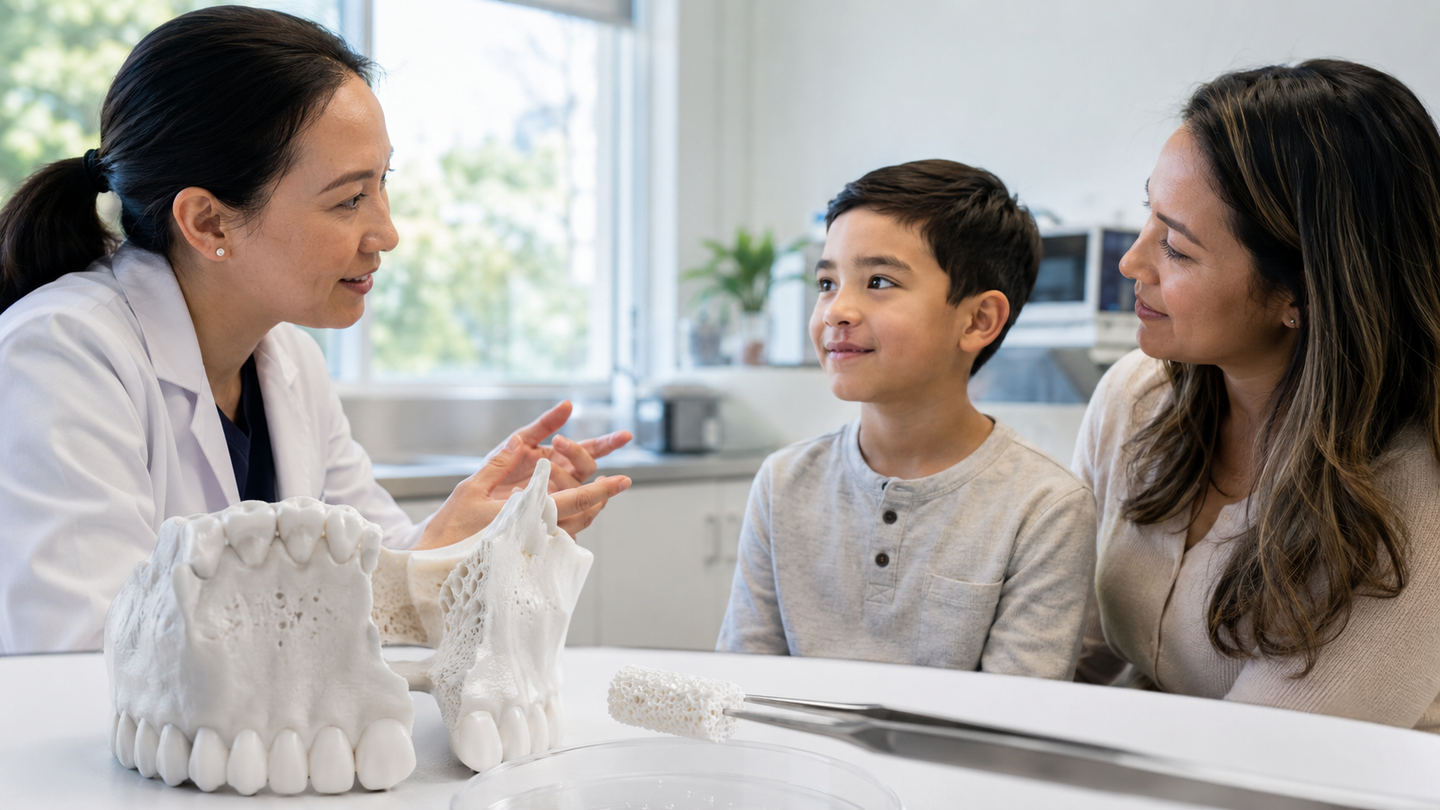
A biodegradable nanomaterial helped rats regrow substantially more bone by activating repair signals already present in the body. (CREDIT: Shutterstock)
- A biodegradable nanomaterial increased new bone formation by about 80% over controls after eight weeks in a preclinical rat skull-defect model.
- The material activated the body’s own latent TGF-β1 bone-repair signal at more than 10 times the efficiency of conventional alkaline activation while also promoting rapid blood clotting.
- Researchers hope the approach could eventually reduce the need for painful bone grafts in children with cleft lip and palate, but human trials have not yet begun.
A tiny engineered material may eventually offer children born with cleft lip and palate a way to rebuild missing jawbone without surgeons harvesting bone from elsewhere in their bodies.
University of Sydney researchers have developed biodegradable calcium-aluminosilicate nanoparticles that activate repair signals already present in the body. In a preclinical rat model, the material produced about 80% more bone volume than controls after eight weeks while triggering a key regenerative growth factor far more efficiently than conventional methods.
The work, published in ACS Nano, was carried out by scientists at the University of Sydney School of Dentistry, Charles Perkins Centre and Sydney Nano in collaboration with the University of Queensland. The experimental material, called CaAl-DMSN, remains far from clinical use, but it points toward a different strategy for bone repair: stimulating the body to rebuild tissue rather than simply filling a defect with grafted material.
A long wait for children with cleft defects
Cleft lip and palate develops when parts of the upper lip or roof of the mouth fail to fuse completely during pregnancy. The condition occurs in roughly one in 700 births, although rates vary among populations.
For many affected children, one of the most difficult later stages of treatment involves an alveolar cleft, a gap in the bone that supports the upper teeth. Secondary alveolar bone grafting is commonly performed during childhood before eruption of the permanent canine, often between about 7 and 12 years of age. Bone taken from the patient's own iliac crest near the hip remains a widely accepted standard because it can provide living bone-forming cells and structural support.
“One of the biggest challenges for children born with cleft lip and palate is repairing the bone defect in the jaw,” said lead researcher Associate Professor Chun Xu, a Sydney Horizon Fellow in the University of Sydney Faculty of Medicine and Health.
“While some children with minor defects are treated as infants, many patients need to wait until they are around 10 to 12 years old before surgeons can take bone from another part of the body and graft it into the defect.”
Nanoparticles switch on a dormant repair signal
Instead of carrying manufactured growth factors into a wound, the new material is designed to activate transforming growth factor beta 1, or TGF-β1, that already exists in an inactive form within the body.
TGF-β1 plays several roles in skeletal tissue, including regulating the behavior of cells involved in bone formation and resorption. Its effects are complex, but it is an important part of the signaling environment that coordinates bone repair.
The researchers engineered dendritic mesoporous silica nanoparticles containing calcium and aluminum. Their radial pore structure creates a confined alkaline environment around the material. That local chemistry helps release active TGF-β1 from its latent form without requiring an externally supplied growth factor.
Laboratory and molecular-dynamics analyses indicated that the nanomaterial activated latent TGF-β1 at more than 10 times the efficiency achieved through conventional homogeneous alkaline treatment. Simulations also suggested that the nanoparticle environment lowered the energy barrier needed for the growth factor to separate from proteins that keep it inactive.
“The material activates dormant repair signals in the body, triggering a cascade of healing processes that attract bone-forming stem cells and stimulate new bone growth,” Xu said.
Healing begins with blood clotting and stem cells
Bone repair requires more than switching on one protein. A wound must first stabilize, recruit appropriate cells and create an environment in which those cells can mature into bone-producing tissue.
The CaAl-DMSN particles promoted clot formation in about 30 seconds. That rapid hemostatic effect could help establish an early framework for healing while limiting bleeding at the injury site.
Experiments also showed increased recruitment of mesenchymal stromal cells carrying the markers CD105 and CD73. These cells can develop along several tissue pathways. Under the conditions created by the nanoparticles, signaling through the TGF-β-associated Smad pathway encouraged osteogenic differentiation, pushing cells toward a bone-forming state.
“Our body already contains many of the signals needed for tissue repair,” Xu said. “We’ve developed a material that can help activate those signals at the right place and time. Instead of supplying external growth factors, we’re encouraging the body to use its own healing potential.”
Rats grew substantially more bone after eight weeks
The researchers then tested the material in critical-size calvarial defects in rats. These are experimentally created skull defects large enough that they do not readily heal on their own, making them a common preclinical model for evaluating bone-regeneration strategies.
After eight weeks, animals treated with CaAl-DMSN showed an approximately 80% increase in bone volume fraction compared with control defects. The researchers also reported good biocompatibility in the experiments.
Those results do not show that the particles can already repair cleft-related jaw defects in children. A rat skull model differs substantially from a growing human jaw, and safety, dosage, degradation, long-term bone quality and effects on developing teeth would all require further investigation before clinical testing.
Existing research has nevertheless shown growing interest in synthetic substitutes for alveolar cleft reconstruction. Reviews have found promising results for materials such as beta-tricalcium phosphate, while also emphasizing that autologous bone remains the benchmark and that stronger clinical evidence for alternatives is still needed.
3D printing could personalize future repairs
The Sydney team is now considering another step: combining the nanoparticles with 3D-printed scaffolds shaped to fit individual bone defects.
That approach reflects a broader movement in craniofacial regenerative medicine. Researchers have already explored patient-specific and 3D-printed structures made from calcium phosphates and other biomaterials to reproduce the complicated geometry of facial bones while providing a framework for new tissue.
“Every patient is different and every bone defect is different,” Xu said. “In the future, we hope to combine these materials with advanced 3D-printing technologies so treatments can be tailored to the specific needs of each patient.”
The larger goal is to move away from repair strategies that require surgeons to create a second wound simply to obtain graft material. If the nanoparticles eventually prove safe and effective in humans, they could offer a material that disappears as a child's own bone takes its place.
For children with cleft lip and palate, that could ultimately mean repairing difficult jaw defects earlier in life. Reaching that point, however, will require substantially more preclinical testing followed by carefully controlled human trials.
Dig deeper into regenerative bone repair
These resources examine cleft bone grafting, regenerative biomaterials, growth-factor biology and personalized approaches to rebuilding craniofacial bone.
Alveolar Bone Grafting and Cleft Lip and Palate: A Review: Reviews the timing, graft sources, orthodontic considerations and clinical evidence surrounding alveolar bone grafting in children with cleft lip and palate. (Plastic and Reconstructive Surgery, 2016)
β-Tricalcium Phosphate as Alveolar Bone Grafting in Cleft Lip/Palate: A Systematic Review: Evaluates synthetic beta-tricalcium phosphate as an alternative graft material and summarizes evidence for combining biomaterials with cells and growth factors. (Dentistry Journal, 2023)
A meta-analysis of alveolar bone grafting using bone substitutes in cleft lip and palate patients: Compares autologous bone with synthetic substitutes and highlights the limited clinical evidence currently available for replacing conventional grafts. (Journal of Oral Biology and Craniofacial Research, 2024)
Transforming growth factor-beta1 to the bone: Explains how TGF-β1 regulates bone-forming and bone-resorbing cells and why the signaling molecule plays a central role in skeletal biology. (Endocrine Reviews, 2005)
Three-Dimensional Printing for Craniofacial Bone Tissue Engineering: Reviews how 3D printing and tissue engineering could create patient-specific structures for reconstructing complex craniofacial bone defects. (Stem Cells International, 2020)
The original story "New ‘Nanobone’ material could help the body regrow bones without painful grafts" is published in The Brighter Side of News.
Related Stories
- Salamander gene could hold the key to regrowing human limbs
- Blocking a key aging enzyme helps regrow knee cartilage, study finds
- Innovative treatment uses sound waves to help regrow bones
Like these kind of feel good stories? Get The Brighter Side of News' newsletter.
Joshua Shavit
Writer and Editor
Joshua Shavit is a NorCal-based science and technology writer with a passion for exploring the breakthroughs shaping the future. As a co-founder of The Brighter Side of News, he focuses on positive and transformative advancements in technology, physics, engineering, robotics, and astronomy. Having published articles on AOL.com, MSN, Yahoo News, and Ground News, Joshua's work highlights the innovators behind the ideas, bringing readers closer to the people driving progress.