Five-dimensional black holes offer a possible explanation for dark matter and neutrinos
Hypothetical primordial black holes could behave differently in a universe with an extra spatial dimension, new calculations suggest.

 Edited By: Joshua Shavit

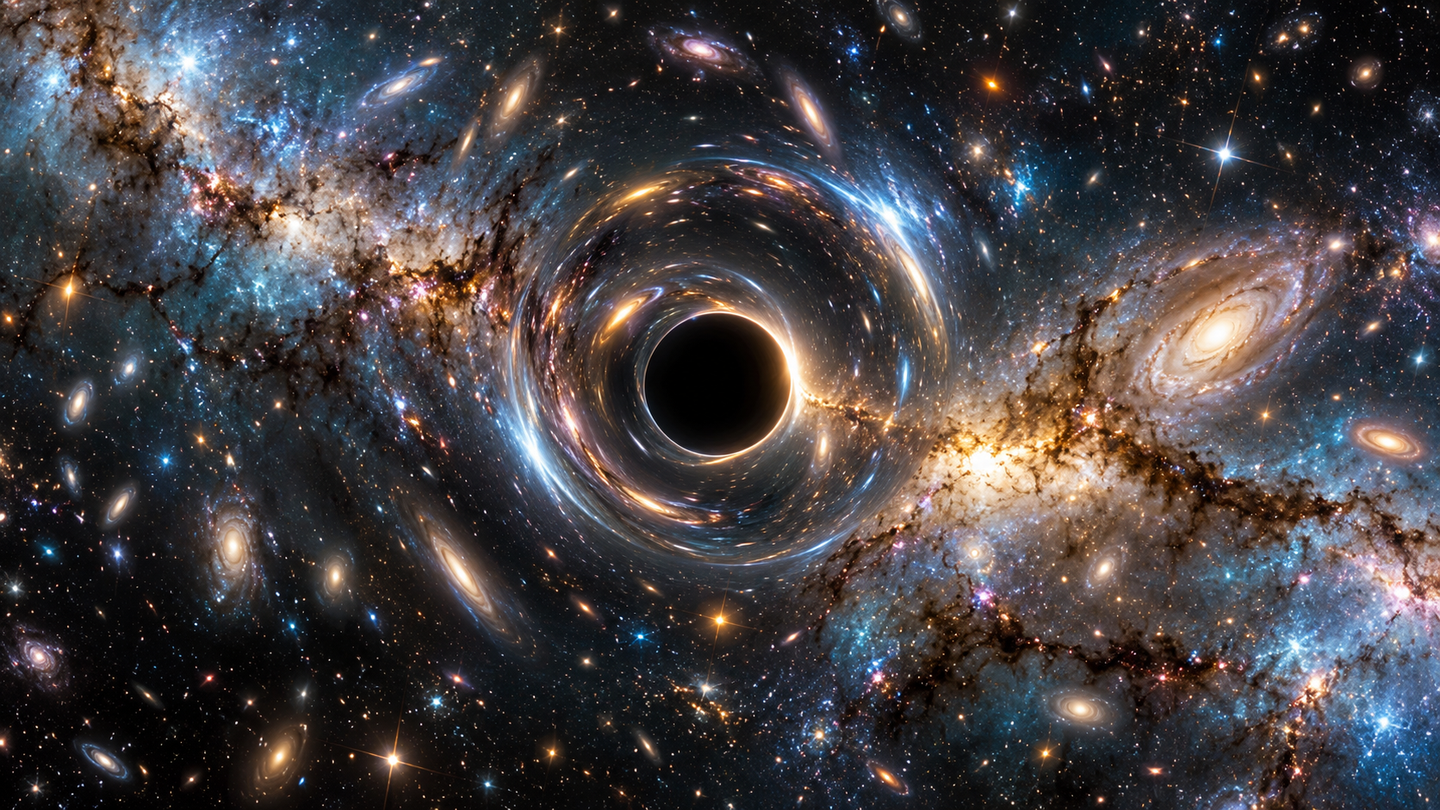
A theoretical study explores how a hidden dimension could shape primordial black holes and a possible high-energy neutrino connection. (CREDIT: The Brighter Side of News)
- A theoretical study predicts five-dimensional primordial black holes within a model containing a hidden extra spatial dimension.
- Some modeled black holes could survive for a time comparable to the universe’s age, potentially linking them to dark matter and neutrinos.
- Primordial black holes and the extra dimension remain unconfirmed, and the observed neutrino does not establish either idea.
A black hole born in the early universe might survive billions of years longer if gravity had an extra direction to spread into. That possibility anchors a theoretical study connecting hypothetical primordial black holes with a hidden dimension of space.
The paper, “Primordial black holes are five dimensional,” appears in Physical Review D. Its authors include Luis Anchordoqui of Lehman College and the CUNY Graduate Center, Alek Bedroya of Princeton University and Dieter Lüst of the Max Planck Institute for Physics and Ludwig Maximilian University of Munich.
Their calculations address how primordial black holes could form and evolve within the proposed “dark dimension” scenario. Neither these ancient black holes nor the extra dimension has been confirmed. The result describes consequences of a particular theoretical framework, rather than a discovery of new objects.
An extra direction for gravity
Ordinary descriptions of spacetime contain three spatial dimensions and one time dimension. The dark dimension scenario adds another spatial direction, with a characteristic size on the order of a micron. A micron is one-millionth of a meter.
The model places ordinary particles and their nongravitational interactions within a four-dimensional spacetime embedded in the larger system. Gravity can extend into the additional direction. Small black holes could therefore behave differently from objects described entirely within conventional four-dimensional spacetime.
In this terminology, a five-dimensional black hole occupies a spacetime with four spatial dimensions and one time dimension. The extra dimension is a physical feature assumed by the model. It is not a newly observed region beyond the visible universe.
Miguel Montero, Cumrun Vafa and Irene Valenzuela developed the dark dimension proposal using ideas about quantum gravity. Those ideas seek to distinguish theories that might fit a consistent quantum description of gravity from those that cannot. Their application here remains a theoretical assumption, not an experimentally established rule.
Two routes to ancient black holes
Primordial black holes would differ from black holes produced by collapsing stars. They could emerge when unusually dense regions of the early universe collapsed under gravity. If enough survived, they might account for some or all of the matter identified as dark matter.
The authors revisit three proposed sources of those dense regions: inflation, phase transitions and cosmic strings. They regard the inflationary route as being in tension with the quantum-gravity principles they apply. Their detailed analysis therefore concentrates on the other two mechanisms.
Phase transitions involve changes in the state of the early universe’s physical fields or matter. Cosmic strings are hypothetical line-like defects associated with symmetry breaking. Loops of these strings could collapse into black holes if compressed within the necessary gravitational radius.
“In this paper, we revisit the formation mechanisms of PBHs and ask whether, within the dark dimension scenario, PBHs are effectively 4D or 5D black holes,” the authors write. Their answer depends on the model’s assumptions and excludes certain possibilities involving exotic physics at low energies.
Formation changes as the universe cools
The team also considers how the extra dimension could have evolved before settling into its assumed micron-scale size. This matters because black holes might form before that stabilization. Their initial properties would then reflect a different environment from the later universe.
The calculations constrain how quickly the dimension could change without producing too much gravitationally interacting material. The authors explore an early phase called kination, in which the motion of a field dominates the universe’s energy density. They also consider an alternative history with little or no such phase.
Within the phase-transition scenario, initially four-dimensional black holes can become unstable and evolve into five-dimensional configurations. The relevant instability is known as the Gregory–Laflamme instability. Their effective dimensionality would change as the surrounding geometry evolved.
Black holes produced by collapsing cosmic-string loops emerge as five-dimensional objects in the authors’ analysis. That conclusion applies to formation before or after the extra dimension stabilizes, under the stated assumptions. It does not imply that all black holes observed in astronomy must be five-dimensional.
A longer lifetime offers a possible link
Hawking’s theory predicts that black holes emit particles and gradually lose mass. Smaller black holes become hotter as they shrink. Their evaporation rate determines whether primordial examples could still exist today.
Five-dimensional black holes in this framework are larger, colder and longer-lived than conventional four-dimensional black holes of the same mass. For cosmic-string formation before stabilization, the paper derives an upper lifetime estimate of roughly 10 trillion years. That is an upper bound, rather than a predicted lifetime for every object.
Depending on the available particle species, some modeled lifetimes could instead approach the universe’s age, about 13.8 billion years. Black holes formed through phase transitions would generally be expected to outlast the present universe. These distinctions connect formation conditions with the possibility of evaporation occurring now.
An earlier Physical Review D paper by Anchordoqui, Francis Halzen and Lüst proposed a neutrino connection. It examined whether evaporation of five-dimensional primordial black holes could explain the exceptionally energetic event designated KM3-230213A. The newer study explores formation pathways compatible with that possibility.
A real signal, an unconfirmed explanation
KM3NeT’s underwater ARCA detector recorded the event on February 13, 2023. Researchers reconstructed a highly energetic muon and inferred that it most probably came from a cosmic neutrino. Simulations gave a median incoming neutrino energy of 220 petaelectronvolts, with substantial uncertainty.
The black-hole proposal invokes particles emitted into the extra dimension that could convert into detectable neutrinos. Such particles include hypothetical sterile neutrinos, which lack the ordinary weak interactions of active neutrinos. Evaporation away from the region containing ordinary matter could also avoid an accompanying high-energy photon signal.
That mechanism remains a possible interpretation. The formation paper acknowledges a challenge involving the lower-energy neutrino signal expected before the event. It discusses a proposed resonant conversion mechanism that could suppress those lower-energy particles.
More observations could help distinguish predictions about particle energies and accompanying signals. POEMMA-Balloon with Radio, a proposed balloon payload planned for spring 2027, aims to investigate extremely energetic neutrinos. Lehman graduate student Karem Peñaló Castillo is among the authors of a study assessing its sensitivity to similar events.
Such measurements would test explanations of the signal without automatically proving a hidden dimension. The observed event is real; its connection to primordial black holes remains hypothetical. The theory’s value lies in specifying what an otherwise elusive idea would need to explain.
Dig deeper into primordial black holes and extra dimensions
These resources explore the theoretical foundations, observational evidence and proposed ways to investigate the idea.
The dark dimension and the Swampland: Introduces the proposed extra dimension and the quantum-gravity reasoning behind its characteristic size. (Journal of High Energy Physics, 2023)
Primordial black holes and their gravitational-wave signatures: Reviews primordial black-hole formation, observational constraints and possible gravitational-wave signals. (Living Reviews in Relativity, 2025)
Observation of an ultra-high-energy cosmic neutrino with KM3NeT: Reports the detector event, its energy reconstruction and possible conventional astrophysical interpretations. (Nature, 2025)
Prospects for PBR detection of KM3-230213A-like events: Assesses how a balloon-based instrument could investigate neutrino events resembling the KM3NeT detection. (Proceedings of Science, 2025)
Particle creation by black holes: Hawking’s foundational paper develops the theory of particle emission and black-hole evaporation. (Communications in Mathematical Physics, 1975)
Research findings are available online in the journal Physical Review D.
The original story "Five-dimensional black holes offer a possible explanation for dark matter and neutrinos" is published in The Brighter Side of News.
Related Stories
- Tiny black holes may form out of a crystal-like state in spacetime
- JWST’s mysterious ‘little red dots’ may hide early black holes inside tiny galaxies
- Strange red object from the early universe could be the first ‘black hole star’
Like these kind of feel good stories? Get The Brighter Side of News' newsletter.
Joseph Shavit
Writer, Editor-At-Large and Publisher
Joseph Shavit, based in Los Angeles, is a seasoned science journalist, editor and co-founder of The Brighter Side of News, where he transforms complex discoveries into clear, engaging stories for general readers. With vast experience at major media companies like The Los Angeles Times, Times Mirror and Tribune Publishing, he writes with both authority and curiosity. His writing focuses on space science, planetary science, quantum mechanics, geology. Known for linking breakthroughs to real-world markets, he highlights how research transitions into products and industries that shape daily life.