NASA’s James Webb telescope reveals the dusty aftermath of 21 planet-shattering collisions
Dust around other stars offers clues to collisions involving planetary embryos and the disruption of established systems.
 NASA Writer: Laura Betz

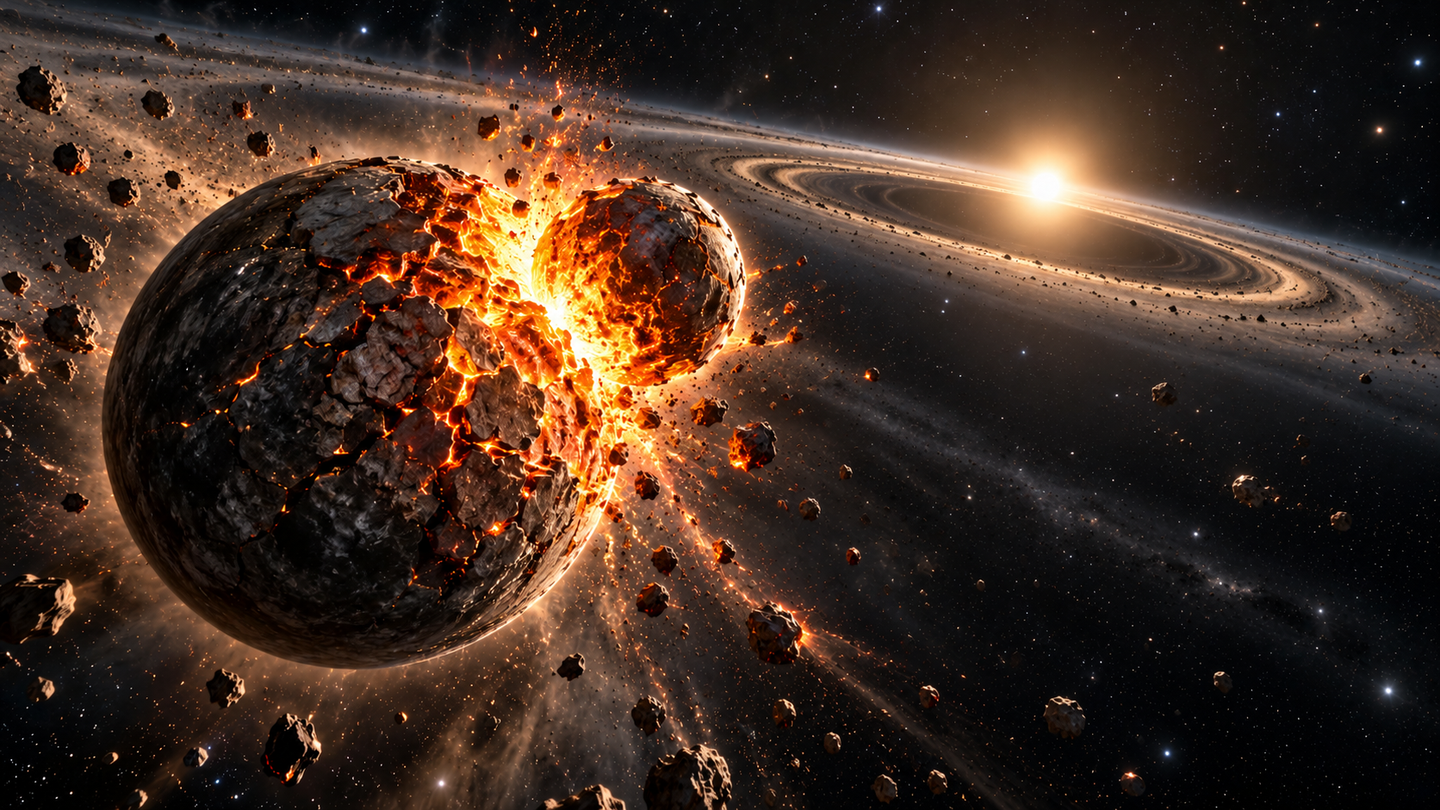
Webb and Spitzer study 21 extreme debris disks, linking dust minerals to possible giant impacts and changing planetary orbits. (CREDIT: The Brighter Side of News)
- Webb and Spitzer spectra reveal two broad mineral groups among 21 extreme debris disks, offering clues to planetary collisions.
- Eight disks are silica-rich, consistent with impacts energetic enough to vaporize substantial amounts of rock.
- The collision sizes and causes remain interpretations, and only three sampled systems are older than 300 million years.
Rock vaporized in a planetary collision can leave a chemical signature long after the impact itself disappears from view. Around other stars, tiny grains of that material are helping astronomers distinguish possible planet-building crashes from less energetic encounters.
An observational analysis led by Kate Su of the Space Science Institute in Boulder, Colorado, examined 21 extreme debris disks. Published in The Astrophysical Journal, the study combined spectra from NASA’s James Webb and retired Spitzer space telescopes. It connected dust composition with stellar age and changes in infrared brightness.
Eight disks contained unusually strong silica signatures, while 13 were classified as silica-poor. The researchers interpret that division as evidence of different collision conditions. They did not directly observe the planetary bodies responsible or measure their sizes.
Small grains expose unusually active systems
Young stars begin surrounded by gas-rich disks that provide material for forming planets. As that gas disperses, a debris disk can remain. Collisions among leftover bodies generate fresh dust within these later systems.
Extreme debris disks stand apart because they contain exceptional amounts of warm dust near their stars. That material occupies regions broadly comparable to the rocky-planet zone of the solar system. Their infrared emission also changes irregularly, sometimes over weeks or months and sometimes over years.
Such systems are rare despite theoretical expectations that violent collisions should be common during planetary assembly. The paper cites estimates that extreme disks occur around roughly 1% of debris-disk systems of similar age. Catching their dusty aftermath therefore provides an unusual opportunity to investigate otherwise hidden activity.
Webb supplied observations of 16 disks, including 12 receiving their first mid-infrared spectra and four previously examined by Spitzer. Five additional systems came from Spitzer’s archive. The overlapping observations also allowed comparisons across roughly two decades for some targets.
The analysis identified abundant small grains, predominantly less than a micrometer across, and evidence of substantial thermal processing. Their prominent infrared features differ from the weaker features commonly found in ordinary debris disks. Those small grains cannot persist indefinitely, strengthening the connection with recent dust-producing events.
Silica offers clues to collision energy
Minerals emit characteristic patterns at infrared wavelengths. Webb’s Mid-Infrared Instrument recorded spectra spanning 4.9 to 27.9 micrometers, allowing the team to examine those patterns. The classification focused on features around 10 micrometers.
The researchers compared the observed signatures with reference materials and previously studied disks. Eight of the 21 systems, about 38%, met their threshold for silica-rich material. Four were already recognized as silica-rich; the analysis identified four more.
These categories describe relative enrichment within the sample rather than chemically uniform disks. Silica-rich systems can also contain other silicate minerals. Grain composition, impurities and porosity complicate detailed identification, so the classification does not provide a complete inventory of every material present.
The team proposes that strong silica signatures arise when high-energy impacts vaporize substantial portions of the colliding bodies. As expanding vapor cools, it can condense into droplets. Further collisions grind those droplets into the fine dust detected through infrared emission.
Under this interpretation, silica-rich disks are consistent with collisions involving Mars-sized planetary embryos. Silica-poor disks could instead reflect encounters between smaller, roughly Moon-sized bodies or less energetic grazing impacts. Their minerals, including crystalline silicates such as forsterite, still indicate heating, but potentially under different conditions.
Younger stars carry the strongest silica signatures
Every silica-rich disk in the sample surrounds a star younger than approximately 300 million years. Silica-poor systems occur across a wider age range. That distinction fits simulations placing the final stages of rocky-planet assembly within a system’s first few hundred million years.
During that interval, planetary embryos can collide, merge or break apart. Giant impacts are therefore both destructive events and possible steps toward larger planets. The observed mineral patterns offer a way to investigate those outcomes without resolving the embryos themselves.
The age boundary remains provisional because only three sampled systems are older than 300 million years. All three are silica-poor, but that small number cannot establish a universal rule. More observations of older systems will test whether the pattern holds.
The proposed connection also depends on how impacts produce and distribute observable dust. Many simulations simplify the physics of shocked rock or do not directly calculate the resulting vapor. Better models of cooling, condensation and subsequent collisions would help link the measured minerals to particular impact conditions.
Brightness changes may reveal orbital disruption
The researchers also used infrared measurements from WISE and other observatories to track changes in the debris. These observations sample different dust temperatures and extend across years or decades. Fading appeared more frequently than brightening in the longer-wavelength comparisons. Spectral shapes remained broadly stable, suggesting that changing amounts of dust, rather than major compositional changes, account for much of the variation.
Silica content alone did not show a clear relationship with variability. Instead, a subset with particularly strong emission features from small grains showed a potential trend. Those systems, all silica-poor, had median relative brightness variability about five times greater than systems with weaker features.
The team suggests that repeated, less energetic collisions could explain this combination. Changing planetary orbits might disturb smaller bodies and trigger additional impacts. In that case, especially active silica-poor disks could flag systems undergoing orbital rearrangement rather than simply completing rocky-planet growth.
That remains a hypothesis. The sample is small, and information about existing planets, distant debris and stellar companions is incomplete. Although many targets have companion stars, the study found no significant correlation establishing their role in the observed disk properties.
A distant comparison for Earth’s violent beginnings
The findings provide context for the giant-impact explanation of the Moon’s origin. In that scenario, a Mars-sized body struck the young Earth, ejecting material that contributed to the Moon. Other stars’ silica-rich debris may record broadly comparable events, although individual collisions need not reproduce Earth’s history.
Older silica-poor systems could offer another comparison with proposed episodes of orbital instability in the solar system. Such links remain tentative, including comparisons with the debated Late Heavy Bombardment hypothesis. The study does not establish that the Sun experienced either observed disk category.
“Our work on extreme debris disks helps us bring together the big picture of what we currently understand,” Su said. Expanding the sample will help determine how reliably these dusty signatures distinguish the collisions that assemble planets from those that rearrange established systems.
Dig deeper into planetary collisions and debris disks
These resources explore impact debris, rocky-planet formation and the solar system’s collision history.
Carbon monoxide gas produced by a giant impact in the inner region of a young system: Examines gas and dust around HD 172555 as evidence favoring a collision between large, volatile-rich bodies. (Nature, 2021)
Immediate Origin of the Moon as a Post-impact Satellite: Uses high-resolution simulations to investigate whether a giant impact could place a Moon-like satellite directly into orbit. (The Astrophysical Journal Letters, 2022)
Large impacts around a solar-analog star in the era of terrestrial planet formation: Reports infrared changes around the star ID8 consistent with a debris-producing impact during rocky-planet assembly. (Science, 2014)
The Late Heavy Bombardment: Reviews evidence and competing explanations for the early solar system’s impact history. (Annual Review of Earth and Planetary Sciences, 2017)
Evolution of Debris Disks: Provides a foundational review of how collisions, planet formation and stellar age shape dusty planetary systems. (Annual Review of Astronomy and Astrophysics, 2008)
Research findings are available online in The Astrophysical Journal.
The original story "NASA's James Webb telescope reveals the dusty aftermath of 21 planet-shattering collisions" is published in The Brighter Side of News.
Related Stories
- Two collisions, one star, and a new view of planet formation
- Research finds that inner solar system planets were formed through violent collisions
- Scientists discover remnants of Theia, the planet that collided with Earth 4.5 billion years ago
Like these kind of feel good stories? Get The Brighter Side of News' newsletter.
Joseph Shavit
Writer, Editor-At-Large and Publisher
Joseph Shavit, based in Los Angeles, is a seasoned science journalist, editor and co-founder of The Brighter Side of News, where he transforms complex discoveries into clear, engaging stories for general readers. With vast experience at major media companies like The Los Angeles Times, Times Mirror and Tribune Publishing, he writes with both authority and curiosity. His writing focuses on space science, planetary science, quantum mechanics, geology. Known for linking breakthroughs to real-world markets, he highlights how research transitions into products and industries that shape daily life.