JWST reveals why some distant galaxies suddenly stop forming stars
Webb spotted faint merger scars in distant galaxies that abruptly stopped forming stars 9 billion years ago.

 Edited By: Joshua Shavit

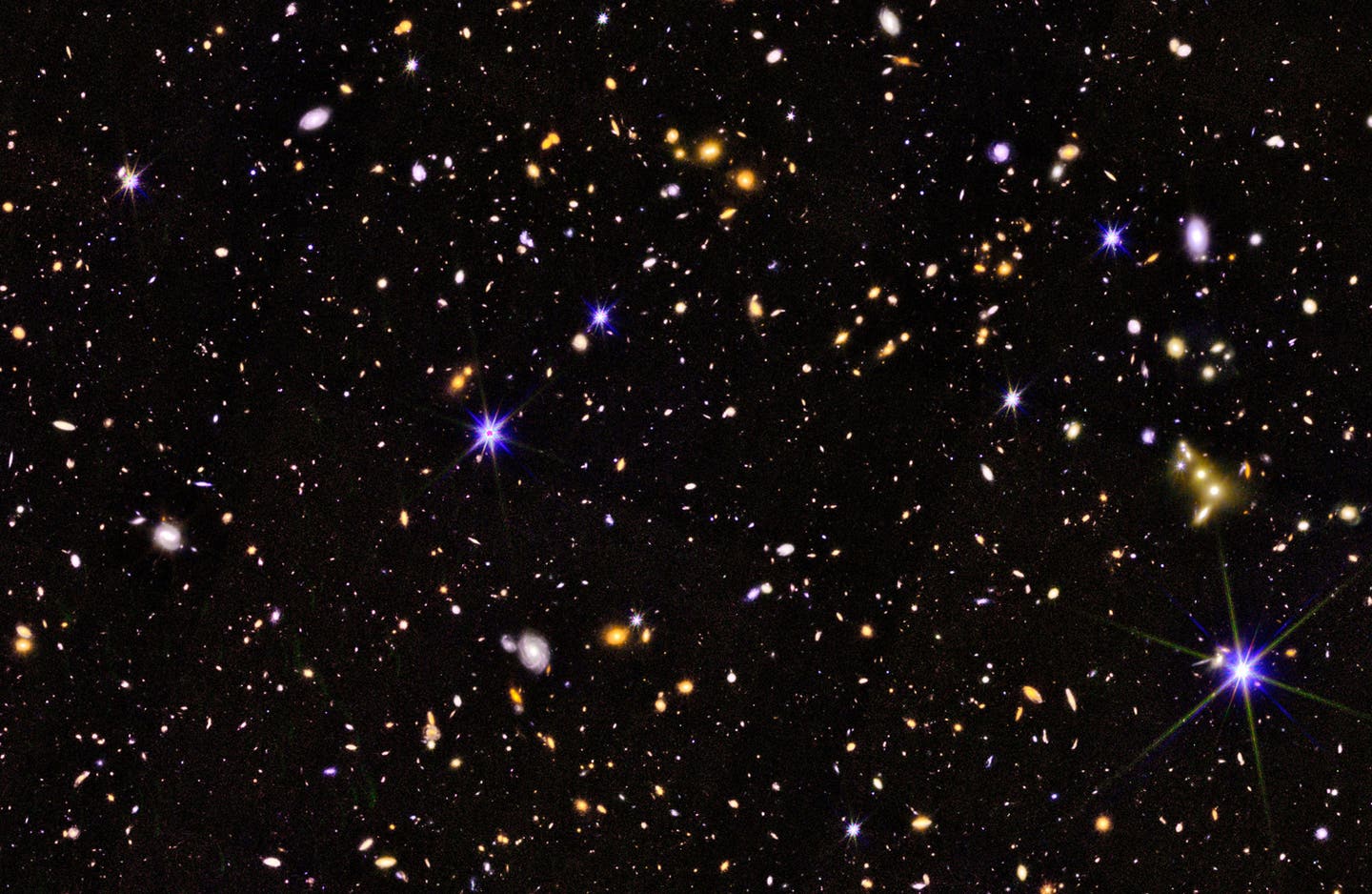
Webb images suggest mergers helped shut down star formation in distant galaxies during a peak era of cosmic growth. (CREDIT: David Maltby – University of Nottingham)
Distant galaxies that abruptly stopped making stars have puzzled astronomers for years.
About 9 billion years ago, during one of the busiest periods in cosmic history, many massive galaxies were still building stars at a furious pace. Yet a smaller group had already slammed on the brakes. New observations from the James Webb Space Telescope suggest that, in many cases, those sudden shutdowns were not gentle. Instead, they may have followed violent collisions. These collisions left behind compact, disturbed remnants.
The work, led by researchers at the University of Nottingham and published in Monthly Notices of the Royal Astronomical Society, examined a large sample of recently quenched galaxies. These are systems that had rapidly stopped forming stars and were caught in transition. Those galaxies are valuable because they offer a snapshot of what happens near the moment when star formation switches off.
“This was the epoch of peak activity in the Universe, when many of the most massive galaxies we see today were formed,” said Professor Omar Almaini, who led the team behind the study. “A long-standing problem has been to understand why these galaxies stop forming stars. With Webb we can see detail that was completely hidden before, allowing us to search for clues to what drives this dramatic transformation”.
The team drew on data from the JWST PRIMER program and the Ultra Deep Survey. They focused on post-starburst galaxies, often shortened to PSBs, a class of galaxies identified by spectral signatures. These show that star formation was cut off rapidly within the last few hundred million years.
Faint damage beneath a smooth surface
At first glance, many of these distant galaxies do not look especially chaotic. But Webb’s deep imaging at multiple wavelengths revealed a more complicated picture.
“These galaxies look calm on the surface, but Webb allows us to see the subtle signs of past violence,” said lead author Dr David Maltby. “The galaxies show clear signs of disturbance, telling us that something dramatic happened to them not long before their star formation shut down, most likely a merger with another galaxy.”
That matters because astronomers have long debated what actually quenches star formation in massive galaxies. Proposed explanations range from gas being stripped away, to black hole activity heating or ejecting star-forming material, to slow exhaustion of the gas supply. A merger does not rule out those other processes. However, it can help trigger them, especially if two gas-rich galaxies crash together. This can funnel material inward, and reshape the galaxy at the same time.
The new study strengthens that merger picture in two ways. First, the recently quenched galaxies show measurable structural disturbance in their residual light. This means faint asymmetries remain after astronomers subtract off a smooth model of the galaxy. Second, many of the most massive quenched systems are exceptionally compact. This matches simulations showing that collisions between gas-rich galaxies can leave behind dense remnants.
That compactness has been one of the most striking features of these galaxies for years. In the distant universe, some quenched systems are much smaller than similarly massive galaxies nearby. The Webb data suggest that this is not just an artifact caused by dust or by looking at different wavelengths. Across the near-infrared range, the structural measurements stayed broadly consistent.
Two different routes to shutting galaxies down
The results also support a broader idea that galaxies do not all stop forming stars the same way.
At lower redshifts in the study, post-starburst galaxies were usually lower-mass systems with disc-like structures. They looked compact, but their shapes were more like passive discs than battered spheroids. That points to a less destructive route. It is one that may preserve the disc while shutting down star formation through milder environmental effects or smaller interactions.
At higher redshifts, the picture changed. Massive post-starburst galaxies were extremely compact and more spheroidal. In those objects, the evidence better fits a rapid, disruptive event. Their structures resembled passive galaxies, but they were even smaller on average.
The study also found a notable difference between what can be seen in the overall galaxy light and what appears in the leftover residuals after model subtraction. Standard measures such as total asymmetry and residual flux fraction did not show post-starburst galaxies as wildly disturbed overall. In many cases, they looked fairly smooth, much like older passive galaxies.
But a more sensitive measure, residual asymmetry, told a subtler story. Among the most massive post-starburst galaxies at redshifts between about 1 and 2, the researchers found elevated residual asymmetry compared with passive galaxies and star-forming galaxies. That suggests these objects can retain faint, off-center structures or tidal leftovers even after most of the system has settled into a compact, smooth body.
A transition caught just after the impact
The age trend added another clue. For massive quenched galaxies, residual asymmetry declined as median stellar age increased. In other words, the younger the quenched system, the stronger the leftover structural disturbance tended to be. That is consistent with a picture in which merger signatures fade with time after the quenching event.
The authors caution that some age estimates come from photometric data and remain uncertain. They also note that the highest-redshift samples are limited in size. Still, the overall pattern lines up with studies in the nearby universe that have linked rapidly quenched galaxies to post-merger signatures.
One important result is what the team did not find. They saw little evidence that strong color gradients or dust effects were fooling astronomers into thinking these galaxies were more compact than they really are. Webb’s eight-band imaging let the researchers track structure across a wider wavelength range. The core trends remained in place. That gives more weight to the argument that these compact forms are real and physically meaningful.
Together, the findings point to a dual picture of rapid quenching. Early in the universe, massive galaxies may have been driven into compact, quenched states by highly dissipative, disruptive events, likely major mergers. Later on, lower-mass systems appear more likely to follow gentler paths that leave their discs largely intact.
Practical implications of the research
The study helps narrow one of galaxy evolution’s central questions: what makes a star-forming galaxy stop. By showing that many recently quenched galaxies from a crucial era still carry faint structural scars, the work ties quenching more closely to mergers in at least one major population, massive galaxies in the early universe.
It also suggests astronomers should not rely only on a galaxy’s smooth overall appearance. Some of the best evidence for how a galaxy shut down is hidden in low-level residual structure that only deeper imaging can reveal.
Moreover, future spectroscopic work could test how quickly those signatures fade and how closely they line up with black hole activity, gas loss, and the final settling of the galaxy.
Research findings are available online in the journal Monthly Notices of the Royal Astronomical Society.
The original story "JWST reveals why some distant galaxies suddenly stop forming stars" is published in The Brighter Side of News.
Related Stories
- Shadow Blaster points to starburst galaxies as hidden sources of cosmic neutrinos
- Astronomers detect first direct evidence of star-forming gas in early galaxies
- Galaxy-killing wind may explain why giant galaxies died so early
Like these kind of feel good stories? Get The Brighter Side of News' newsletter.
Shy Cohen
Writer