Light-powered neural network could transform future quantum communications
Trained optical layers classify hidden features of laser beams, offering a new way to decode information carried by topological light.
 Wits University Writer: Shirona Patel

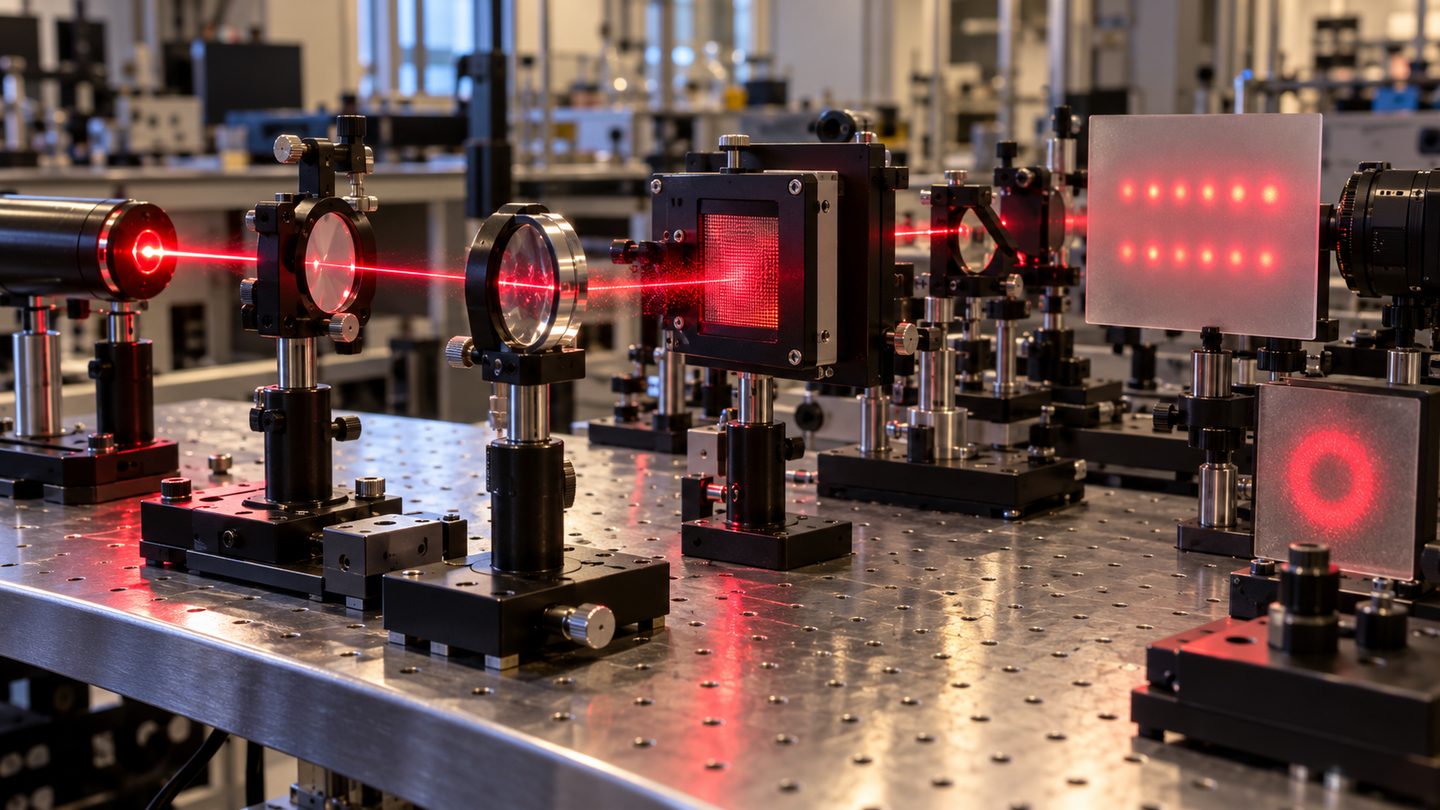
A Wits optical neural network reads topological information in structured light, with promising lab results and practical limits ahead. (CREDIT: The Brighter Side of News)
- A Wits optical neural network extracts topological labels from structured laser beams without reconstructing their full polarization patterns.
- The experiment tested 81 input configurations spanning 15 topological classes, using two channels trained to recognize nine mode labels each.
- Controlled noise tests and image transmission showed promise, but computer-assisted training, optical losses and untested turbulence remain practical limits.
Light patterns can differ in appearance while carrying the same topological information. Reading that shared property usually requires multiple measurements and a detailed reconstruction, making an attractive information carrier difficult to decode efficiently.
A system built at the University of the Witwatersrand offers another route. It lets light pass through trained optical layers that direct different components toward distinct output locations. Those locations reveal the information needed to identify the beam's topology.
The study, published in Nature Communications, was led by Hadrian Bezuidenhout at the Wits Structured Light Laboratory. Isaac Nape and Andrew Forbes conceived and supervised the research, with contributions from Cade Peters and Ram Nandan Kumar.
The device combines optical processing with electronic training and readout. Its importance lies in extracting a specific physical label directly, reducing the need to reconstruct every detail of the incoming light field.
Topology carries a label beneath the changing texture
The experiment studied optical skyrmions, structured fields whose polarization changes across the beam. Their topological number describes how that polarization pattern wraps around an abstract sphere used to represent possible polarization states.
Different patterns can share the same number. Local appearance therefore does not necessarily identify the topological class, just as reshaping an object need not change an underlying structural property.
Nape compares the idea with a twisted ribbon. Bending it into different shapes can leave the relevant twist information unchanged. For light, extracting the comparable label requires measuring the right properties rather than every visual detail.
“We don’t need to map every crease in our fabric of light to count the twists,” Bezuidenhout said. The team's detector focuses on the features needed to determine the topological number.
That narrower task matters because a complete reconstruction remains useful for some applications, including correcting optical distortions. Communications, however, may require only the encoded label, making full reconstruction unnecessary overhead.
Two optical channels reveal the necessary ingredients
The detector first separates horizontal and vertical polarization components. Each then passes through a sequence of five phase-modulation layers, with free-space propagation between them.
These layers alter the light's phase, shaping how the waves combine and where they arrive. Training adjusts the layers so that different input modes land in separate output regions.
The relevant mode label describes orbital angular momentum, a property associated with a twisted wavefront. Measuring that label in both polarization channels supplies the ingredients for calculating the skyrmion number through simple arithmetic.
This avoids treating every complete beam as an unrelated pattern. Instead, the network learns the component labels that generate the topological information.
For training, each phase layer was represented by 121 weighted Fourier modes. That uses far fewer adjustable parameters than optimizing every pixel independently, simplifying the search for a working optical transformation.
The demonstration used programmable spatial light modulators and a camera. Light performed the forward transformation, while a computer optimized the settings from recorded intensities. Optical processing therefore did not eliminate electronic assistance.
Eighty-one configurations did not mean eighty-one classes
Each polarization channel was trained to distinguish nine orbital-angular-momentum labels, ranging from minus four to plus four. Combining the two channels produced 81 possible input configurations.
Those configurations spanned fifteen topological classes in the tested dataset. Several different beams belonged to the same class, so the numbers describe different levels of the problem.
The result demonstrates a useful form of generalization. Learning the component labels allowed the system to interpret their combinations without training every complete beam as an independent example.
Measured channel visibilities were approximately 93%, indicating that most detected intensity was directed toward the expected outputs. More than 70% of the light reaching the camera fell within the designated channel regions.
For the classical laser-beam measurements, selecting the strongest output signal allowed the researchers to report 100% classification under the tested conditions. That result concerns this finite laboratory dataset, rather than guaranteed accuracy for arbitrary light fields or individual photons.
The system identifies the topological number, not every aspect of the beam's texture. Its demonstrated scope was a particular family of structured fields and a specified polarization basis.
Background light challenged the detector
The researchers added incoherent background light after training to test detection under noisy conditions. The system retained 100% classification until the background intensity reached approximately 95% of the signal level in their setup.
Beyond that point, accuracy declined. The successful measurements depended on the camera distinguishing small intensity differences between the desired output and competing channels.
This is an important qualification. The experiment tested isotropic noise at the detector, rather than every disturbance encountered in an optical communication link.
The paper specifically calls for further investigation of modal noise, phase distortions and atmospheric turbulence. Those effects can change the incoming field differently from adding background illumination to its measurement.
The team also demonstrated communication by assigning fourteen topological labels to colors. It transmitted an image pixel by pixel and reconstructed it with 100% accuracy in the proof-of-principle experiment.
That shows the labels can carry recoverable information. It does not establish a high-speed network operating over realistic distances or under uncontrolled environmental conditions.
Speed and energy depend on the complete apparatus
The optical transformation offers a route to rapid classification once the system has been trained. The existing training process, however, took approximately forty-five hours for both channels.
The authors suggest faster modulators and camera hardware could reduce that time substantially. Their shorter estimate is a proposed improvement, rather than a training time demonstrated by this apparatus.
Optical losses also matter. With diffraction gratings included, approximately 15% of input power reached the camera. That overall transmission differs from the greater-than-70% efficiency measured within the detected light's output channels.
Similarly, lower computational overhead does not establish lower total energy consumption. The paper notes that a complete assessment must include the laser, modulators, camera and control electronics.
Fixed optical elements, compact devices and improved components could eventually reduce these constraints. Their performance will need to be measured, alongside communication speed and reliability.
Quantum applications remain a next step
The experiment used classical laser beams. Extending the approach to single photons or entangled optical states is a research direction, not a quantum communication result demonstrated here.
That distinction is especially important because individual-photon measurements introduce different detection constraints. Strongest-signal decisions based on many photons cannot simply be assumed to deliver identical performance in that regime.
For now, the advance is a practical measurement strategy linking physical knowledge with trainable optics. It shows that useful information can be extracted without reproducing an entire field, while defining the hardware and environmental tests needed before broader deployment.
Dig deeper into optical neural networks and topological light
These resources explain the optical computing foundations and related classical and quantum topology research.
All-optical machine learning using diffractive deep neural networks: Demonstrates how trained diffractive layers can perform optical classification and other transformations. (Science, 2018)
Optical skyrmions and other topological quasiparticles of light: Reviews the generation, classification and control of optical skyrmions. (Nature Photonics, 2024)
Non-local skyrmions as topologically resilient quantum entangled states of light: Investigates skyrmionic topology as a shared property of entangled photons. (Nature Photonics, 2024)
Topological rejection of noise by quantum skyrmions: Examines the resilience of quantum topological observables under a specified noise model. (Nature Communications, 2025)
Topological protection of optical skyrmions through complex media: Explores conditions under which optical topological properties remain protected during propagation through complex media. (Light: Science & Applications, 2024)
Research findings are available online in the journal Nature Communications.
The original story "Light-powered neural network could transform future quantum communications" is published in The Brighter Side of News.
Related Stories
- Optical deep neural networks are revolutionizing AI computation
- Stanford researchers discover a language-specific network hidden in the human brain
- Neural networks behind social media can consume an infinite amount of energy
Like these kind of feel good stories? Get The Brighter Side of News' newsletter.
Shy Cohen
Writer