Life-changing robotic glove restores hand function for paralysis patients
New soft robotic glove helps people with paralysis grasp objects using muscle signals and machine learning.

 Edited By: Joseph Shavit

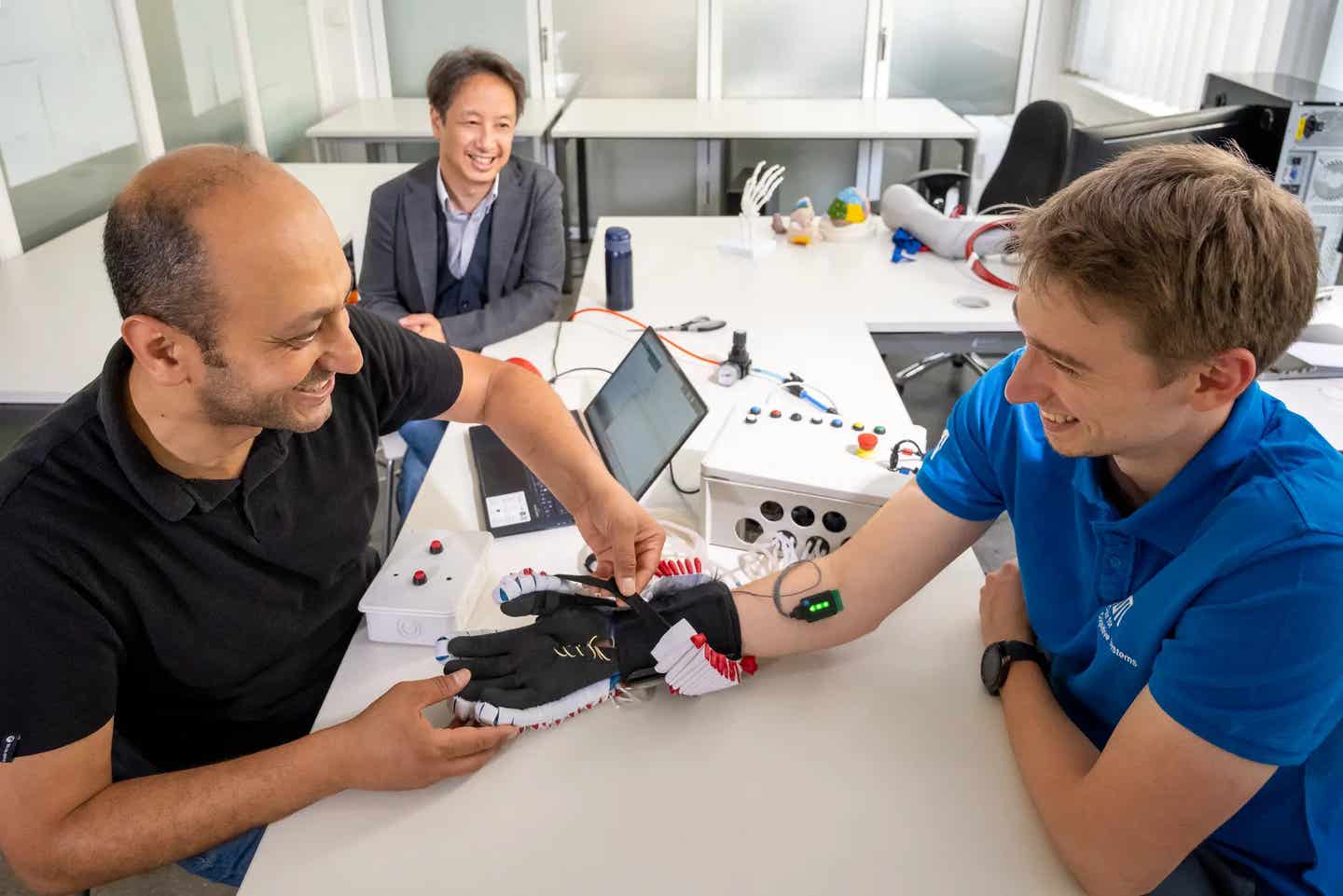
Dr. John Nassour (left) and Nicolas Berberich (right) are testing the newly developed glove. In the background: Prof. Gordon Cheng. (CREDIT: Astrid Eckert / TUM)
A simple piece of fabric stitched with air tubes is offering new hope to people who have lost the use of their hands. The device may look modest, but its impact could be life changing for those living with paralysis.
Researchers at Technical University of Munich have developed a soft robotic glove that helps people grasp and hold objects again. The system combines lightweight materials with intelligent sensing, allowing it to respond to a person’s intent in real time.
The project brings together engineering, medicine, and patient input. It also addresses a long-standing gap in assistive technology, restoring one of the most basic human abilities, the use of the hand.
A Daily Struggle With Lasting Impact
Losing hand function affects nearly every part of daily life. Simple tasks such as eating, drinking, or holding a phone can become impossible.
For people with conditions like amyotrophic lateral sclerosis, known as ALS, the loss happens gradually. Nerve cells that control movement weaken over time, leaving muscles unable to respond.
Even small actions, like lifting a fork, can require intense effort or outside help. This loss of independence can be emotionally difficult and deeply frustrating.
While tools exist to support walking, solutions for hand function have lagged behind. Many devices require some remaining strength, which limits their use for people with severe paralysis.
A Glove Designed To Restore Movement
The new device takes a different approach. It is a soft-hand exoskeleton made from fabric, designed to assist movement without restricting comfort.
Air-filled cushions line the outside of the glove. These cushions connect through 13 thin tubes that inflate and deflate as needed.
This system allows each finger to move on its own. It can bend, extend, and even help rotate the wrist. These coordinated movements make it possible to grasp objects of different shapes and sizes.
The design focuses on natural motion. Instead of forcing the hand into fixed positions, the glove adapts to the intended action.
Reading Intent From Muscle Signals
The glove does not rely on buttons or manual controls. Instead, it reads electrical signals from the forearm.
Sensors placed on the skin detect tiny muscle signals. These signals appear when a person tries to move, even if the movement is too weak to see.
Machine learning algorithms analyze these signals and predict what the user wants to do. The system can identify grasping intent with about 97 percent reliability.
“To prevent objects from being dropped accidentally, we use additional motion sensors to detect transport movements and keep the exoskeleton’s grip securely closed throughout the movement,” said Nicolas Berberich.
This combination of sensing and prediction allows the glove to respond quickly and accurately. It also creates a more natural experience for the user.
Built With Simplicity And Accessibility
Despite its advanced features, the glove remains simple in design. The fabric is inexpensive, and much of the construction is straightforward.
“Our solution is intelligent in two ways,” said John Nassour. “On the one hand, we’ve developed a highly reliable method of predicting grasping movements by inferring intentions from signals with 97% reliability. On the other hand, with our glove, we’ve developed hardware that optimally supports the intended movements.”
The focus on affordability sets the device apart. Many assistive technologies are expensive and out of reach for many patients.
“We’ve found a solution that anyone can afford but still works very well,” said Gordon Cheng.
This approach could make the technology accessible to a wider group of users, including those with limited resources.
A Patient’s Breakthrough Moment
The development of the glove involved close collaboration with a patient living with ALS. At the start, the patient had almost no control of his hand.
He could only move a small part of his thumb. Researchers focused on this remaining signal to control the glove.
Sensors detected activity in a thumb muscle called the flexor pollicis longus. These signals triggered the glove’s movements.
Despite their weakness, the system recognized the patient’s intent in nine out of ten attempts. This allowed him to perform basic tasks again.
He was able to pick up objects, move small cubes, and, for the first time in four years, hold a fork.
That moment marked more than a technical success. It restored a sense of independence that had been lost.
Training The Brain And Body Together
Researchers also introduced a simple training tool to improve control. The patient played a video game that required him to move a character using thumb signals.
This exercise helped strengthen the connection between intention and action. After just five minutes, his ability to control the glove improved.
The result shows how quickly the brain can adapt when given the right feedback. Even small signals can become meaningful with practice.
“This patient has shown us that our soft-hand exoskeleton can support him despite one of the most severe neurological disorders,” Cheng said.
Expanding To Other Conditions
While the study focused on ALS, the glove may help many others. Stroke survivors often face similar challenges with hand control.
People with nerve damage from accidents or conditions like polyneuropathy could also benefit.
Neurologist Tobias Wächter sees broad potential. “In principle, this glove can help people with flaccid paralysis, including, for example, people who have sustained peripheral nerve damage following motorcycle or bicycle accidents, or patients with polyneuropathy,” he said.
The team is now adapting the system for these groups. Each condition presents unique challenges, but the core concept remains the same.
Challenges And Next Steps
The glove is still in development, and several challenges remain. The system must be adjusted for each user, and muscle signals can vary from person to person.
Long-term testing will be needed to ensure reliability over time. Researchers also aim to improve comfort and ease of use.
Despite these hurdles, the results are encouraging. The system has already shown that meaningful function can return, even in severe cases.
Practical Implications Of The Research
This research could reshape how paralysis is treated. By restoring the ability to grasp objects, the glove may help people regain independence in daily life. Tasks like eating, drinking, and handling tools could become possible again.
The use of muscle signals also opens new paths for assistive technology. Devices that respond to intent rather than direct movement may become more common. This could benefit people with a wide range of conditions.
The glove’s low cost is another key advantage. It increases the chance that such technology can reach more patients, not just those with access to advanced medical care.
In the future, similar systems could be integrated into home care, rehabilitation programs, and even everyday wearable devices. As the technology improves, it may help bridge the gap between disability and independence for millions of people.
Research findings are available online in the journal Nature Machine Intelligence.
The original story "Life-changing robotic glove restores hand function for paralysis patients" is published in The Brighter Side of News.
Related Stories
- Engineering major creates robotic glove for her dad’s hand pain
- MIT ultrasound wristband revolutionizes AR, VR and robotic movement
- Soft robotic wearable could transform stroke and ALS recovery
Like these kind of feel good stories? Get The Brighter Side of News' newsletter.
Mac Oliveau
Writer
Mac Oliveau is a Los Angeles–based science and technology journalist for The Brighter Side of News, an online publication focused on uplifting, transformative stories from around the globe. Having published articles on MSN, and Yahoo News, Mac covers a broad spectrum of topics including medical breakthroughs, health and green tech. With a talent for making complex science clear and compelling, they connect readers to the advancements shaping a brighter, more hopeful future.