Magnetic nanoparticles rewarm and restore function to pig kidneys one year after cryogenic storage
Nanowarming restored partial function in stored pig kidneys, with two-hour transplant tests marking an early step toward organ banking.

 Editor: Hannah Shavit-Weiner

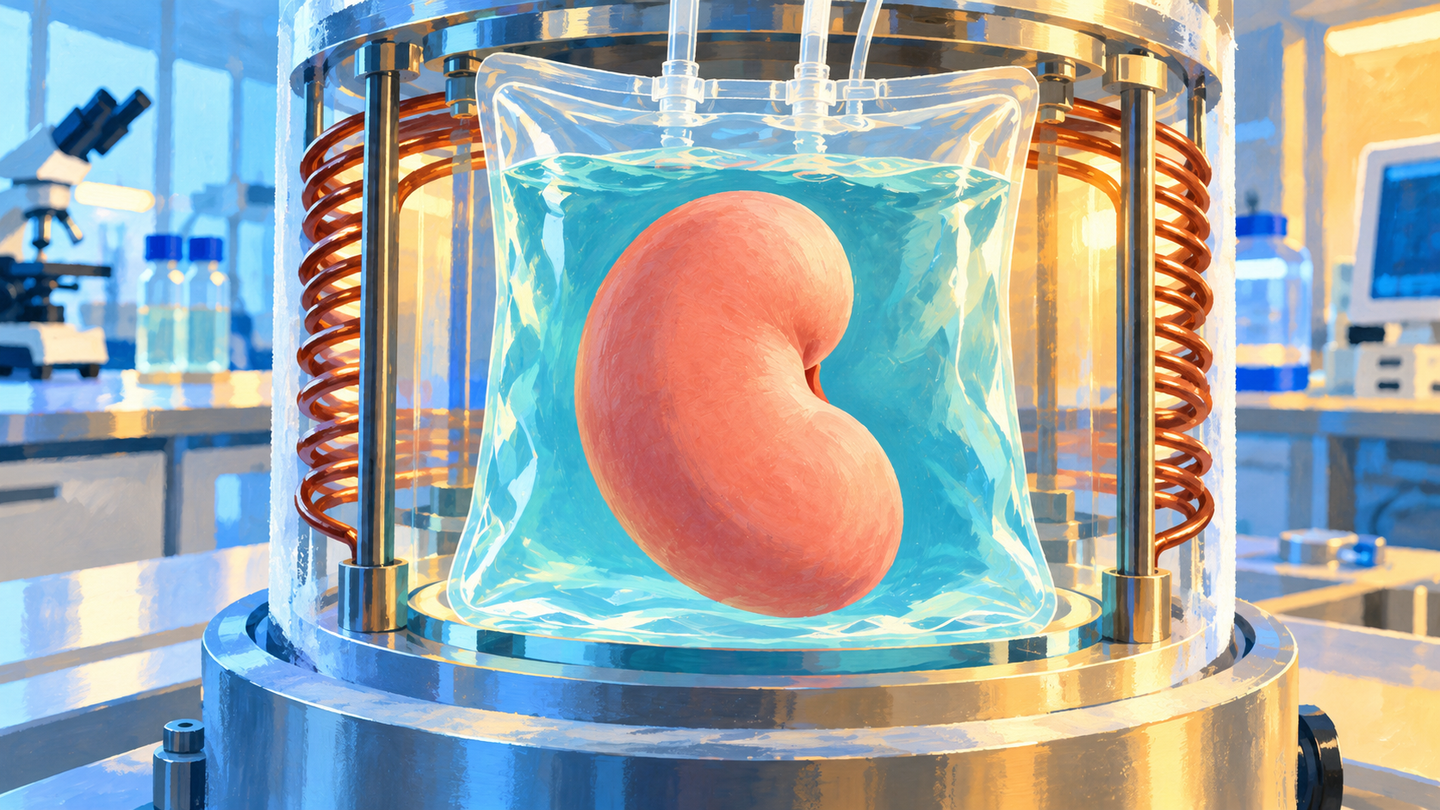
A pig kidney recovered partial function after a year at −150°C, but long-term transplant survival remains untested. (CREDIT: The Brighter Side of News)
- Pig kidneys regained partial function after vitrification and nanowarming, including one stored for 366 days at −150°C.
- Separate transplant experiments showed immediate blood flow and urine production, but observations lasted only two hours.
- Filtration remained impaired, and the unreviewed study has not demonstrated long-term life support or tested human kidneys.
A pig kidney stored at −150 degrees Celsius for 366 days produced urine after rewarming. Other kidneys treated with the same preservation approach regained blood flow and began producing urine immediately after transplantation into pigs.
The results bring long-term organ banking closer to human-relevant dimensions, but they stop short of proving that these kidneys can sustain life. Transplant observations lasted only two hours, filtration remained impaired, and the year-stored kidney underwent machine testing rather than transplantation.
The University of Minnesota team, led by surgeon Erik Finger and mechanical engineer John Bischof, reported the findings in a bioRxiv preprint. The research has not been certified by peer review, and no human kidneys were tested.
A larger organ changes the problem
Preserving donated organs usually buys time measured in hours. Extending that window to months or years could allow more flexible matching, transportation and assessment. It could also give transplant teams more time to prepare recipients before surgery.
The new experiments used pig kidneys weighing approximately 100 grams, with a reported range of 84 to 132 grams. These organs were roughly 100 times heavier than the rat kidneys the group previously preserved and nanowarmed. Their size makes them a useful model for developing human kidney preservation.
In the earlier work, published in Nature Communications in 2023, rat kidneys stored for up to 100 days supported life after transplantation. Achieving the same outcome in larger organs requires more than increasing the dimensions of the equipment.
Heat moves slowly through a large kidney, making its center harder to cool quickly. Protective chemicals also need more time to reach different regions. Longer exposure can increase chemical injury, while uneven cooling or warming can produce damaging ice and cracks.
Replacing ice with a glass-like state
The researchers used vitrification, which converts the organ and its surrounding solution into an ice-free, glass-like state. Cryoprotective chemicals suppress ice formation. The challenge is providing enough protection without causing unacceptable damage to the tissue.
A formulation that worked in rat kidneys did not provide sufficient protection under the slower cooling conditions of pig kidneys. The team developed a replacement called PEZ42. It contains several cryoprotectants and synthetic compounds that inhibit ice formation.
Delivery required carefully controlled changes in both concentration and temperature. The researchers began perfusion at 4 degrees Celsius with dilute protective solution. As concentrations increased, they lowered temperatures below −15 degrees Celsius to reduce toxicity.
Cooling also included a 100-minute pause at −114 degrees Celsius, just above the solution’s glass transition. That allowed temperatures within the kidney to become more uniform. The organs then cooled gradually to −150 degrees Celsius for storage.
After refinements to the procedure, the team reported no further detectable cracking or ice formation. Imaging supported successful vitrification, although the authors acknowledge that their measurements cannot exclude microscopic ice everywhere within an organ.
Heating from the inside
Rewarming creates another obstacle. Heating only the surface leaves the center cold, potentially allowing ice to form internally while warmer outer regions expand. The team instead distributed silica-coated iron oxide nanoparticles through the kidney’s blood vessels before cooling.
An alternating electromagnetic field makes those particles generate heat throughout the organ. This approach, called nanowarming, reduces reliance on heat traveling inward from the surface. The researchers adjusted power in two stages to balance rapid heating against thermal stress.
The kidneys warmed from −150 to approximately −10 degrees Celsius in about 340 to 350 seconds. Subsequent perfusion progressively removed the cryoprotectants and nanoparticles. The organs could then undergo functional assessment.
This process is not simply thawing a kidney taken from an ordinary freezer. It combines tailored chemistry, controlled perfusion, cryogenic storage and specialized radiofrequency equipment. Each stage must work well enough to preserve both the kidney’s structure and its biological function.
What recovered after storage
For machine testing, the team compared eight vitrified and nanowarmed kidneys with six fresh kidneys, nine stored cold for 24 hours and nine exposed only to cryoprotectants. The machines circulated a blood-based solution at 37 degrees Celsius for two hours.
Storage lasted between one and 366 days, although most kidneys had been banked for only one to seven days. The single year-stored organ regained blood flow and metabolic activity within the range of the other nanowarmed kidneys. Its urine output was lower than that of most kidneys in that group.
Across the nanowarmed group, average urine production was about 29 percent below the 24-hour cold-storage group. That difference did not reach statistical significance after adjustment. Small samples mean the result cannot establish that the approaches perform equally well.
A more demanding measure, creatinine clearance, showed a substantial gap. It averaged 4.16 milliliters per minute per 100 grams in nanowarmed kidneys, compared with 12.56 after cold storage and 18.35 in fresh controls. This measure reflects the kidney’s ability to remove a waste product from circulating fluid.
The findings therefore show partial functional recovery. Producing urine, restoring circulation and consuming oxygen are encouraging signs, but they do not alone demonstrate adequate long-term filtration.
The transplant test remains unfinished
The surgical experiments involved three kidneys per group: nanowarmed organs, fresh organs and kidneys stored cold for 24 hours. These were acute, non-survival experiments designed to assess surgical feasibility and immediate function.
The nanowarmed kidneys regained circulation uniformly and produced urine throughout the two-hour observation period. However, filtration remained low. Tissue examination also revealed greater injury after transplantation than after machine perfusion, including damage to blood-vessel lining cells and hemorrhage.
Comparison with cryoprotectant-only kidneys suggests chemical exposure and delivery account for much of the remaining dysfunction. That does not exclude additional injury from cooling or rewarming. The team did not transplant cryoprotectant-only kidneys, limiting conclusions about the source of damage seen after surgery.
Small sample sizes and the single year-long storage test leave important questions unresolved. Longer survival experiments must establish whether filtration improves, tissue damage heals and the organs can provide sustained life support. Human kidneys declined for transplantation would also require separate validation.
The authors additionally report University of Minnesota patents covering aspects of the technology. Before clinical use, the process would need further standardization, automation and evaluation of residual nanoparticles.
The achievement is a step toward banking organs at a clinically relevant scale. Whether those organs can reliably support recipients for months or years remains the decisive test.
Dig deeper into organ banking and cryopreservation
These studies explain the foundations of nanowarming, earlier transplant results and the remaining challenges of preserving larger organs.
Vitrification and nanowarming enable long-term organ cryopreservation and life-sustaining kidney transplantation in a rat model: Reports the smaller-animal experiments in which cryopreserved kidneys recovered life-supporting function after transplantation. (Nature Communications, 2023)
Physical vitrification and nanowarming at liter-scale CPA volumes: toward organ cryopreservation: Demonstrates physical cooling and rewarming at larger volumes, without establishing functional recovery of a transplanted organ. (Nature Communications, 2025)
55 MHz constant field dielectric warming of kidneys and ovaries cryopreserved by vitrification: Examines an alternative electromagnetic warming method that directly heats water and cryoprotectant molecules. (Cryobiology, 2025)
Improved tissue cryopreservation using inductive heating of magnetic nanoparticles: Establishes an early foundation for rapid, distributed rewarming using magnetic nanoparticles. (Science Translational Medicine, 2017)
The promise of organ and tissue preservation to transform medicine: Reviews how longer preservation could change transplantation and outlines the scientific and logistical barriers. (Nature Biotechnology, 2017)
Research findings are available online in the journal bioRxiv.
The original story "Magnetic nanoparticles rewarm and restore function to pig kidneys one year after cryogenic storage" is published in The Brighter Side of News.
Related Stories
- Kidney transplant patients could live drug-free thanks to new stem cell therapy
- Scientists develop artificial kidney that could eliminate the need for dialysis
- Scientists convert type A kidney to type O for first human transplant
Like these kind of feel good stories? Get The Brighter Side of News' newsletter.
Joseph Shavit
Writer, Editor-At-Large and Publisher
Joseph Shavit, based in Los Angeles, is a seasoned science journalist, editor and co-founder of The Brighter Side of News, where he transforms complex discoveries into clear, engaging stories for general readers. With vast experience at major media companies like The Los Angeles Times, Times Mirror and Tribune Publishing, he writes with both authority and curiosity. His writing focuses on space science, planetary science, quantum mechanics, geology. Known for linking breakthroughs to real-world markets, he highlights how research transitions into products and industries that shape daily life.