Scientists take a major step toward quantum computers that correct their own errors
An IBM processor revealed a transition from scrambling to control, demonstrating repeated quantum feedback across up to 100 physical qubits.
 Rutgers University Writer: Megan Schumann

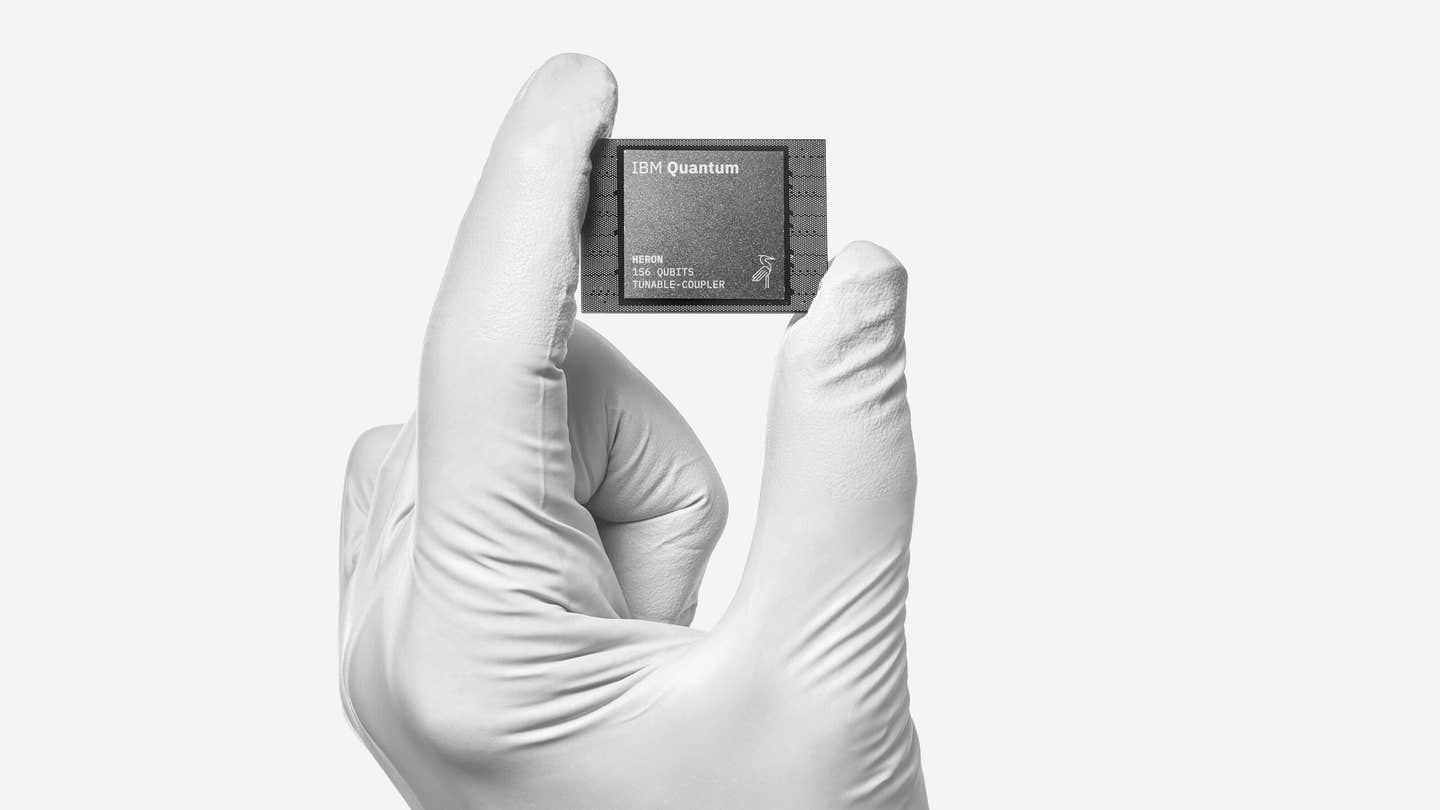
IBM Quantum Heron quantum processing unit in hand. Repeated measurements and resets controlled chaos across 100 qubits, testing hardware capabilities relevant to future error correction. (CREDIT: IBM)
- Adaptive circuits on an IBM processor controlled a system of up to 100 physical qubits through repeated measurements and conditional resets.
- Changing the balance between scrambling and resetting revealed a transition near an equal probability of the two operations.
- The experiment demonstrated capabilities relevant to future error correction, but did not protect a logical qubit or deliver fault-tolerant computation.
A quantum processor can do more than execute a fixed sequence and reveal its answer at the end. It can measure selected qubits while a circuit is running, use the result to choose an action and continue. Repeating that cycle across a large system is an important challenge for quantum hardware.
An experiment involving Rutgers University, IBM and collaborators has now used that capability to steer up to 100 qubits from scrambling toward an orderly state. Published in Nature Physics, the study tested how competing quantum operations produce a collective transition between chaotic and controlled behavior.
The work demonstrates coordination between quantum gates, measurements and feedback over thousands of operations. Those capabilities matter for future error-corrected machines. However, the experiment controlled a deliberately designed physical system; it did not demonstrate a computer correcting arbitrary mistakes during a useful calculation.
Making decisions before a circuit ends
Conventional bits take values of either zero or one. A qubit can occupy a quantum superposition, whose measurement produces an outcome according to the state’s probabilities. Interactions between qubits can create entanglement, linking their states in ways that have no simple classical equivalent.
These features make measurement a delicate operation. Reading a qubit can disturb information, and unknown quantum states cannot simply be copied as a backup. Useful feedback therefore requires carefully coordinating what gets measured, how the result is processed and which operation follows.
“The challenge was not simply to measure a qubit, but to do it repeatedly while the rest of the processor continued to operate,” said senior author Maika Takita, an IBM researcher working on quantum error correction and dynamic circuits. Here, a measurement outcome determined whether a qubit needed an additional operation to reset it.
The researchers used IBM’s 156-qubit superconducting processor, ibm_fez, selecting chains containing up to 100 physical qubits. This allowed measurements and resets to be interspersed with quantum evolution. The processor was not examining its own circuitry or diagnosing hardware damage; it was following programmed conditional instructions.
Two operations pull the system in opposite directions
The experiment set up a competition between scrambling and control. A scrambling operation acted on neighboring qubits, spreading information and generating complex quantum states. The opposing operation measured an individual qubit and returned it to the zero state.
If measurement found that qubit in the one state, a conditional operation flipped it to zero. Repeating these local resets pushed the system toward a target in which every qubit was zero. The researchers varied the probability of choosing control rather than scrambling at each step.
That balance determined the system’s long-term behavior. When scrambling dominated, the circuit continued generating disorder. When resets were frequent enough, control dominated and drove the system toward the selected state.
The largest circuits involved nearly 5,000 entangling gates and nearly 5,000 measurement-and-reset operations. Coordinating so many interventions is a central engineering achievement of the study. It shows that repeated feedback can support a substantial physics experiment on present-day hardware.
A transition emerges near an even balance
The researchers observed a change near a control probability of one-half. On one side, scrambling prevailed; on the other, resetting prevailed. The distinction became sharper as they studied larger systems, as expected for the predicted phase transition.
A phase transition describes a collective change in behavior as a controlling condition crosses a threshold. Freezing water provides a familiar example, although this experiment involved driven quantum dynamics rather than a material cooling. The approximately 50% threshold belongs to this particular circuit model, not every quantum processor or feedback procedure.
The team tracked measurements describing how strongly the qubits aligned with the zero-state target. It also examined fluctuations arising from different quantum measurement outcomes. Agreement with theoretical predictions supported the interpretation of a control-induced transition.
The model contains another distinction as well: its transition in entanglement occurs before the transition to control. These are related but separate changes. The experiment’s main control threshold should therefore not be described as the point where all quantum entanglement suddenly disappears.
Checking that quantum behavior survives the feedback
Producing an orderly final state would not, by itself, show that a quantum processor had explored genuinely quantum dynamics along the way. A sufficiently noisy system could lose coherence and behave more like a classical random process. The researchers therefore compared the experimental fluctuations with several theoretical descriptions.
Quantum simulations better reproduced aspects of the data in the chaotic regime and near the transition than models that removed coherence. The comparisons were made at system sizes accessible to those calculations. Some quantum simulations extended to 40 qubits, although difficulty depended strongly on the regime being simulated.
That matters when interpreting the experiment’s scale. Running 100 qubits is not automatically proof of a computational advantage over every classical method. Some measured averages could be described by simpler models, while reproducing detailed quantum states and fluctuations posed different computational demands.
Hardware imperfections remained visible too. Readout errors prevented the controlled-state results from matching an ideal noiseless model exactly. Successful agreement on the transition did not mean the processor had become error-free.
A relevant ingredient for future error correction
Quantum error correction requires preserving encoded information while repeatedly gathering information about errors and responding appropriately. That task differs from resetting a deliberately chosen system toward all zeros. Simply erasing qubits would also erase the unknown information a calculation needs to retain.
“To build a fault-tolerant quantum computer, we have to make these checks and corrections not just once or twice, but a huge number of times during a calculation,” said Rutgers physicist Jedediah Pixley, another senior author. The experiment tests the repeated measurement-and-feedback coordination that such systems will require.
It does not replace separate demonstrations of logical-qubit protection, nor establish a general-purpose fault-tolerant machine. Its scientific result is the observation and characterization of a quantum control transition. Its engineering result is reliable enough coordination to investigate that behavior across a large physical-qubit system.
The project grew from theoretical work on whether ideas from classical chaos control could carry into quantum mechanics. Turning those predictions into an experiment required both an appropriate model and hardware able to perform repeated interventions. The result gives researchers a larger testing ground for adaptive quantum dynamics, with useful lessons for the longer effort to build dependable quantum computers.
Dig deeper into quantum feedback and error correction
These papers explain the theoretical foundations of chaos control and separate experimental progress toward protecting quantum information.
Controlling chaos: Presents foundational work on controlling chaotic classical systems through targeted interventions. (Physical Review Letters, 1990)
Measurement and Feedback Driven Entanglement Transition in the Probabilistic Control of Chaos: Develops a quantum model linking probabilistic control, measurement and changing entanglement. (Physical Review Letters, 2023)
Local and nonlocal stochastic control of quantum chaos: Measurement- and control-induced criticality: Examines when entanglement and control transitions coincide or separate in related quantum models. (Physical Review B, 2024)
Suppressing quantum errors by scaling a surface code logical qubit: Tests whether increasing an error-correcting code’s size can improve protection of a logical qubit. (Nature, 2023)
Quantum error correction below the surface code threshold: Reports surface-code quantum memories whose performance improves as the code grows, a distinct milestone in error correction. (Nature, 2025)
Research findings are available online in the journal Nature Physics.
The original story "Scientists take a major step toward quantum computers that correct their own errors" is published in The Brighter Side of News.
Related Stories
- Future quantum computers may be built like modular data centers
- Physicists convert microwaves to light helping quantum computers communicate over optical networks
- Strange behavior in focused laser light could change how quantum computers control qubits
Like these kind of feel good stories? Get The Brighter Side of News' newsletter.
Shy Cohen
Writer