Smart glasses turn blinks and jaw movements into precise health monitoring
Tiny sensors on GlassTENG glasses capture blinks, jaw movements and pulse, offering a step toward future battery-free wearables.
 Northwestern University Writer: Amanda Morris

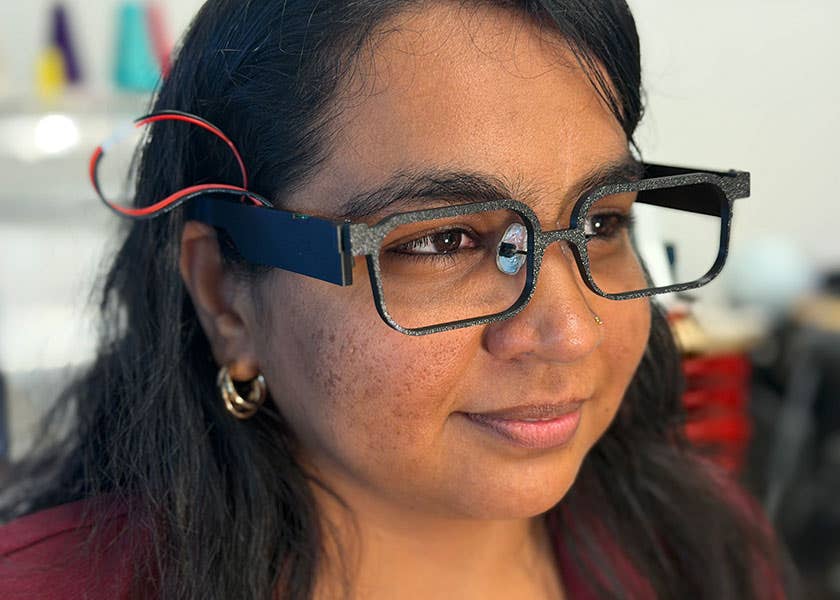
Nivedita Arora
Breed Chair Assistant Professor of Electrical and Computer Engineering and Computer Science wearing the GlassTENG prototype. (CREDIT: Northwestern University)
- GlassTENG converts tiny facial movements into electrical signals using three triboelectric sensors attached to glasses.
- A 20-person study reported 93.8% overall classification accuracy, while resting heart-rate validation involved 10 participants.
- The sensing circuitry used 4.1 microwatts, but fully battery-free operation and clinical health monitoring remain future goals.
A blink, a clenched jaw and the faint pressure of an arterial pulse can all leave electrical traces. Capturing those traces through ordinary-looking glasses could offer a less obtrusive way to study daily behavior. The challenge is doing so without adding substantial power demands to an accessory people already wear.
Northwestern University engineers have developed GlassTENG, an experimental eyewear platform that turns facial movement into electrical signals. Its three flexible sensors need no external power to generate those signals. The accompanying analog readout circuitry consumes just 4.1 microwatts across all three channels.
The paper appears in the proceedings of the 2026 ACM International Symposium on Wearable Computers, held October 11–15 in Shanghai. Led by Nivedita Arora, the work explores a route toward battery-free health-sensing glasses. The prototype has not yet demonstrated a complete battery-free system.
Static electricity becomes a measurement tool
GlassTENG relies on the triboelectric effect, familiar from the static charge produced when different materials touch and separate. Here, movement within a layered sensor creates a changing voltage. The physical event being measured also supplies the energy that produces its electrical signature.
Each sensor combines flexible polymer layers with thin silver electrodes. Facial pressure brings an electrode into contact with a fluorinated polymer surface. When the pressure relaxes, the layers separate, producing a voltage difference that the circuitry can measure.
The team adjusted materials, surface treatment and placement to detect very small forces. In characterization tests, arterial-scale pressure generated signals of roughly 50 to 100 millivolts. Blinking and eyebrow movements produced about 200 to 500 millivolts, while stronger jaw movements reached approximately 1.5 volts.
Those voltages describe signal strength, not the amount of usable power available to run the glasses. The sensors produce very small currents, requiring specialized readout electronics. Generating a detectable signal and powering an entire wearable are separate engineering tasks.
The analog circuit helps make those weak-current signals readable without drawing much power itself. Its high-input-impedance amplifiers minimize interference with the sensors’ outputs. A modified channel also reduces the amplitude of stronger jaw signals to keep them within the electronics’ measurement range.
Three contact points capture different movements
One sensor sits near the nasal bridge, where it detects arterial pulsation and upper-face movements. A second contacts the anterior temple through a small downward-extending arm. A third sits farther back along the glasses’ temple arm, over the temporalis muscle.
These locations provide complementary measurements. The nasal sensor responds strongly to forceful blinking, while the temple sensors capture jaw activity. The frame maintains contact without gels or skin adhesives, although the downward arm remains a noticeable departure from conventional eyewear.
The project’s co-first authors are master’s students Raj Dave, Jovanis Prodanich and Yung-ching Lai. Arora leads Northwestern’s Vasudhaiva Kutumbakam Embodied Systems Lab, which develops self-powered electronics. The team designed the sensors and electronics together to fit an unusually small sensing-power budget.
“The human face is a goldmine for health data, making everyday glasses the perfect wearable,” Arora said. Her group’s approach builds on existing eyewear research, including earlier work on pulse, eye movement and jaw sensing. Its contribution centers on combining several signals with a low-power readout.
Strong recognition results have an important exception
Twenty participants tested the activity-sensing system, including 10 habitual glasses wearers and 10 non-wearers. They performed forceful blinking, eyebrow raising, teeth clenching, teeth tapping, eating and talking. The protocol also included periods without activity to establish a baseline.
A random forest machine-learning model achieved 93.8% overall accuracy in leave-one-subject-out testing. In each round, the evaluation withheld one participant’s data from training. The reported confusion matrix included the six activities and a no-activity category.
Forceful blinks and teeth taps each reached 99% correct classification, while teeth clenching reached 96%. Eyebrow raising and eating each reached 95%. Removing any single sensor left overall accuracy near 92%, suggesting some redundancy among the contact points.
Talking proved substantially harder. The model correctly classified only 55% of talking samples and labeled 37% as eating. The authors attribute that confusion to similar jaw movements and muscle activation, an important limitation for interpreting the overall score.
These were structured tasks rather than uninterrupted observation of everyday life. People may talk while eating, move their heads or perform several actions together. Larger studies involving such combinations are needed before the results can support reliable daily monitoring.
Pulse tracking worked while participants rested
The researchers also evaluated heart-rate measurement in a subset of 10 participants. Each remained seated at rest for five minutes while wearing a Polar H10 chest strap as a reference. The analysis selected the best sensor channel for each person and calculated heart rate over 30-second windows.
The glasses’ mean absolute error was 1.82 beats per minute. Average bias was 0.20 beats per minute, with 95% limits of agreement ranging from −5.17 to 5.58 beats per minute. These results support the feasibility of resting pulse tracking under the tested conditions.
They do not establish equivalent performance during exercise, conversation or daily movement. Nor did the study validate blood-pressure measurement or diagnose cardiovascular disease. Multiple pulse-sensing locations may support future investigations, but those applications require their own testing.
The battery-free goal needs more engineering
The crucial power figure applies to the analog front end, which conditions the sensors’ outputs for measurement. Each channel consumed approximately 1.36 microwatts. It excludes the microcontroller, data storage, wireless communication and any computation used to classify activities.
For validation, the researchers used an ESP32-C6 module and recorded signals to a microSD card at 100 samples per second. Classification occurred offline. The paper therefore does not demonstrate a self-sustaining pair of glasses continuously transmitting Bluetooth data or issuing intelligent alerts.
The user study also used temporary protoboard electronics while a smaller circuit board was being fabricated. Participants’ responses about a future compact version were encouraging, particularly among existing glasses wearers. However, that finished form still needs direct comfort and acceptability testing.
Habitual glasses wearers rated their likelihood of daily use at 5.4 out of seven, compared with 3.5 among non-wearers. Four of the five complaints about weight came from non-wearers. Those differences suggest that familiarity with eyewear may influence acceptance, alongside the eventual device design.
Future work includes integrating lower-power computation, validating energy harvesting and simplifying the frame. Possible applications include studying jaw clenching, eating behavior and cardiovascular signals. Turning those possibilities into useful feedback will require broader validation alongside the remaining hardware work.
Dig deeper into self-powered sensing and smart eyewear
These five publications provide context on energy harvesting, eyewear sensing and the assessment of jaw-muscle activity.
- Flexible triboelectric generator: Describes an early flexible generator that converts mechanical contact and separation into electrical output. (Nano Energy, 2012)
- Battery-Free Eye Tracker on Glasses: Demonstrates a low-power eye tracker supplied by solar cells mounted on glasses. (ACM MobiCom, 2018)
- Frequency-encoded eye tracking smart contact lens for human–machine interaction: Explores a chip-free, battery-free contact lens read by electronics mounted on glasses. (Nature Communications, 2024)
- Closed-loop wearable neurostimulation system with triboelectric sensing to alleviate hemifacial spasms: Investigates eyewear-based facial sensing combined with responsive electrical stimulation. (Nature Communications, 2026)
- International consensus on the assessment of bruxism: Report of a work in progress: Explains definitions and assessment challenges relevant to measuring awake and sleep bruxism. (Journal of Oral Rehabilitation, 2018)
Research findings are available online in the journal Proceedings of the 2026 ACM International Symposium on Wearable Computers.
The original story "Smart glasses turn blinks and jaw movements into precise health monitoring" is published in The Brighter Side of News.
Related Stories
- Groundbreaking smart glasses cure night blindness and peripheral vision problems
- Groundbreaking eye glasses help color blind people see colors for the first time
- Stanford engineers develop compact 3D holographic glasses suitable for all-day wear
Like these kind of feel good stories? Get The Brighter Side of News' newsletter.
Joseph Shavit
Writer, Editor-At-Large and Publisher
Joseph Shavit, based in Los Angeles, is a seasoned science journalist, editor and co-founder of The Brighter Side of News, where he transforms complex discoveries into clear, engaging stories for general readers. With vast experience at major media companies like The Los Angeles Times, Times Mirror and Tribune Publishing, he writes with both authority and curiosity. His writing focuses on space science, planetary science, quantum mechanics, geology. Known for linking breakthroughs to real-world markets, he highlights how research transitions into products and industries that shape daily life.