Meandering rivers existed before land plants appeared, Stanford study finds
New Stanford research suggests meandering rivers existed before plants evolved, reshaping views of Earth’s climate history.

 Edited By: Joseph Shavit

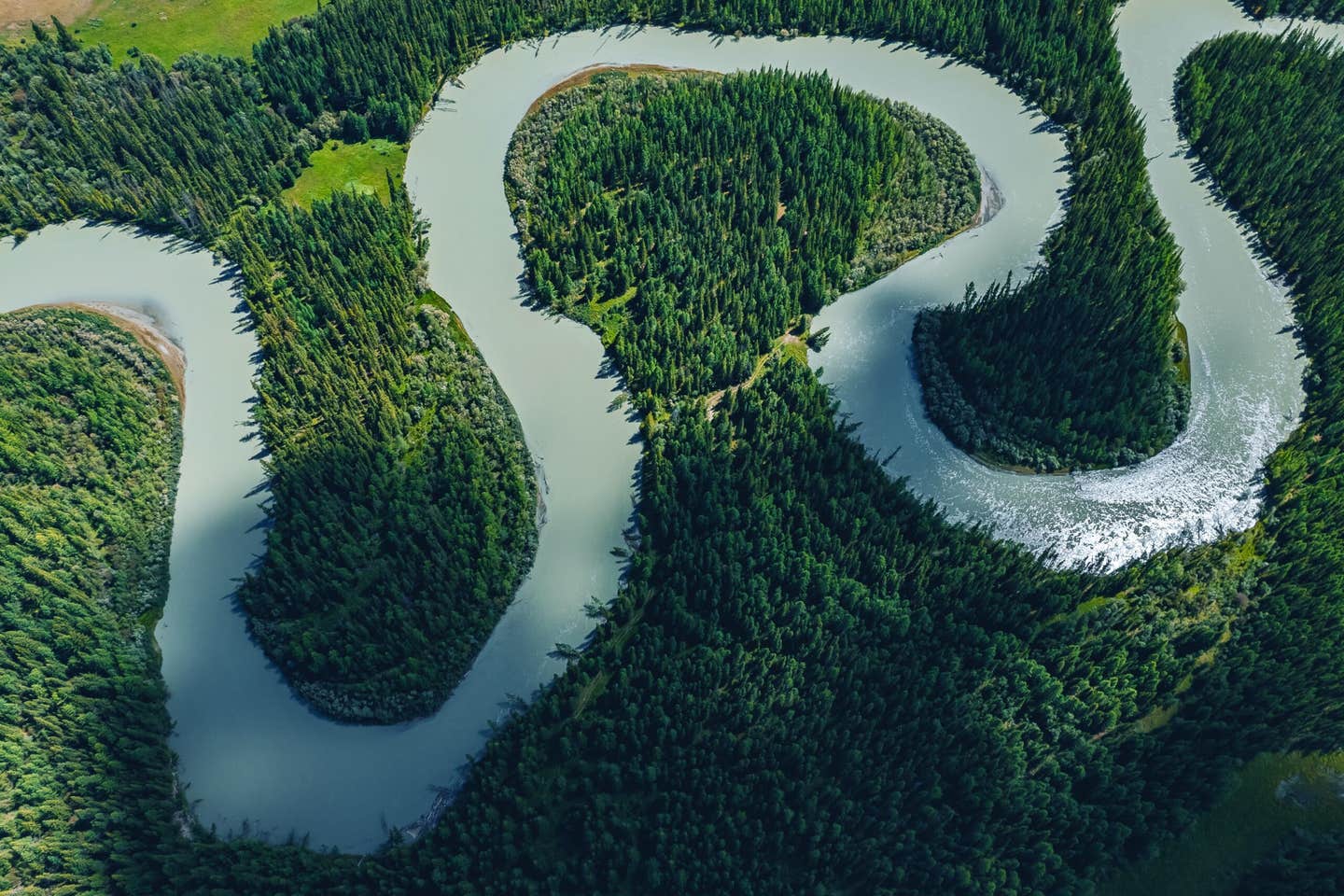
A Stanford study challenges a decades-old geological theory, finding that meandering rivers likely existed long before plants colonized land, with major implications for climate and carbon storage history. (CREDIT: Shutterstock)
For generations, geologists have taught a simple story about the history of rivers. Before plants spread across the continents hundreds of millions of years ago, rivers were thought to be wide, shifting networks of channels known as braided rivers. Then, as vegetation took hold and stabilized riverbanks, rivers supposedly began winding across landscapes in graceful curves, creating the meandering channels familiar today.
A new study from Stanford University challenges that long-standing view. The research suggests that scientists may have misread a key part of the geological record. According to the findings, meandering rivers likely existed long before plants colonized land, but the evidence they left behind has often been mistaken for signs of braided rivers.
The discovery could reshape scientists’ understanding of Earth’s ancient landscapes, carbon cycling, and climate history.
“With our study, we’re pushing back on the widely accepted story of what landscapes looked like when plant life first evolved on land,” said lead author Michael Hasson, a Ph.D. student in Mathieu Lapôtre’s lab at the Stanford Doerr School of Sustainability. “We’re rewriting the story of the intertwined relationship between plants and rivers, which is a significant revision to our understanding of the history of the Earth.”
A Story Written in River Deposits
Rivers generally fall into two broad categories. Braided rivers split into multiple channels that weave around sandy bars. Meandering rivers, by contrast, flow through a single channel that curves across the landscape in a series of bends.
For decades, scientists believed vegetation played a crucial role in creating meandering rivers. Plant roots help hold riverbanks together, reducing erosion and encouraging rivers to maintain stable, winding channels.
This idea seemed supported by ancient rock formations. Geologists studying sedimentary deposits noticed a major shift around the time plants first appeared on land roughly 425 million to 500 million years ago. Deposits formed before that period often appeared consistent with braided rivers, while younger deposits showed characteristics associated with meandering systems.
As a result, the rise of land plants became linked to a dramatic transformation in river behavior.
However, recent observations began raising questions. Scientists discovered modern rivers with little or no vegetation that still meandered. These rivers challenged the assumption that plants were necessary for meandering channels to exist.
That mystery inspired the Stanford team to take a closer look.
Looking At Rivers From Space
To investigate how vegetation truly affects river behavior, researchers examined satellite imagery from 49 modern meandering rivers around the world. About half had little or no vegetation, while the rest were partially or densely vegetated.
The team analyzed roughly 4,500 river bends, focusing on features known as point bars. These sandy deposits form on the inside of river bends as flowing water drops sediment.
Point bars are important because they leave clues about how rivers move over time. Geologists often use their orientation in ancient rocks to reconstruct the shape and behavior of long-vanished rivers.
For decades, scientists relied on a key assumption. If point bars appeared to move mainly downstream, they were interpreted as evidence of braided rivers. If they migrated in more varied directions, they were associated with meandering systems.
The new analysis revealed a surprising pattern.
When Meandering Rivers Look Like Braided Ones
Researchers found that vegetation consistently changes how point bars migrate. In vegetated rivers, point bars move in a wider variety of directions. In rivers without vegetation, however, point bars often shift predominantly downstream.
That downstream movement closely resembles the behavior traditionally associated with braided rivers.
“In our paper, we show that this conclusion, which is taught in all geology curricula to this day, is most likely incorrect,” said Lapôtre, the study’s senior author and an assistant professor of Earth and planetary sciences at the Stanford Doerr School of Sustainability.
The finding means many ancient river deposits may have been classified incorrectly. Unvegetated meandering rivers can leave behind sedimentary patterns that closely resemble those produced by braided rivers.
“In other words, we show that, if one were to use the same criterion geologists use in ancient rocks on modern rivers, meandering rivers would be miscategorized as braided rivers,” Lapôtre said.
The researchers found that river bends in vegetated systems showed about 62% greater directional variability than those in unvegetated rivers. This difference appears to result directly from vegetation’s influence on riverbank stability and bend evolution.
Their results suggest that many rivers flowing across Earth before plants evolved may have been meandering all along.
Rethinking Ancient Landscapes
The implications stretch far beyond river classification.
Meandering rivers create extensive floodplains, broad areas of sediment deposited when rivers overflow their banks. These floodplains play a critical role in storing carbon, nutrients and sediment.
For years, scientists assumed such environments became widespread only after plants colonized land. If meandering rivers existed much earlier, then carbon-rich floodplains may have been common for far longer than previously believed.
The muddy floodplains associated with meandering rivers rank among the largest non-marine carbon reservoirs on Earth. They can trap organic material for thousands or even millions of years.
That process directly affects atmospheric carbon dioxide levels, which help regulate global temperatures over geological timescales.
“Floodplains play an important role in determining how, when, and whether carbon is buried or released back into the atmosphere,” Hasson said. “Based on this work, we argue carbon storage in floodplains would have been common for much longer than the classic paradigm that assumes meandering rivers only occurred over the last several hundred million years.”
A New Baseline For Climate History
Understanding ancient carbon storage matters because scientists rely on Earth’s geological past to understand climate change today.
The rock record serves as a long-term archive of how the planet responded to environmental shifts, volcanic activity and changes in atmospheric composition. If scientists have been misinterpreting ancient river systems, then some climate models may require revision.
The study suggests an important control on carbon cycling may have been underestimated for decades.
“Understanding how our planet is going to respond to human-induced climate change hinges on having an accurate baseline for how it has responded to past perturbations,” Hasson said. “The rock record provides that baseline, but it’s only useful if we interpret it accurately.”
He added: “We’re suggesting that an important control on carbon cycling, where carbon is stored, and for how long, due to river type and floodplain creation, hasn’t been fully understood. Our study now points the way to better assessments.”
Revisiting A Geological Textbook Story
The findings do not suggest plants had no influence on rivers. Instead, they indicate the relationship between vegetation and river evolution is more complex than scientists once thought.
Plants clearly affect how river bends migrate and how landscapes develop. Yet the study argues that meandering rivers did not suddenly appear when vegetation arrived. Rather, many may have existed long before, leaving behind deposits that researchers misinterpreted.
That realization opens a new window into Earth’s distant past. Ancient continents may have hosted winding rivers, broad floodplains and significant carbon storage hundreds of millions of years earlier than current models suggest.
The research also serves as a reminder that scientific understanding continues to evolve. Sometimes the evidence has been present all along, waiting for a new perspective to reveal its meaning.
Practical Implications Of The Research
This study could significantly improve how scientists reconstruct Earth’s environmental history. By recognizing that ancient meandering rivers may have been misidentified as braided systems, researchers can revisit geological records with new tools and interpretations. That may lead to more accurate reconstructions of ancient ecosystems, sediment movement and carbon storage.
The findings also have important implications for climate science. Floodplains act as major long-term carbon reservoirs, and understanding when and where they formed helps scientists estimate how carbon moved between land and atmosphere throughout Earth’s history. Better estimates of ancient carbon storage can improve climate models that seek to understand both past climate shifts and future warming.
More broadly, the research highlights the value of questioning long-held assumptions. By reexamining evidence with modern data and satellite observations, scientists can uncover new insights about how Earth’s landscapes evolved and how natural systems have regulated the planet over billions of years.
Research findings are available online in the journal Science.
The original story "Study suggests meandering rivers existed before land plants appeared" is published in The Brighter Side of News.
Related Stories
- Researchers develop plant-based cleanup for harmful antibiotics found in rivers and fish
- NASA satellites help scientists observe how rivers carve the Earth
- Rivers release ancient carbon dioxide into the atmosphere - reshaping climate science
Like these kind of feel good stories? Get The Brighter Side of News' newsletter.
Joshua Shavit
Writer and Editor
Joshua Shavit is a NorCal-based science and technology writer with a passion for exploring the breakthroughs shaping the future. As a co-founder of The Brighter Side of News, he focuses on positive and transformative advancements in technology, physics, engineering, robotics, and astronomy. Having published articles on AOL.com, MSN, Yahoo News, and Ground News, Joshua's work highlights the innovators behind the ideas, bringing readers closer to the people driving progress.